

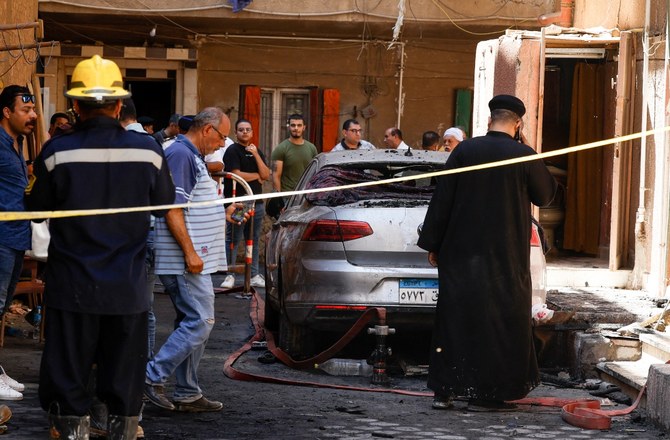

CAIRO: A series of church fires in Egypt over the past 10 days has prompted speculation as to whether they were intentional or due to negligence, despite authorities saying they were caused by electrical short circuits.
A blaze in Abu Sefein Church in the village of Imbaba killed 41 people. Fires in four other churches did not cause any casualties.
“The fires were the result of a short circuit, or a malfunction in the electricity in those areas, especially with the high temperature during the summer,” Maj. Gen. Ayman Sayed Al-Ahl, a former civil protection official, told Arab News.
“This indicates that occupational safety in churches is neglected, which requires Egyptian officials to observe it from now on to avoid these fires,” he said.
“I’m fully aware from my work in the Civil Protection Forces that electrical short circuits cause most fires in Egypt during this time. I witnessed major errors in random or weak electrical connections, which don’t tolerate increases in load as a result of the use of air conditioners in the summer,” he added.

There have been three church fires in August, pressing some to question if this is more tha coicidence. (FILE/AFP)
“During increased loads, the plastic wire insulation material melts, which causes an electrical short and a fire breaks out within minutes.”
But despite the officials explanation, many believe enough is still not being done.
Dina Helali, a member of the Egyptian Senate, told Arab News: “The frequent fires in Egypt reveal the need to work on reviewing the civil protection system and the necessary preventive measures not only in churches but in all vital facilities, as well as the presence of specialists in fighting fire in those facilities, or training guards in how to deal with and monitor these disasters in real time.”
She added: “Churches in general contain many materials that help ignition, especially materials used to draw paintings of historical and religious Christian figures, as well as the wood of the seats and fabrics that adorn altars.”
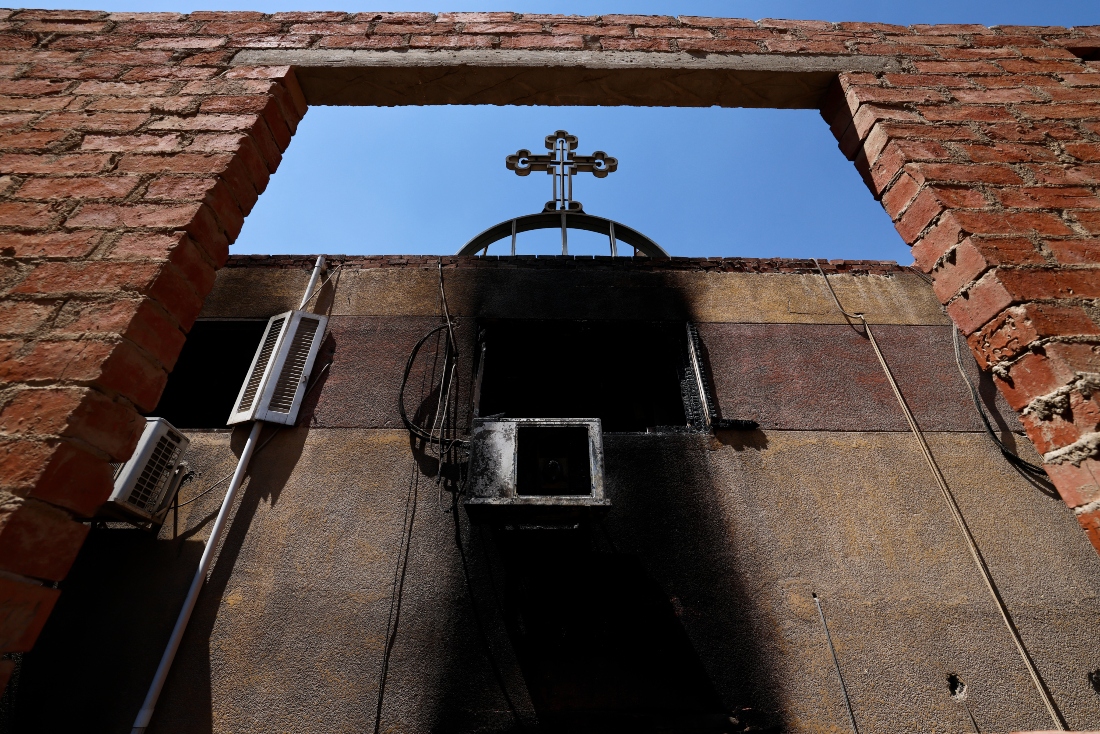
There have been three church fires in August, pressing some to question if this is more tha coicidence. (FILE/AFP)
Some Coptic activists in Egypt have noted that the church fires coincided with the anniversary of the dispersal of Muslim Brotherhood sit-ins in Cairo and Giza on Aug. 14, 2013. Hanan Fikri, a Copt, described it as “a strange coincidence” on Facebook.
Coptic activist Magdi Khalil told Arab News: “For 50 years, hundreds of churches have been burned in Egypt, and there hasn’t been a single serious investigation … Rather, the pre-prepared answer is that it was a short circuit or air conditioning.”
He added: “In Egypt, there are hundreds of mosques where the air conditioning works seven days a week, but we’ve never heard of a fire in a mosque as a result of a short circuit or an air conditioning device.”
The recent fires were not limited to churches, but also hit a Carrefour supermarket in Alexandria and Badrashin Central Hospital in Giza. These fires resulted in injuries, mostly from suffocation.


