

Israel’s refusal to release Palestinian prisoners heightens tensions

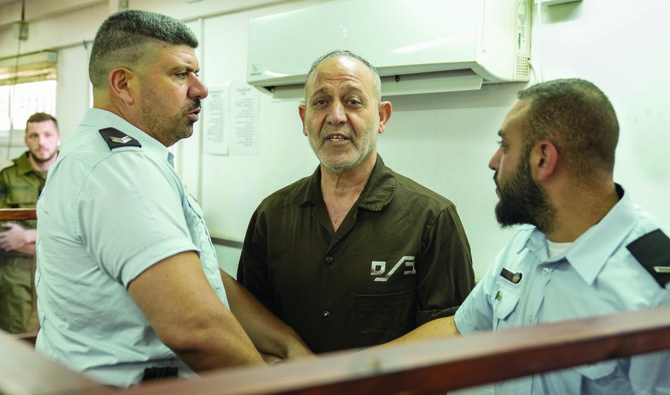
Palestinian prisoner Bassam Al-Saadi appears in a courtroom for Sunday’s hearing at the Israeli Ofer military base near the West Bank city of Ramallah. (AP)
Short Url
Updated 22 August 2022
Follow

Israel’s refusal to release Palestinian prisoners heightens tensions

  • Occupied territory is being rocked by significant tensions over plight of Khalil Awawda and Bassam Al-Saadi, analyst tells Arab News

GAZA CITY: Israel’s refusal to release two Palestinian prisoners has raised tensions in the Palestinian arena, sparking fears about the possibility of a re-escalation.

The prisoners are Khalil Awawda, who has been on hunger strike for over 150 days, and Islamic Jihad leader Bassam Al-Saadi.

Islamic Jihad agreed to an Egyptian-brokered ceasefire during the latest round of fighting in Gaza — with the peace lasting for three days — in exchange for the release of Al-Saadi and Awawda.

But the Israeli Supreme Court on Sunday rejected a petition it received to cancel the administrative detention of Awawda.

The military court in Ofer had frozen the administrative detention of Awawda while he remained in the hospital without releasing him.

Under Israeli law, the hunger striker’s administrative detention would be reactivated immediately if his health condition improved and he was cleared to leave the hospital. 

Meanwhile, Al-Saadi’s detention was extended for another five days for the third time in a row.

The Israeli measures against the prisoners has reportedly angered Cairo after Egyptian representatives worked with their Israeli counterparts to secure their release. Egypt stated its efforts in this regard in its declaration of a ceasefire with Islamic Jihad. 

Various reports suggested a brewing crisis in diplomatic relations between Egypt and Israel as a result of various issues, with the plight of the Palestinian prisoners adding to the growing rift between the two parties.

Israeli Defense Minister Benny Gantz confirmed on Monday afternoon that a diplomatic crisis had erupted in recent days with Egypt over the fighting in Gaza this month.

But he expressed hope that his government’s links with Cairo would be solved in the next few days.

Gantz said in an interview with Kan Beit radio station: “Relationships between friends experience ups and downs … without entering into one particular incident or another. We will know how to stabilize the relations. It is their interest and ours ... We do not need to take every crisis and turn to the most important thing.”

Haaretz newspaper reported at the weekend that the diplomatic tension with Egypt began after Israel refused to curb Israeli army operations in the West Bank in early August as part of ceasefire conditions to end the clashes with Islamic Jihad.

According to the Israeli Kan channel, an Egyptian official said on Monday that the head of the Israeli Shin Bet service, Ronen Bar — who arrived in Cairo on Sunday night — will inform the head of the Egyptian intelligence service, Maj. Gen. Abbas Kamel, of release dates for Al-Saadi and Awawda.

According to the channel, Bar will brief Kamel on the efforts made to locate the mass grave in which 20 Egyptian soldiers were buried near Jerusalem during the 1967 Arab-Israeli war.

The channel pointed out that relations between Egypt and Israel had recently suffered from disagreements over ceasefire understandings, leading to Kamel canceling a scheduled visit to Israel.

Reports indicate that the Egyptian side rapidly drafted the ceasefire document to urgently halt the fighting to the satisfaction of all parties, and it believed that Israel would find a solution to the issue of the two prisoners.

But the Israeli position has not met expectations, sparking tension between the two sides.

Political writer Mustafa Ibrahim said that Palestine is being rocked by significant tensions over the issue and that one incident may ignite the region again.

Ibrahim told Arab News there has been no progress in the terms of the ceasefire agreement sponsored by Egypt, bringing the issue back to the starting point in the event that no result was reached.

Ibrahim said that diplomatic relations between Israel and Egypt “are strategic and the dispute will not worsen, and they will find a way out of the current crisis.”


Iraq says it will prosecute Daesh detainees sent from Syria

Updated 8 sec ago
Follow

Iraq says it will prosecute Daesh detainees sent from Syria

  • Iraq government says transfer was pre-emptive step to protect national security
  • Prosoners have been held for years in prisons and camps guarded by the Kurdish-led SDF
BAGHDAD: Iraq’s Supreme Judicial Council said on Thursday it would begin ​legal proceedings against Daesh detainees transferred from Syria, after the rapid collapse of Kurdish-led forces in northeast Syria triggered concerns over prison security.
More than 10,000 members of the ultra-hard-line militant group have been held for years in about a dozen prisons and detention camps guarded by the Kurdish-led Syrian Democratic Forces (SDF) in Syria’s northeast.
The US military said on Tuesday its forces had transferred 150 Daesh detainees from Syria to Iraq and that the operation could eventually see up to 7,000 detainees moved out of Syria.
It cited concerns over security at the prisons, which also hold thousands more women and children with ties to the militant group, after military setbacks ‌suffered by the ‌SDF.
A US official told Reuters on Tuesday that about 200 low-level ‌Daesh ⁠fighters ​escaped from ‌Syria’s Shaddadi prison, although Syrian government forces had recaptured many of them.
Iraqi officials said Prime Minister Mohammed Shia Al-Sudani mentioned the transfer of Daesh prisoners to Iraq in a phone call with Syrian President Ahmad Al-Sharaa on Tuesday, adding that the transfers went ahead following a formal request by the Iraqi government to Syrian authorities.
Iraqi government spokesperson Basim Al-Awadi said the transfer was “a pre-emptive step to protect Iraq’s national security,” adding that Baghdad could not delay action given the rapid pace of security and political developments in Syria.
Daesh emerged in Iraq and Syria, and at the ⁠height of its power from 2014-2017 held swathes of the two countries. The group was defeated after a military campaign by ‌a US-led coalition.
An Iraqi military spokesperson confirmed that Iraq had received ‍a first batch of 150 Daesh detainees, including ‍Iraqis and foreigners, and said the number of future transfers would depend on security and field assessments. The ‍spokesperson described the detainees as senior figures within the group.
In a statement, the Supreme Judicial Council said Iraqi courts would take “due legal measures” against the detainees once they are handed over and placed in specialized correctional facilities, citing the Iraqi constitution and criminal laws.
“All suspects, regardless of their nationalities or positions within the terrorist ​organization, are subject exclusively to the authority of the Iraqi judiciary,” the statement said.
Iraqi officials say under the legal measures, Daesh detainees will be separated, with senior figures including foreign nationals to ⁠be held at a high-security detention facility near Baghdad airport that was previously used by US forces.
Two Iraqi legal sources said the Daesh detainees sent from Syria include a mix of nationalities, with Iraqis making up the largest group, alongside Arab fighters from other countries as well as European and other ‌Western nationals.
The sources said the detainees include nationals of Britain, Germany, France, Belgium and Sweden, and other European Union countries, and will be prosecuted under Iraqi jurisdiction.