

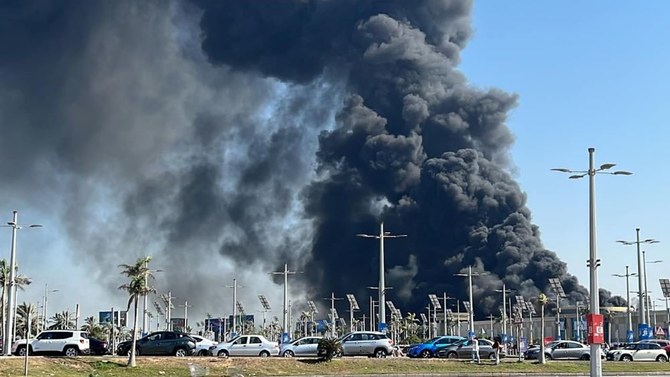
Massive fire put out at Alexandria Carrefour

Black smoke billows from the Carrefour hypermarket in Muharram Bek, Alexandria. (Twitter Photo)
Short Url
Updated 21 August 2022
Follow

Massive fire put out at Alexandria Carrefour

  • The fire broke out in a central air conditioning unit on top of a mall in Muharram Bek, where Carrefour is based

CAIRO: A huge fire that broke out at a Carrefour hypermarket in Egypt’s Mediterranean port city Alexandria was put out on Saturday without any loss of life, the Ministry of Interior said.

In a statement, the ministry added that the fire broke out in the central air conditioner at the top of the mall building in Muharram Bek where Carrefour is based, noting that it did not affect the rest of the building.

Sirens sounded and people at the mall left in a panic as columns of smoke rising from the fire were seen.

The Muharram Bek Police Department said officers, civil protection forces, six fire engines, and an ambulance attended the blaze.

Authorities brought the fire under control, stopping it from spreading to the remaining shops after evacuating all shoppers and store owners from the mall.


Swimming team in war-torn Gaza uses the sea as a pool

Updated 6 sec ago
Follow

Swimming team in war-torn Gaza uses the sea as a pool

  • Two years of war and air strikes have destroyed most recreational facilities in the Palestinian territory, including swimming pools
  • “On more than one occasion, some swimmers have been exposed to gunfire from the naval vessels present offshore,” Abu Ahmed said

GAZA CITY, Palestinian Territories: Just meters from tents for displaced people and trying to ensure they avoid Israeli naval patrols, men of all ages take to the beach at Gaza City for swimming practice.
Two years of war and air strikes have destroyed most recreational facilities in the Palestinian territory, including swimming pools.
So the men led by team captain Abu Mahmud now have to train in the Mediterranean Sea.
“We practice swimming amid serious dangers — foremost among them the Israeli patrol boats which chase swimmers and fishermen out at sea,” Abu Mahmud told AFP.
Despite a ceasefire in place since October 2025, Gaza remains a dangerous place with people killed by Israeli air strikes and gunfire every day.
At least 509 people have been killed since the ceasefire began, according to Gaza’s Hamas-run health ministry.
On Saturday alone, Israeli air strikes killed 22 people, mostly women and children, the civil defense agency said.
“On more than one occasion, some swimmers have been exposed to gunfire from the naval vessels present offshore,” Abu Ahmed said.
“The risks are many, but we try to avoid them by gathering in areas that the warships cannot reach.”
Abu Mahmud, 45, used to compete in local championships, and now he leads the men into the water after warm-up exercises including stretches, push-ups and jumping jacks.
He hopes the sport can become a psychological outlet for those affected by trauma caused by the war.
He said the swimming group once had more than 1,000 members, but most of them were displaced during the conflict.
Almost all of Gaza’s 2.2 million inhabitants were displaced at least once during the war. Hundreds of thousands still live in tents and makeshift shelters.

- Strict blockade -

One member of the swimming squad is Yehya Ali Awwad, a 54-year-old psychiatrist.
“From my perspective and my background in mental health, swimming is an excellent psychological exercise that helps us face daily events, everyday problems, and the difficult circumstances we are going through at this time,” he told AFP.
Mohamad Farahat, a young professional swimmer, lamented the destruction of Gaza’s swimming pools that he used to rely on for training.
“Before the war we used to participate in championships with the swimming federation, and I won many titles,” the 21-year-old said.
“But during the war, (Israel) left nothing behind, not a single swimming pool, and the destruction has spread across all of Gaza.”
The strict blockade that Israel imposed on the Gaza Strip makes the reconstruction of sports facilities particularly complicated, as many building materials routinely get rejected.
The official Palestinian news agency Wafa reported last week that a shipment of AstroTurf donated by China to Gaza’s youth and sports council was not allowed in.
With medicine, food and fuel all in short supply, sports equipment comes much lower on the list of items entering the Palestinian territory.
Among the men swimming with Abu Mahmud, few wore swimming caps. Many simply took to the water in cotton tank tops and polyester long johns.
A fishing boat was pulled from the water at the harbor as the men entered to swim, splashing each other and laughing.
Further up the beach, rows of tents bearing the logos of international charities or United Nations agencies stood on the sand.
The UN office for the coordination of humanitarian affairs, OCHA, reported Saturday that the camps for the displaced continue to face significant challenges, “with piles of debris and rubble obstructing stormwater drainage and contributing to frequent flooding.”
OCHA added that the rubble from damaged buildings has contributed to a rise in rodent infestations at several camps, creating hygiene risks for the displaced.
But for those who came to the beach under a winter sun, swimming is the best personal hygiene.
After spending some time in the water, the swimmers returned to shore and shared sweets and coffee as they warmed up again.
In the distance an Israeli military vessel could be seen patrolling at high speed off the Gaza coast.