

Oil Updates — Crude down; Russia China’s top oil supplier in July; Petrobras begins selling refining assets

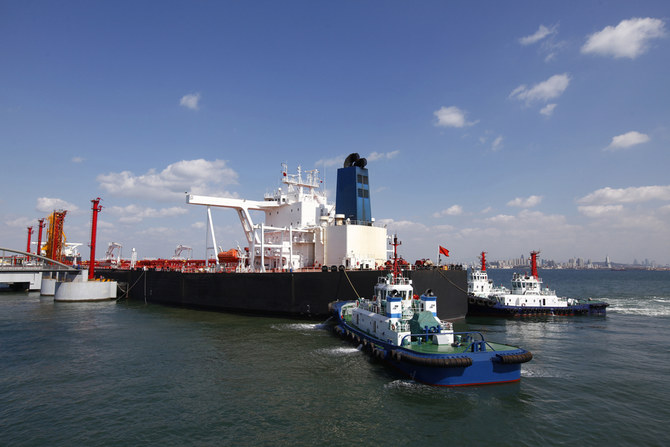
Russia held its spot as China’s top oil supplier for a third month in July. (Shutterstock)
Short Url
Updated 21 August 2022
Follow

Oil Updates — Crude down; Russia China’s top oil supplier in July; Petrobras begins selling refining assets

RIYADH: Oil prices steadied on Friday, but fell for the week on a stronger US dollar and fears that an economic slowdown would weaken crude demand.

Brent crude futures settled at $96.72 a barrel, gaining 13 cents. 

US West Texas Intermediate crude ended 27 cents higher at $90.77. 

Both benchmarks fell about 1.5 percent on the week.

Russia is China’s top oil supplier for 3rd month in July

Russia held its spot as China’s top oil supplier for a third month in July, data showed on Saturday, as independent refiners stepped up purchases of discounted supplies while cutting shipments from rival suppliers such as Angola and Brazil.

Imports of Russian oil, including supplies pumped via the East Siberia Pacific Ocean pipeline and seaborne shipments from Russia’s European and Far Eastern ports, totaled 7.15 million tons, up 7.6 percent from a year ago, data from the Chinese General Administration of Customs showed.

Still, Russian supplies in July, equivalent to about 1.68 million barrels per day, were below May’s record of close to 2 million bpd. China is Russia’s largest oil buyer.

Imports from second-ranking Saudi Arabia rebounded last month from June, the lowest in more than three years, to 6.56 million tons, or 1.54 million bpd, but still slightly below the year-ago level.

Year-to-date imports from Russia totaled 48.45 million tons, up 4.4 percent on the year, still trailing behind Saudi Arabia, which supplied 49.84 million tons, or 1 percent below the year-ago level.

China’s crude oil imports in July fell 9.5 percent from a year earlier, with daily volumes at the second lowest in four years, as refiners drew down inventories and domestic fuel demand recovered more slowly than expected.

The strong Russian purchases squeezed out competing supplies from Angola and Brazil, which fell 27 percent year-on-year and 58 percent, respectively. 

Brazil’s Petrobras in non-binding phase of selling refining assets

Brazilian oil giant Petrobras said on Friday it had begun the non-binding phase of selling its refining assets.

The assets to be sold by the state-run company include its refineries RNEST, REPAR and REFAP.

Nigerian president worried over large-scale crude oil theft

Nigeria’s President Muhammadu Buhari expressed concern on Friday over large-scale crude oil theft, saying it was affecting the country’s revenues “enormously.”

The oil regulator has said that Nigeria lost $1 billion in revenue during the first quarter of this year due to crude theft.

Nigeria is unable to meet some of its financial obligations to its citizens due to the oil theft, Buhari told government workers who are requesting a pay increase to help deal with double-digit inflation.

“On your request for a salary review, I wish to urge you to appreciate the revenue constraints being presently faced by the government which are caused mainly by the activities of unscrupulous citizens through the theft of our crude oil, a major contributor to our revenue base,” Buhari said.

Crude theft poses an existential threat to Nigeria’s oil industry, the local head of Shell has said, resulting in the shutdown of two of its major pipelines.

(With input from Reuters) 


Free trade negotiations between GCC, India mark new phase of partnership, says sec-gen

Updated 24 February 2026
Follow

Free trade negotiations between GCC, India mark new phase of partnership, says sec-gen

RIYADH: The Gulf Cooperation Council’s secretary-general affirmed that the negotiations for a free trade agreement between the GCC and India, and the signing of the joint statement, represents a new phase of strategic partnership.

Jasem Mohamed Al-Budaiwi said that this contributes to enhancing close cooperation and strengthening economic and trade ties, according to the Saudi Press Agency.

This came during the signing ceremony of the joint statement on launching the free trade agreement negotiations between the Al-Budaiwi and India’s Minister of Commerce and Industry, Piyush Goyal, which took place in New Delhi, on Tuesday.

During the signing ceremony, Al-Budaiwi said that the Terms of Reference, signed on Feb. 5, provide a comprehensive and clear framework for these negotiations. The two nations agreed to discuss enhancing cooperation in vital strategic areas, including trade in goods, customs procedures, and services.

Additionally, the framework covers Sanitary and Phytosanitary measures, intellectual property rights, cooperation on Micro, Small, and Medium Enterprises, along with other topics of mutual interest. This reflects the comprehensive nature of the agreement and its ability to keep pace with the future economy.

Al-Budaiwi expressed hope that these negotiations would lead to a comprehensive and ambitious free trade agreement that works to remove customs and non-customs barriers, enhance the flow of quality investments in both directions, and achieve further liberalization in trade and investment cooperation between the GCC and India for mutual benefit. 

This would provide a stimulating economic environment and an investment climate that opens broad horizons for the business sector, supports supply chains, and accelerates the pace of economic growth in line with the ambitious developmental visions of the GCC states. 

The top official affirmed the full readiness of the General Secretariat to host the first round of negotiations at its headquarters in Riyadh during the second half of this year.

The two sides held a meeting during which they reviewed the existing cooperation relations between the GCC and India and discussed ways to develop and elevate them to broader horizons, serving mutual interests and enhancing opportunities for strategic partnership between the two sides, particularly in the economic, investment, and trade fields.

They praised the role undertaken by the negotiating teams from both sides, appreciating the efforts contributing to reaching a comprehensive agreement that enhances economic integration and supports the smooth flow of trade between the two nations.