LONDON: The frontrunner to be Britain’s next prime minister Liz Truss said her government’s defining mission would be to revive the economy as she set out a series of measures to help parts of northern England.
Britain’s economic performance has lagged behind those of the United States, Italy and France in recovering from the COVID-19 pandemic. The economy is expected to enter a long downturn at the end of the year amid surging inflation and rising interest rates.
“The defining mission of my government will be to get our economy growing again, cutting taxes to put more money into the pockets of hardworking people,” Truss said.
Outgoing Prime Minister Boris Johnson had said reducing regional economic inequality was his main goal. But public spending in the north of England fell behind the national average in the first two years of his government, research by the Institute for Public Policy Research has shown.
Truss said she was committed to the current government’s goal of reducing economic inequalities but would do so in a “Conservative way,” interpreted as meaning a focus on tax cuts and deregulation.
Speaking ahead of election hustings in Manchester in northern England on Friday, Truss pledged to provide more devolution, to ensure poorer areas receive the government funding they need, and to build two new vocational colleges in the north of England that will be “the vocational equivalent of Oxford and Cambridge,” dubbed “Voxbridge.”
Truss has portrayed herself as a radical insurgent who would overturn the current failed orthodoxy and has proposed to reverse more than £30 billion ($36 billion) of tax rises.

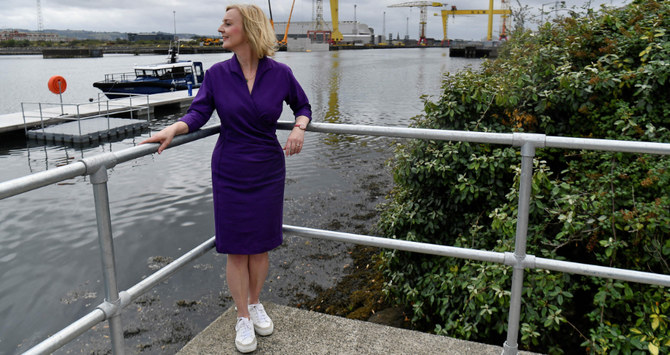
UK’s Liz Truss says defining mission will be reviving the economy
https://arab.news/vsd4f
UK’s Liz Truss says defining mission will be reviving the economy
First EU–Saudi roundtable on critical raw materials reflects shared policy commitment
RIYADH: The EU–Saudi Arabia Business and Investment Dialogue on Advancing Critical Raw Materials Value Chains, held in Riyadh as part of the Future Minerals Forum, brought together senior policymakers, industry leaders, and investors to advance strategic cooperation across critical raw materials value chains.
Organized under a Team Europe approach by the EU–GCC Cooperation on Green Transition Project, in coordination with the EU Delegation to Saudi Arabia, the European Chamber of Commerce in the Kingdom and in close cooperation with FMF, the dialogue provided a high-level platform to explore European actions under the EU Critical Raw Materials Act and ResourceEU alongside the Kingdom’s aspirations for minerals, industrial, and investment priorities.
This is in line with Saudi Vision 2030 and broader regional ambitions across the GCC, MENA, and Africa.
ResourceEU is the EU’s new strategic action plan, launched in late 2025, to secure a reliable supply of critical raw materials like lithium, rare earths, and cobalt, reducing dependency on single suppliers, such as China, by boosting domestic extraction, processing, recycling, stockpiling, and strategic partnerships with resource-rich nations.
The first ever EU–Saudi roundtable on critical raw materials was opened by the bloc’s Ambassador to the Kingdom, Christophe Farnaud, together with Saudi Deputy Minister for Mining Development Turki Al-Babtain, turning policy alignment into concrete cooperation.
Farnaud underlined the central role of international cooperation in the implementation of the EU’s critical raw materials policy framework.
“As the European Union advances the implementation of its Critical Raw Materials policy, international cooperation is indispensable to building secure, diversified, and sustainable value chains. Saudi Arabia is a key partner in this effort. This dialogue reflects our shared commitment to translate policy alignment into concrete business and investment cooperation that supports the green and digital transitions,” said the ambassador.
Discussions focused on strengthening resilient, diversified, and responsible CRM supply chains that are essential to the green and digital transitions.
Participants explored concrete opportunities for EU–Saudi cooperation across the full value chain, including exploration, mining, and processing and refining, as well as recycling, downstream manufacturing, and the mobilization of private investment and sustainable finance, underpinned by high environmental, social, and governance standards.
From the Saudi side, the dialogue was framed as a key contribution to the Kingdom’s industrial transformation and long-term economic diversification agenda under Vision 2030, with a strong focus on responsible resource development and global market integration.
“Developing globally competitive mineral hubs and sustainable value chains is a central pillar of Saudi Vision 2030 and the Kingdom’s industrial transformation. Our engagement with the European Union through this dialogue to strengthen upstream and downstream integration, attract high-quality investment, and advance responsible mining and processing. Enhanced cooperation with the EU, capitalizing on the demand dynamics of the EU Critical Raw Materials Act, will be key to delivering long-term value for both sides,” said Al-Babtain.
Valere Moutarlier, deputy director-general for European industry decarbonization, and directorate-general for the internal market, industry, entrepreneurship and SMEs at European Commission, said the EU Critical Raw Materials Act and ResourceEU provided a clear framework to strengthen Europe’s resilience while deepening its cooperation with international partners.
“Cooperation with Saudi Arabia is essential to advancing secure, sustainable, and diversified critical raw materials value chains. Dialogues such as this play a key role in translating policy ambitions into concrete industrial and investment cooperation,” she added.


