

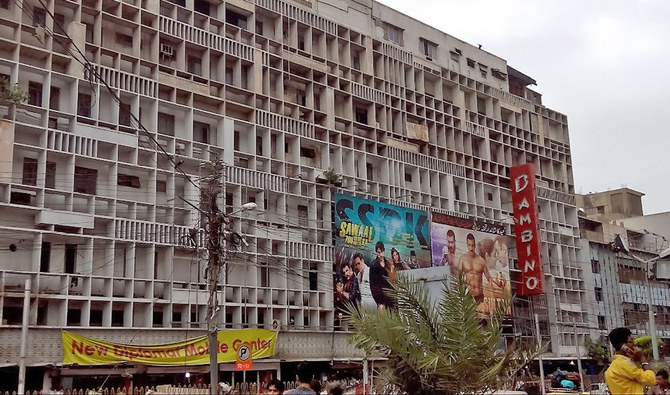

KARACHI: Once abuzz with the sounds of laughter and thunderous applause, Bambino Cinema in Pakistan’s southern port city of Karachi now wears a deserted look when one wanders inside the movie theater, with a few movie posters, a staircase and a gallery the only proof that the cinema used to be a happening place a few decades ago.
Bambino Cinema rose with the ascent of the Pakistan film industry in the 1960s. Located in Karachi’s busy Saddar area, Bambino was Pakistan’s first cinema to feature a 70mm film screen and double balcony seating. Of these, one was a dedicated space exclusively for families. Once owned by Hakim Ali Zardari, father of former Pakistani president and prominent politician Asif Ali Zardari, it used to attract dignitaries the likes of ex-army chief and military dictator, Ayub Khan.
However, the cinema has run into problems over the past couple of years, as India and Pakistan’s worsening ties led to Pakistan banning films from its neighbor.
“Cinema investment is heavy and with a ban on Indian movies, cinemas can’t sustain [the pressure]. It is about demand and supply,” Sheikh Adeel Imtiaz, whose father took over Bambino cinema in 1978, told Arab News in an interview at his office within the cinema space.
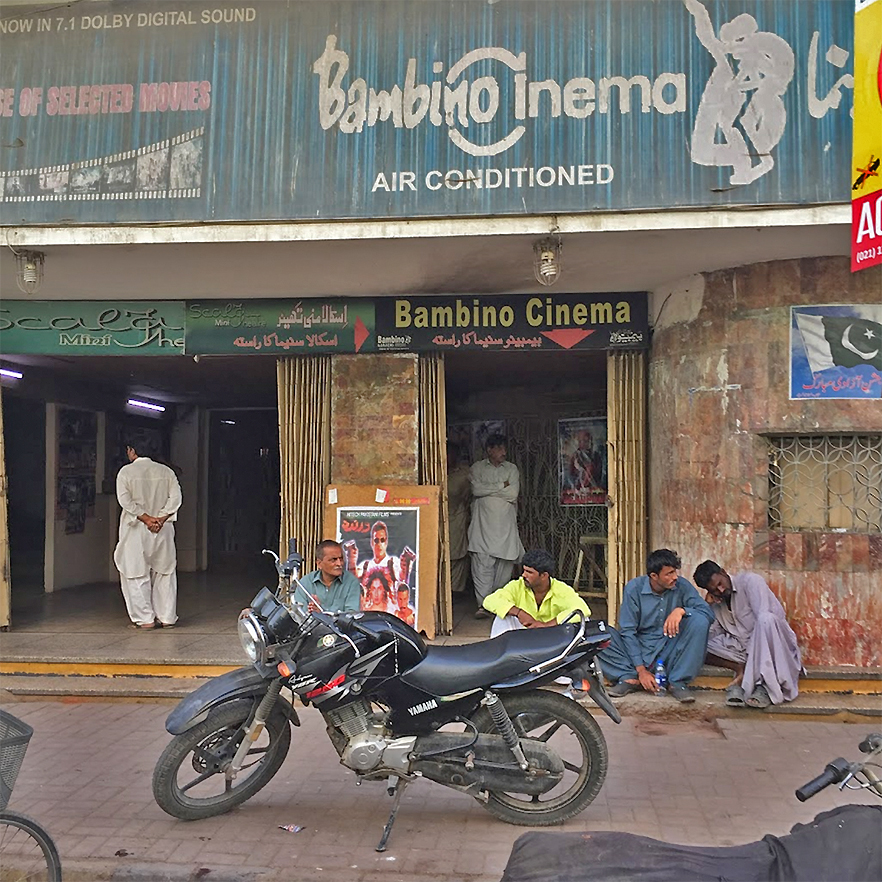
People sit outside Bambino Cinema in Karachi, Pakistan, in April 2019. (Dr. Taha Shabbir/Online)
He said the cinema was putting up Pakistani and Hollywood movies till 2019, before the first coronavirus case was reported in Pakistan. “It is not situated in Defense so I cannot cover the cost of English movies; four to five films a year are not enough to keep a cinema going,” Imtiaz said. “I no longer plan to revive it and instead, I am in talks to turn it into a plaza,” he added.
Bambino has seen several highs and lows over the past couple of years. The cinema was burnt in an attack by violent protesters in September 2012 during a protest against an anti-Islam foreign film.
However, the cinema opened a month later before Eid al Adha in Pakistan, so people could enjoy the newest releases at the time, Bollywood film ‘Rush’ and Pakistani movie ‘Sher Dil’. Imtiaz said the cinema was doing well in 2012, with the Salman Khan-starrer ‘Dabangg 2’ released in December 2012, proving to be a big break and helping recover some money lost due to the carnage earlier.
Pakistan was once a country where the movie business thrived. There were 150 cinemas in Sindh and over 500 cinemas across the country. However, a ban on Indian content and monopoly over local films, Imtiaz said, affected business and hence, made expenses unaffordable. Soon, families stopped thronging the cinema.
“By 2005-2006, around 50 cinemas were left in Sindh,” Imtiaz said. “Once the ban was lifted in 2007 and audiences came back, we started investing in the cinema on the seating and sound system. Multiplexes such as Cinepax Cinemas and The Place (mall that features Nueplex cinema) were also being built at that time,” he added.
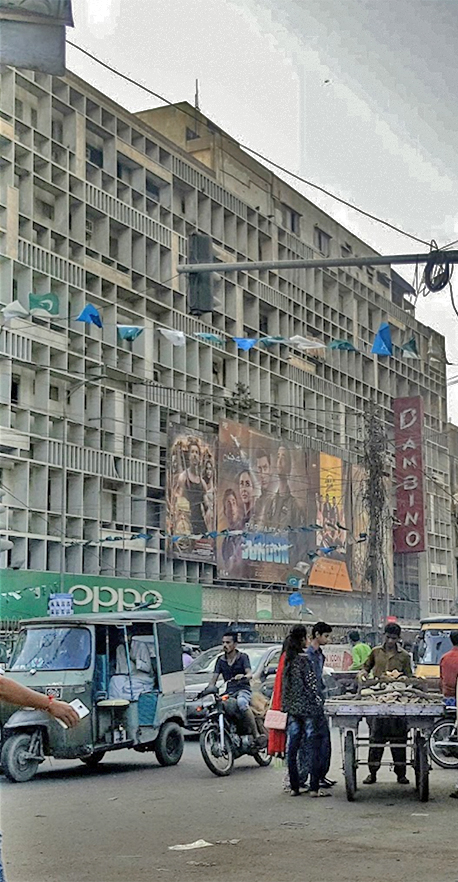
The image shows the building of Bambio Cinema in Karachi, Pakistan in July 2016. (Muhammad Jawwad Ali/Online)
“We last showed the Salman Khan-starrer Bajrangi Bhaijan in 2015 and Sultan in 2016 on Eid before another ban,” Imtiaz said, referring to Bollywood blockbusters featuring the veteran actor.
Film critic Omair Alavi recalled watching the Arnold Schwarzenegger-starrer ‘True Lies’ in Bambino during the early ‘90s. “I was blown away by the experience since it had a huge screen as well as a sound system at that time,” he told Arab News.
Since Capri and Nishat cinemas were right around the corner, he said one was able to find seats available whenever an English film was screened at Bambino. During 1998-2004, he watched a few Pakistani films at the cinema after which the industry suffered losses and his trips to Bambino decreased.
“In pre-multiplex days, it was a place where people from all walks of life could meet and enjoy films, and after Nishat and Prince Cinema were burned down in 2012, it could have become a star attraction but it didn’t,” Alavi said.
“Unlike Capri, it didn’t improve its standard despite having a huge screen and that’s why people started going to the nearby Atrium (cinema) instead of an old-fashioned standalone Bambino,” he added.
Nadeem Mandviwalla, film distributor and cinema owner, told Arab News every cinema needs content. He said it was the government’s incentive to unban Indian movies and then ban them.
“Only the government will have to come forward to find the solution,” he said, adding that it needed to ensure 100 films were released a year, regardless of whether they are Pakistani or Indian.
“This isn’t an issue that cannot be resolved. If there aren’t enough films, cinemas will die again,” he said.




