

Dubai airport to see pre-pandemic monthly passenger volumes by end of 2023

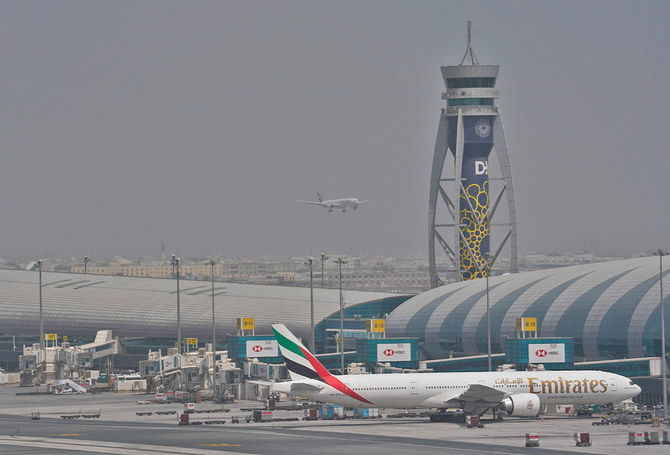
An Emirates Boeing 777 stands at the gate at Dubai International Airport as another prepares to land on the runway in Dubai, United Arab Emirates, on August 17, 2022. (AP)
Short Url
Updated 17 August 2022
Follow

Dubai airport to see pre-pandemic monthly passenger volumes by end of 2023

  • 62.4 million passengers are now expected to travel through the airport this year
  • Airport is expecting an average of 5.6 million a month in the second half of this year

DUBAI: The operator of Dubai International Airport said on Wednesday the Middle East hub could see monthly passenger traffic return to pre-pandemic levels in the latter half of next year.

Dubai Airports Chief Executive Paul Griffiths told Reuters 62.4 million passengers were now expected to travel through the airport this year, about 7% more than its most recent forecast after traffic more than doubled in the first half.

"We should be back at the normal sort of monthly throughputs of about 7 million passengers-plus by the end of next year. That's what we're predicting," he said in an online interview.

The airport is expecting an average of 5.6 million a month in the second half of this year.

The state-owned operator has previously said Dubai International could return to pre-pandemic annual passenger traffic levels in 2024. It handled 86.4 million passengers in 2019.

Dubai airport screened 27.9 million passengers in the first half of the year, compared to 10.6 million a year ago, while second quarter traffic nearly tripled to 14.9 million.

"As soon as people have been able to travel again, they've voted with their feet ... and the evidence is there," Griffiths said.

The recovery at the airport, hub for airline Emirates, continues to be led by passengers starting or ending their journey in Dubai, rather than catching connecting flights.

Griffiths said about 75% of pre-pandemic transit traffic had recovered and that point-to-point traffic was expected to remain strong.


Syrian army declares Daesh-linked camp ‘closed security zone’

Updated 6 sec ago
Follow

Syrian army declares Daesh-linked camp ‘closed security zone’

  • Al-Hol is the largest camp for suspected Daesh relatives
  • A military source said the army’s measure aimed to control security around the camp

DAMASCUS: Syria’s army announced Friday that a camp housing suspected relatives of Daesh group fighters was closed to the public, a measure a military source said was meant to bolster security around the facility.
Earlier this month, the army entered the vast Al-Hol camp after the withdrawal of the Kurdish-led Syrian Democratic Forces (SDF).
In a statement Friday, it said the area was a “closed security zone.”
Located in a desert region of Hasakah province, Al-Hol is the largest camp for suspected Daesh relatives and is home to some 24,000 people, mostly women and children, including 6,200 foreigners.
A military source told AFP the army’s measure aimed to control security around the camp and maintain order within it.
Some camp residents fled during the “security vacuum” between when the SDF withdrew and the army took control, two former employees of organizations working at the site told AFP last week.
In recent days, new reports emerged of attempts to flee the camp.
In the latest issue of its official Al-Naba publication — translated by the SITE monitoring group — Daesh called on supporters to free women held captive in Al-Hol.
In 2014, Daesh swept across Syria and Iraq, committing massacres and forcing women and girls into sexual slavery, but backed by a US-led coalition, the Kurdish-led SDF ultimately defeated the militants in Syria five years later.
The SDF went on to jail thousands of suspected militants and detain tens of thousands of their relatives in camps.
When the Syrian army took control of the camp, most humanitarian organizations withdrew, and aid has only been trickling in since.
The Save the Children charity warned on Friday that the humanitarian situation in the camp was “rapidly deteriorating as food, water and medicines run dangerously low.”
After Syrian government forces advanced against Kurdish forces, Washington said it would transfer 7,000 Daesh suspects, previously held by Syrian Kurdish fighters, to Iraq.
The transfer is still underway.