WHO turns to public for monkeypox name change

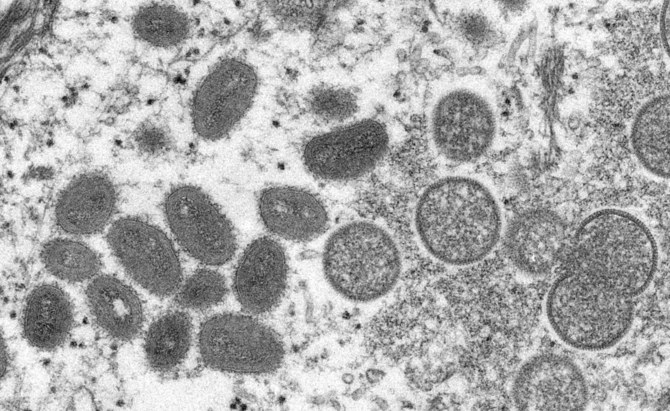
The UN health agency announced last week that a group of experts it had convened had already agreed on new names for monkeypox virus variants, or clades. (File/AFP)
Short Url
Updated 16 August 2022
Follow

WHO turns to public for monkeypox name change

  • Experts warn the name can be stigmatising to the primates it was named after

GENEVA: The World Health Organization, which is looking to rename monkeypox, called Tuesday for help from the public in coming up with a less stigmatising designation for the fast-spreading disease.
The UN health agency has for weeks voiced concern about the name of the disease that emerged onto the global stage in May.
Experts warn the name can be stigmatising to the primates it was named after, but who play little role in its spread, and to the African continent that the animals are often associated with.
Recently in Brazil, for instance, there have been reported cases of people attacking monkeys over disease fears.
“Human monkeypox was given its name before current best practices in naming diseases,” WHO spokeswoman Fadela Chaib told reporters in Geneva.
“We want really to find a name that is not stigmatising,” she added, saying the consultation is now open to everyone through a dedicated website: https://icd.who.int/dev11.
Monkeypox received its name because the virus was originally identified in monkeys kept for research in Denmark in 1958, but the disease is found in a number of animals, and most frequently in rodents.
The disease was first discovered in humans in 1970 in the Democratic Republic of Congo, with the spread among humans since then mainly limited to certain West and Central African countries where it is endemic.
But in May, cases of the disease, which causes fever, muscular aches and large boil-like skin lesions, began spreading rapidly around the world, mainly among men who have sex with men.
Worldwide, over 31,000 cases have been confirmed since the start of the year, and 12 people have died, according to the WHO, which has designated the outbreak a global health emergency.
While the virus can jump from animals to humans, WHO experts insist the recent global spread is due to close-contact transmission between humans.
The UN health agency announced last week that a group of experts it had convened had already agreed on new names for monkeypox virus variants, or clades.
Until now, the two main variants have been named after the geographic regions where they were known to circulate, the Congo Basin and West Africa.
The experts agreed to rename them using Roman numerals instead, calling them Clade I and Clade II. A subvariant of Clade II, now known as Clade IIb, is seen as the main culprit behind the ongoing global outbreak.


EU parliament approves 90-bn-euro loan for Ukraine amid US cuts

Updated 5 sec ago
Follow

EU parliament approves 90-bn-euro loan for Ukraine amid US cuts

  • awmakers voted by 458 to 140 in favor of the loan, intended to cover two-thirds of Ukraine’s financial needs for 2026 and 2027

The EU parliament on Wednesday approved a 90-billion-euro loan for Ukraine, providing a financial lifeline to cash-strapped Kyiv four years into Russia’s invasion.
Lawmakers voted by 458 to 140 in favor of the loan, intended to cover two-thirds of Ukraine’s financial needs for 2026 and 2027 and backed by the EU’s common budget — after plans to tap frozen Russian central bank assets fell by the wayside.

Military aid to Ukraine hit its lowest level in 2025 as the US pulled funding, leaving Europe almost alone in footing the bill and averting a complete collapse, the Kiel Institute said Wednesday.
Kyiv's allies allocated 36 billion euros ($42.9 billion) in military aid in 2025, down 14 percent from 41.1 billion euros the previous year, according to Kiel, which tracks military, financial and humanitarian assistance pledged and delivered to Ukraine since Russia's full-scale invasion.
Military aid in 2025 was even lower than in 2022, despite the invasion not taking place until February 24 that year.
US aid came to a complete halt with President Donald Trump's return to the White House in early 2025.
Washington provided roughly half of all military assistance between 2022 and 2024.
European countries have thus made a significant effort to plug the gap, increasing their collective allocation by 67 percent in 2025 compared with the 2022-2024 average.
Without that effort, the US cuts could have been even more damaging, the institute argued.
However, the think tank points to "growing disparities" among European contributors, with Northern and Western European countries accounting for around 95 percent of military aid.
The institute calculated that Northern European countries (Denmark, Estonia, Finland, Iceland, Latvia, Lithuania, Norway, and Sweden) provided 33 percent of European military aid in 2025, despite accounting for only eight percent of the combined GDP of European donor countries.
Southern Europe, which accounts for 19 percent of the combined GDP of European donors, contributed just three percent.
To help fill the gap left by the United States, NATO launched the PURL programme, under which European donors purchased US weapons for Ukraine, worth 3.7 billion euros in 2025.
Kiel called the initiative a "notable development", which had enabled the acquisition of Patriot air-defense batteries and HIMARS multiple-launch rocket systems.
European allies are also increasingly placing orders with Ukraine's own defence industry, following a trend started by Denmark in 2024.
War-torn Ukraine's defence production capacity has "grown by a factor of 35" since 2022, according to Kiel, but Kyiv lacks the funds to procure enough weapons to keep its factories working at full capacity.
Orders from 11 European donor countries helped bridge that gap last year.
In the second half of 2025, 22 percent of weapons purchases for Ukraine were procured domestically, a record high.