Saudi banks shut down 42 branches in 12 months, increase digital presence

The past three years of the pandemic slowly began the transformation toward digital banking, which can be seen closely in the Saudi banking sector. (Supplied)
Short Url
Updated 15 August 2022
Follow

Saudi banks shut down 42 branches in 12 months, increase digital presence

  • More banks are switching to increased virtual interactions and digitalization, and new banks are opening entirely on that premise

CAIRO: Saudi banks shut down 42 branches over the year ending in June, revealed the Saudi Central Bank, also known as SAMA.

The number of bank branches in Saudi Arabia also inched lower to 1,927 in the second quarter this year from 1,932 in the same quarter last year.

So, what are the reasons behind this decreased number of bank branches, and when did this trend begin?

The most common assumption would be the COVID-19 pandemic and its prolonged effect on the entire economy, including the financial and banking sectors.

Between the fourth quarter of 2019 and the first quarter of 2021, which includes the peak of the pandemic, 68 branches were closed. 
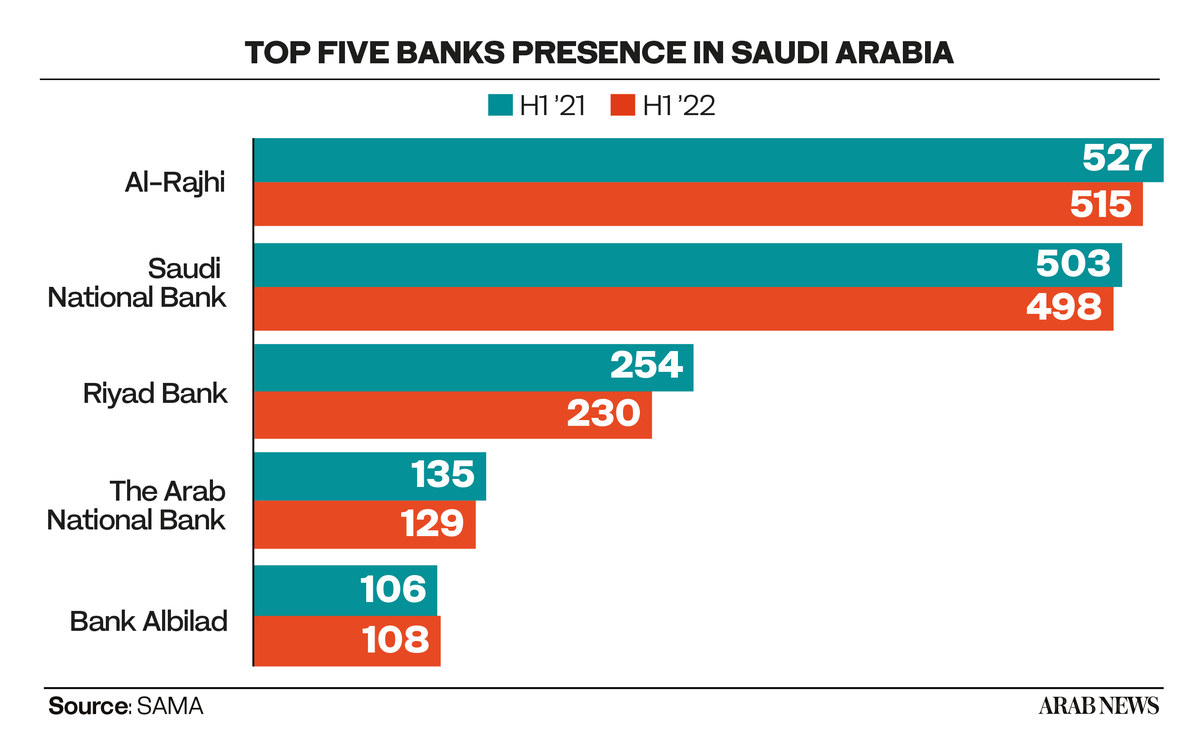
Also, bank branches continued to decrease quarterly long after lifting COVID-19 restrictions, albeit there was no clear trend.

Between May 2020 and June this year, 137 bank branches in the Kingdom shut shop.

It is worth mentioning that branches that have closed are not second-tier or underperforming banks but some of the largest and well-performing ones. For instance, Al Rajhi Bank, which had 543 branches in the fourth quarter of 2020, reduced it to 515 by June this year.

While COVID-19 sparked the digital revolution, advanced and innovative technologies did the job.

The past three years of the pandemic slowly began the transformation toward digital banking, which can be seen closely in the Saudi banking sector.

More banks are switching to increased virtual interactions and digitalization, and new banks are opening entirely on that premise.

Last February, SAMA licensed and welcomed the Kingdom’s third digital bank D360 Bank, following the launch of STC and Saudi Digital Bank in June last year.

Similarly, according to SAMA, 19 Saudi fintech companies have been authorized to provide payment services, consumer microfinance and electronic insurance brokerage over the past few months.

So, what does the future of digital banking in the Kingdom hold and will the population accept this digital revolution?

In a survey conducted by Ipsos in the Kingdom in October 2021, the research major pointed out that 61 percent still trust traditional banks, while 47 percent counted on mobile service providers and 40 percent depended on popular digital brands to carry out financial transactions.

The report added: “63 percent said that they will be making all their financial transactions through digital banking in the future, and 58 percent believe that people would no longer use cash as a payment method.”


Closing Bell: Saudi main market ends week in red at 11,189

Updated 05 February 2026
Follow

Closing Bell: Saudi main market ends week in red at 11,189

RIYADH: Saudi Arabia’s Tadawul All Share Index closed lower at the end of the trading week on Thursday, falling 1.34 percent, or 152.54 points, to finish at 11,188.73. 

The benchmark index opened at 11,320.52 and trended lower throughout the session, finishing well below its previous close of 11,341.27.  

Market breadth was sharply negative, with only 28 gainers compared with 236 decliners. Trading activity saw a volume of 239 million shares exchanged, with total turnover reaching SR5.5 billion ($1.47 billion). 

In the parallel market, Nomu closed higher, rising 0.23 percent to 23,865.95, although decliners continued to outnumber advancers. The MT30 index closed at 1,508.60, down 1.46 percent, shedding 22.38 points by the end of the session. 

Among the session’s top gainers, Dar Al Majed Real Estate Co. led advances, rising 5.43 percent to close at SR9.91. 

Al Aziziah REIT Fund added 4.67 percent to SR4.48, while Al Majed Oud Co. gained 2.81 percent to SR161.20. AFG International Co. advanced 2.45 percent to SR17.17, and Al Mawarid Manpower Co. rose 1.37 percent to SR125.70.

On the losing side, Saudi Research and Media Group posted the steepest decline, falling 6.88 percent to SR107. Cherry Trading Co. dropped 6.23 percent to SR28.88, while Saudi Arabian Mining Co. slipped 5.41 percent to SR72.55.  

Almasane Alkobra Mining Co. declined 5.38 percent to SR102, and Power and Water Utility Co. for Jubail and Yanbu ended 4.56 percent lower at SR31.36. 

On the announcements front, Saudi Industrial Investment Group released its interim financial results for the twelve-month period ended Dec. 31, 2025, reporting a return to profitability on an annual basis despite posting a quarterly loss.  

The company recorded a net loss of SR104 million in the fourth quarter, compared with a net profit of SR201 million in the same quarter of the previous year, which it attributed mainly to lower selling prices, higher operating costs, and increased general and administrative expenses.  

For the full year, however, the group posted a net profit attributable to shareholders of SR197 million, compared with SR161 million a year earlier, supported by higher sales volumes and improved operational performance at several subsidiaries. The stock last traded at SR14.77, down 3.59 percent. 

Separately, Saudi Exchange Co. announced the approval of a request by Merrill Lynch Kingdom of Saudi Arabia to terminate its market-making activities for Saudi Arabian Oil Co., effective Feb. 8.

The exchange said the termination relates specifically to the market-making agreement for Saudi Aramco shares and was approved in line with applicable market-making regulations.