

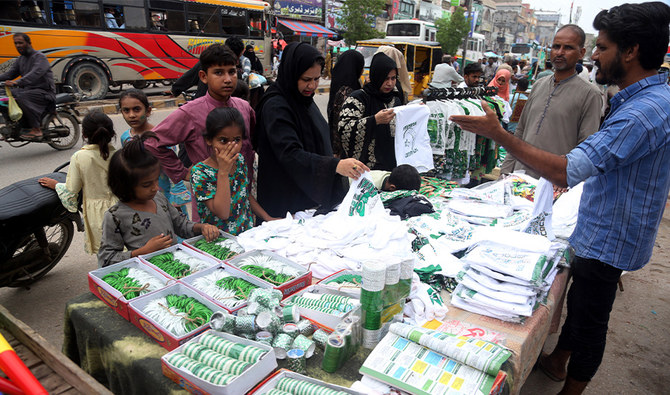

KARACHI: Each year in August, Pakistan’s national flag sees a boom in sales as the nation celebrates its independence from British colonial India on August 14. However, this time around, traders say flag sales have declined in the face of soaring inflation and torrential rains.
As Pakistan celebrates its Diamond Jubilee this year, the government’s recent hike in prices of energy products, such as petrol and diesel, has also caused inflation to surge. Pakistan’s Consumer Price Index (CPI) increased to 24.9 percent in July this year, compared to 8.4 percent last year.
A few days before Independence Day each year, one comes across many stalls in Pakistan’s southern port city of Karachi, selling the country’s national flags and green-and-white themed buntings, bangles and T-shirts.
Other items that also sell a lot are badges, caps, lockets, stickers, bracelets, headbands and various other decorative items.
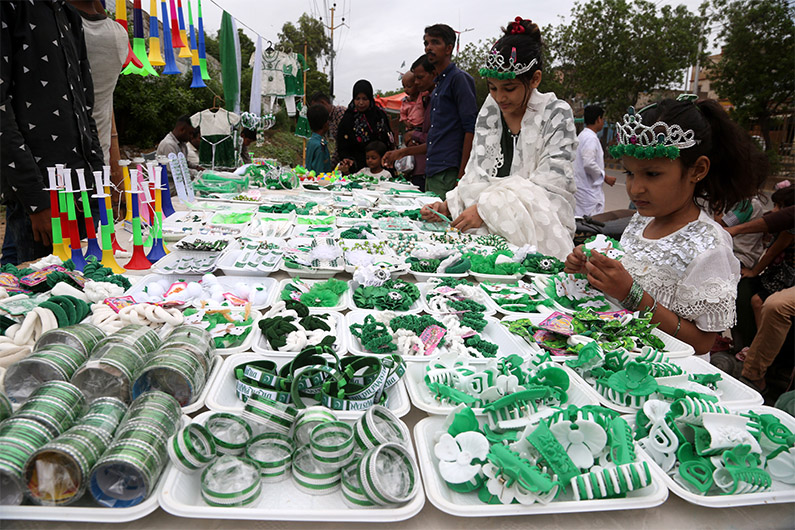
Women and children buy bangles, hair clips and other accessories from a roadside vendor ahead of Pakistan's Independence Day celebrations on August 13, 2022. (AN Photo/S.A. Babar)
While the enthusiasm to celebrate Pakistan’s Diamond Jubilee remains the same, sellers say rising inflation has decreased people’s purchasing power while the recent torrential rains across Pakistan have also put a damper on the festivities.
“Cost of inputs are increasing, including electricity, petrol and labor charges so the impact is on everything,” Sheikh Nisar Ahmed Perchamwala, CEO of VIP Flags, a manufacturer of national flags, told Arab News.
He added that the business of selling flags was also not immune to inflation.
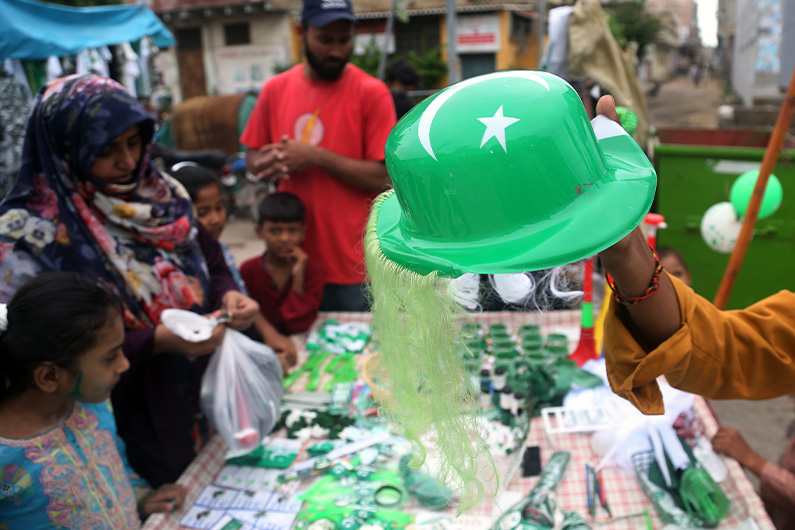
A vendor displays a green hat with the star and crescent on it, at a roadside stall in Karachi on August 13, 2022. (AN Photo/S.A. Babar)
“Prices of many items have increased by over 20-25 percent when we compare them to last year,” he lamented. “For instance, last year, the flag that was available for Rs 100 is being sold now for Rs 125-150.”
Independence Day festivities also offer earning opportunities for hundreds of low-wage earners, irrespective of their age and gender, as they set up stalls in markets and on Karachi’s roads to cope with the rising inflationary pressure.
“For the last 12 years, I have been coming here to sell flags, buntings, badges and other things that are used for Pakistan’s Independence Day celebrations,” Noor Jehan, an 85-year-old vendor at Hassan Ali Effendi Road in Karachi, told Arab News.
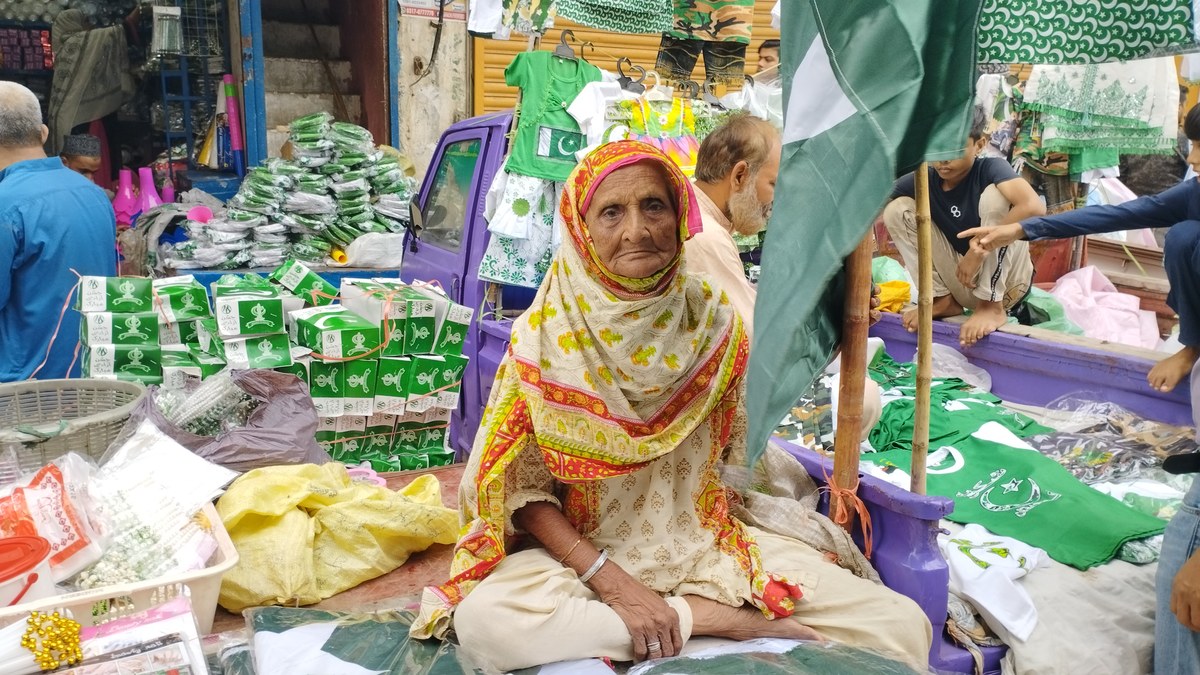
Noor Jehan, an 85-year-old vendor, is selling flags in Karachi, Pakistan on August 13, 2022. (AN Photo/S.A. Babar)
The octogenarian, who migrated from India at the time of migration in 1947, said rising inflation had compelled her to earn so that she could support her family.
“In recent years, the prices of essential goods have increased manifold. A 10-kilogram bag of flour was available for Rs 300 in the past,” she said. “Now,flour is being sold for Rs100 per kilogram,” Jehan said.
She said in the past, the entire household could live off the earnings of a single person in a family. However, nowadays, all members of a household earn yet their combined income isn’t enough to meet rising expenses.
Another vendor, Muhammad Imran, told Arab News that low trading activities and the recent spell of rains in Karachi disrupted his business this year.
“We have been setting up a stall from August 1, every year for the last nine years but this year, it was set up on the second week of August due to rains and slow trading activities,” Imran said.
“Business is moving on now, though sales are not as high as compared to the previous years because [people’s] purchasing power is falling due to high prices,” Imran said.
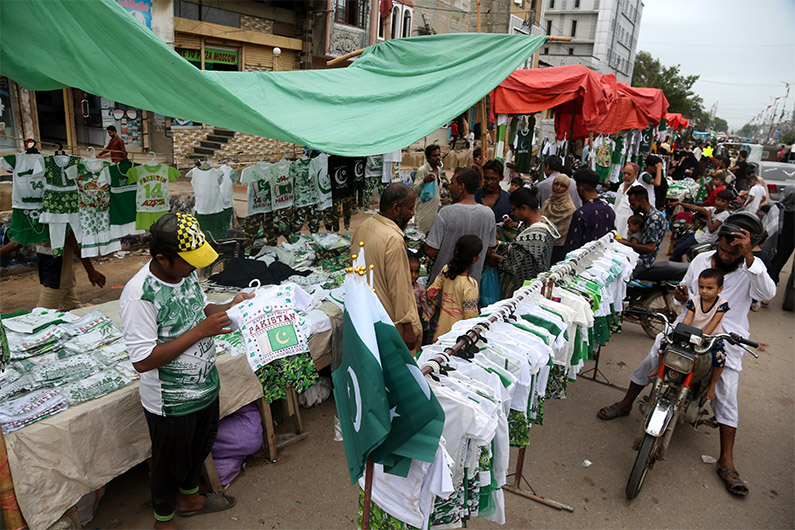
Green and white clothes and Pakistan's national flags are the center of attention at a roadside stall in Karachi ahead of the Independence Day celebrations on August 13, 2022. (AN Photo/S.A. Babar)
He said people are visiting stalls but selecting only a few items necessary for celebrations.
Shaheer Khan, another vendor, said the rising prices of flags have reduced his turnover as the declining value of the rupee against the US dollar is making things costlier.
“The price of a flag that was sold last year for Rs 200 has now increased [in selling price] to over Rs 400 because the cost of everything has increased in the market due to the dollar’s appreciation and other factors,” he added.
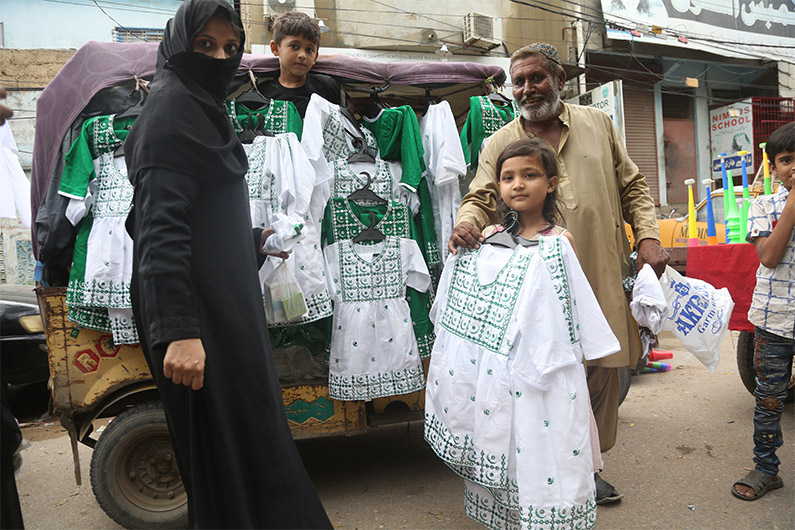
A woman and a child stand nearby a rickshaw, which serves as a makeshift stall for dresses representing Pakistan's national colors, on August 13, 2022. (AN Photo/S.A. Babar)
However, flag manufacturers and sellers acknowledged that though in limited numbers, people are still buying items from their stalls according to their purchasing power to partake in the celebrations.
“Buying [flags and other items] to celebrate ‘Freedom Day’ is a welcoming gesture, especially from the younger generation, who express their love for the country,” Perchamwala said.
A buyer at a stall expressed his resolve to keep the spirit of Independence Day alive.
“I have bought a flag and a bugle for the August 14 celebrations,” Muhammad Assadullah, a teenager, told Arab News. “We celebrate Independence Day by cutting a cake and expressing our happiness. We will continue to celebrate,” he added.


