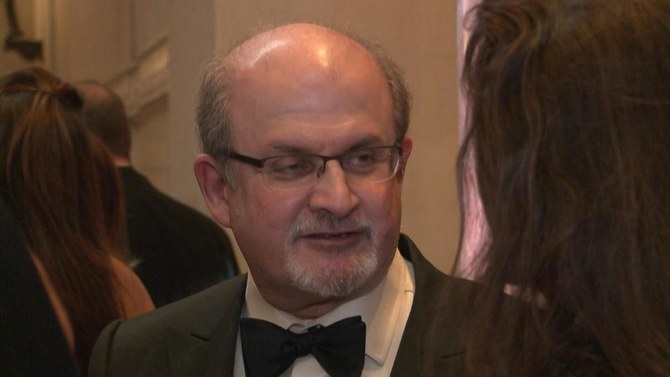
TEHRAN: Iranian ultra-conservative newspaper Kayhan on Saturday hailed the man who stabbed British author Salman Rushdie — the target of a 1989 Iranian fatwa calling for his death.
Rushdie was on a ventilator after the attack during a literary event in New York state on Friday, more than 30 years after he went into hiding following late supreme leader Ayatollah Ruhollah Khomeini’s fatwa.
“Bravo to this courageous and duty-conscious man who attacked the apostate and depraved Salman Rushdie in New York,” wrote the paper, whose chief is appointed by current supreme leader Ayatollah Ali Khamenei.
“Let us kiss the hands of the one who tore the neck of the enemy of God with a knife,” the daily added.
With the exception of reformist publication Etemad, Iranian media followed a similar line, describing Rushdie as an “apostate.”
State-owned paper Iran said that the “neck of the devil” had been “cut by a razor.”
Iranian authorities have yet to make any official comment on the stabbing attack against Rushdie.
But Mohammad Marandi, an adviser to the negotiating team for Iran’s nuclear talks in Vienna, wrote on Twitter: “I won’t be shedding tears for a writer who spouts endless hatred and contempt for Muslims and Islam.”
“But, isn’t it odd that as we near a potential nuclear deal, the US makes claims about a hit on Bolton... and then this happens?” he questioned.
The attack came after Iran hinted earlier on Friday that it may accept a final compromise to revive its 2015 nuclear deal with world powers. This followed the European Union’s submission of a “final text” in Vienna.
The US Justice Department said Wednesday that it had indicted a member of Iran’s Revolutionary Guards over allegations he had offered to pay an individual in the United States $300,000 to kill former White House national security adviser John Bolton.
Iran dismissed the allegations as “fiction.”
Rushdie, 75, was propelled into the spotlight with his second novel “Midnight’s Children” in 1981, which won international praise and Britain’s prestigious Booker Prize for its portrayal of post-independence India, where he was born.
But his 1988 book “The Satanic Verses” transformed his life when Khomeini issued a religious decree ordering his killing.
In 1998, the government of Iran’s reformist president Mohammad Khatami assured Britain that Iran would not implement the fatwa.
But Khamenei said in 2005 he still believed Rushdie was an apostate whose killing would be authorized by Islam.


![]()

Iran conservative media hail Salman Rushdie attacker
Short Url
https://arab.news/zswg6
Iran conservative media hail Salman Rushdie attacker
- Rushdie was on a ventilator after the attack during a literary event in New York state on Friday, more than 30 years after he went into hiding following late supreme leader Ayatollah Ruhollah Khomeini’s fatwa


Latest updates



Recommended


© 2026 SAUDI RESEARCH & PUBLISHING COMPANY, All Rights Reserved And subject to Terms of Use Agreement.