Beirut bank gunman still behind bars as family takes to the street in protest

A man shouts as he protests against banks outside a bank where another armed man holds hostages in Beirut, Lebanon, Thursday, Aug. 11, 2022. (AP)
Short Url
Updated 12 August 2022
Follow

Beirut bank gunman still behind bars as family takes to the street in protest

  • Bassam Al-Sheikh Hussein was arrested on Thursday after holding employees hostage
  • After surrendering himself he was told he would not be jailed

BEIRUT: The Lebanese man who held eight bank employees hostage at gunpoint while demanding the release of his frozen savings remained behind bars on Friday pending further inquiries.

Bassam Al-Sheikh Hussein was arrested after voluntarily leaving the Federal Bank branch in Beirut on Thursday evening following a seven-hour standoff.

On Friday, members of his family blocked Al-Ouzai Road in Beirut in protest at his continued detention saying it was in breach of an agreement made the night before.
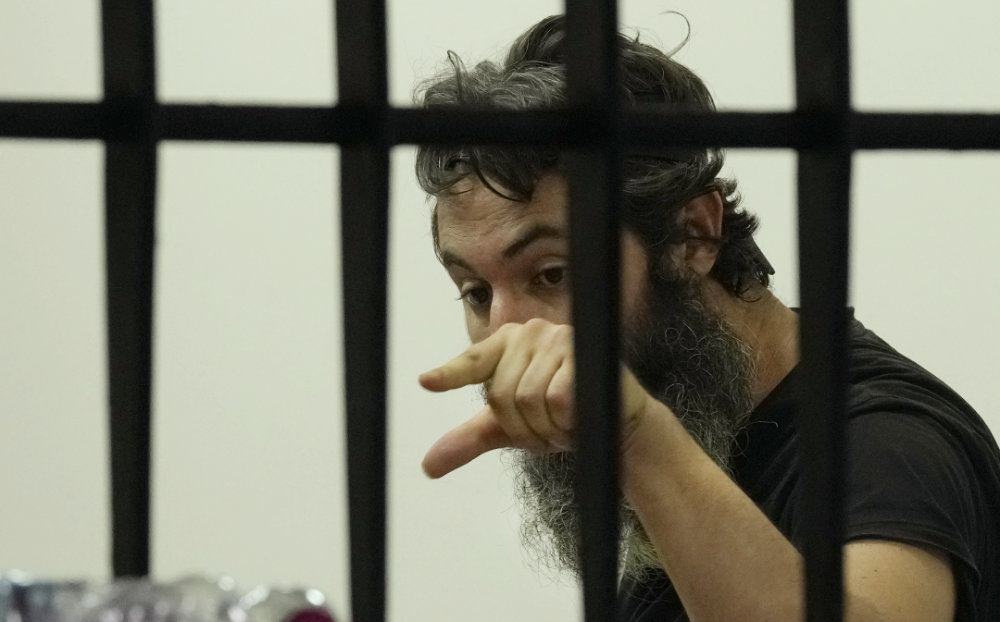


An armed man Bassam al-Sheikh Hussein, 42, speaks with one of his hostages inside a bank, in Beirut, Lebanon, Thursday, Aug. 11, 2022. (AP)

Al-Sheikh Hussein, 42, surrendered after being told his family would be given $35,000 of his money and being promised he would be questioned and then set free. Inside the bank he had been armed with a pump-action shotgun and gasoline, which at on point he said he would use to set himself alight.

Many people in the crowd that had gathered outside the bank during the siege applauded as he was led away. Lebanon’s central bank imposed a freeze on all bank deposits in 2019.

Despite the promise that he would be allowed to walk free, after leaving the bank Al-Sheikh Hussein was arrested and detained on the orders of the Lebanese judiciary.

Lawyer Haytham Ezzo told Arab News that Al-Sheikh Hussein was detained by the Information Branch of the Lebanese Internal Security Forces and denied access to a lawyer despite it being his legal right to have one present.

“Even if no one sues him, there’s the public right,” he said. “Either the investigating judge asks for his release after he’s referred to him by the Information Branch, or asks for his arrest.”

Ezzo said it was possible that Al-Sheikh Hussein had been arrested for endangering state security or threatening to kill or kidnap.

As for the money paid to the family, that could not be reclaimed by the bank as “it doesn’t constitute a criminal tool. It is the arrested depositor’s right and property,” he added.

Hassan Mughnieh, the head of Lebanon’s Depositors Association, who was in charge of the negotiations between Al-Sheikh Hussein and the bank, told Arab News that “neither the employees who were held hostage nor the Federal Bank sued him.”

But the gunman would remain behind bars until next week at the earliest, he said.

“Things will become clear on Tuesday, as it’s the weekend and judges do not work on Monday in the Justice Palaces.”

He added: “As depositors, we will organize a protest in front of Beirut’s Justice Palace on Tuesday and in front of the Directorate General of the Internal Security Forces. We don’t have a problem with Al-Sheikh Hassan’s arrest, but justice says the bank owner should also be arrested.”

Mughnieh said he had received many calls from other disgruntled bank depositors saying they wanted to act as Al-Sheikh Hassan had done.

Lebanese bank customers have had their deposits frozen since the start of the country’s economic crisis and slump of its currency.

Castro Abdallah, head of the National Federation of Trade and Employees Unions, said on Friday that “the affected people should stand together in order to recover the stolen public and depositors’ money.”

He called on unions to protest next Thursday in the commercial street of Hamra in Beirut.

Lebanon’s caretaker deputy Prime Minister Saade Chami warned that Lebanon was standing at a crossroads.

“We need to acknowledge the reality and the crises we are facing and confront them. This means that we should take the needed measures and carry out the critical and necessary reforms that put the country on the right path.”

He added that the financial and monetary policies adopted in recent years in a bid to buy time had failed and that time was now running out.

“No one will rescue us if we don’t try to rescue ourselves,” he said. “Receiving help from the little friends we have left in the world will not achieve the desired outcome.”


Security, economic and political partnerships in the spotlight at first Jordan-EU Summit

Updated 11 sec ago
Follow

Security, economic and political partnerships in the spotlight at first Jordan-EU Summit

  • Event reflects international confidence in Jordan as a reliable partner in efforts to address security threats, advance peace initiatives, and expand cooperation, analysts say
  • Timing is significant, expert says, given the region faces overlapping crises and threats that place security and defense cooperation at the heart of Jordanian-European relations

AMMAN: The inaugural Jordan-EU Summit underlined the depth of the country’s strategic partnership with Europe, officials and experts said, and confirmed the pivotal role Jordan plays in regional security, political stability and economic cooperation.

Analysts told the Jordan News Agency that Thursday’s summit took place at a sensitive moment for the region, but reflected international confidence in Jordan as a reliable partner in efforts to address cross-border security threats, advance peace initiatives, and expand cooperation in trade, investment and development.

Bashir Al-Dajeh, an expert in security and strategy, said the timing of the summit was significant, given the region is facing overlapping crises and transnational threats that place security and defense cooperation at the heart of Jordanian-European relations.

Jordan’s strategic location positions it on the front lines of efforts to tackle illegal migration, organized crime, drug and arms smuggling and cross-border terrorism, he added. The country has hosted more than 3.5 million refugees over the past decade without compromising its security infrastructure, he noted.

Jordan’s effective border controls were helping to curb irregular migration to Europe and disrupting the plans of extremist groups and trafficking networks, Al-Dajeh said, which was directly benefiting regional and European security.

Khaled Abu Hassan, a member of the Jordanian parliament, said the country’s foreign policy under King Abdullah had reinforced its influence, in the region and internationally, particularly its firm stance in support of the Palestinian cause and a two-state solution to the conflict with Israel.

He said the summit reaffirmed Jordan’s political influence in the shaping of regional balances and advancement of efforts to achieve a just and comprehensive peace. The timing of the meeting also demonstrated the resilience of the nation in managing multiple regional and domestic challenges.

Abu Hassan also highlighted the economic aspects of the summit, including the announcement of a Jordan-EU economic conference in April, as a sign of the international recognition of Jordan’s political and economic role.

Economist Mufleh Aql said the high-level summit reflected a shared desire for a broadening of cooperation to encompass politics, trade, security and renewable energy, and Jordan was well-placed to benefit from access to the EU’s large markets, technology and investment opportunities.

The country could benefit from increased exports, technology transfers and financing for major infrastructure projects in sectors such as water, transport and energy, he added, and in return offer the EU skilled human capital amid labor shortages in Europe.

EU support for Jordan’s positions on issues such as Jerusalem, regional stability, energy and migration further strengthens the partnership, Aql said. Jordan also already benefits from EU grants, concessional loans and exports of agricultural, pharmaceutical and chemical products to European markets, he noted.