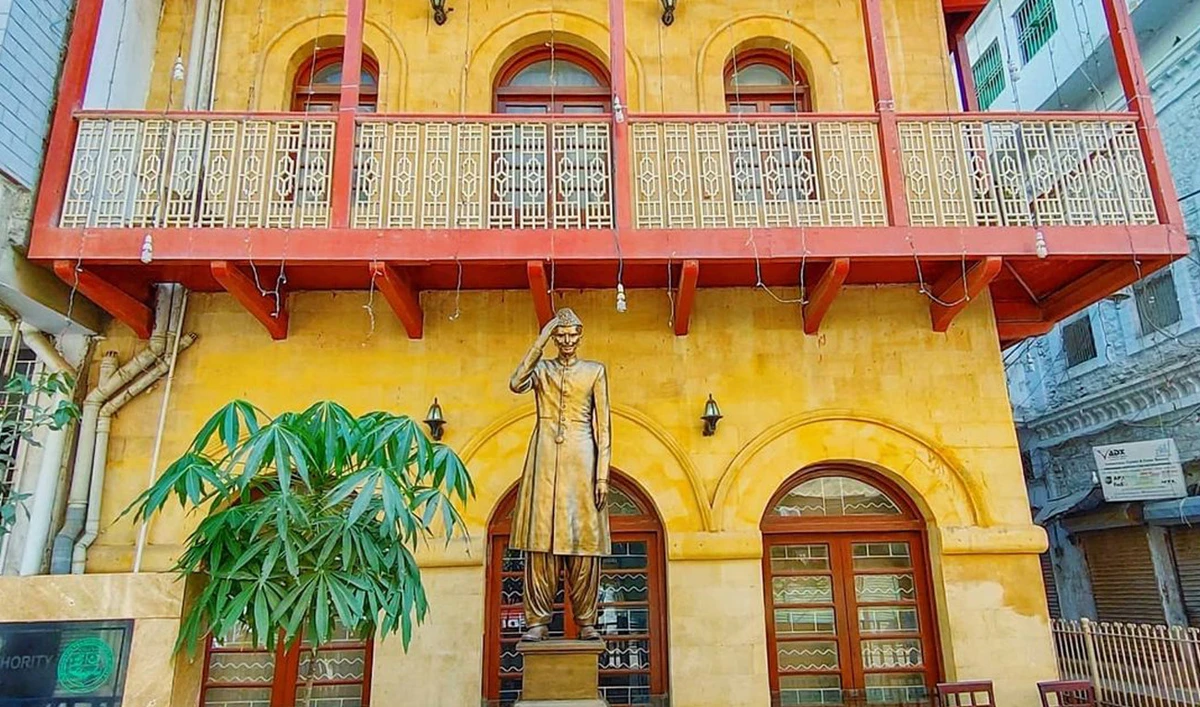
- Wazir Mansion in Newnham Road has been officially recognized as Muhammad Ali Jinnah’s birthplace since 1953
- Some scholars say the actual place of Quaid-e-Azam’s birth was 20 yards away, a building behind Wazir Mansion
KARACHI: While thousands of people flock daily to Mazar-e-Quaid, the mausoleum and final resting place of Muhammad Ali Jinnah in Karachi, and most know that he spent his last days at the Ziarat Residency in Balochistan, few can tell you with certainty where the founder of Pakistan was born.
Jinnah’s official place of birth, the three-story Wazir Mansion, is just a few kilometers away from his tomb, tucked away in a narrow street on Karachi’s Newnham Road, surrounded by shops and residential apartments.
Wazir Mansion was officially recognized in 1953 as the birthplace of Jinnah, revered as the country’s founder, who led the struggle for a separate homeland for the Muslims of the British-ruled Indian subcontinent from 1937 to Aug. 14, 1947, when Pakistan gained independence. He served as the new republic’s first governor general until his death in 1948.
“It was built during 1860-1870 with stone masonry in lime and jute mortar to suit the volatile weather of Karachi,” an information board on the house reads. “This is a precious national monument that provides inspiration to our nation.”
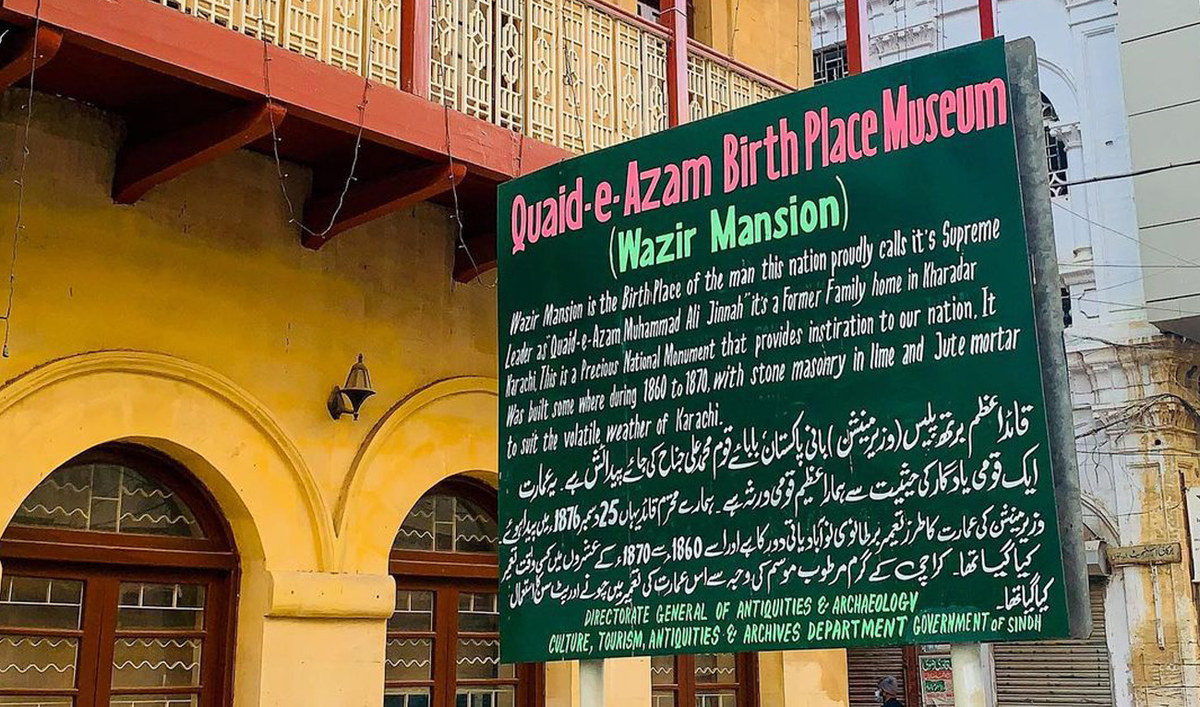
While there are disputes over whether Wazir Mansion was the actual birthplace of Jinnah — some believe he was born in Jhirk, a small town in Thatta district, over 150 km away from Karachi — the building’s custodian, Muneer Hussain, said the building housed the very room “where Jinnah was born.”
Jinnah’s father, Jinnahbhai Poonja, arrived in Karachi from Mumbai to set up a business, and chose Newnham Road, then a steel trade hub, for his enterprise, Hussain said. He rented an apartment in Wazir Mansion, where Jinnah was born on Dec. 25, 1876.
“Seven siblings of Jinnah were also born in this building,” he told Arab News. “Fifteen hundred to two-thousand people, mostly students, visit us monthly and I want this number to be doubled because this small building has changed the map of the world.”
Dr. Kaleemullah Lashari, an archaeologist and historian, told Arab News theories claiming Jinnah’s birthplace was in another city were incorrect.
“This has been refuted by the statements of Quaid himself,” Lashari said. And then quoting a speech by Jinnah, he added: “He said that, ‘It gives me immense pleasure to stand here in front of you and tell you that I was born in Karachi’.”
However, according to Lashari, it was a building behind Wazir Mansion that was Jinnah’s true place of birth.
“Jinnahbhai was occupying the part of property which was behind it [Wazir Mansion],” Lashari said.
“So, it’s the building which is behind it and this is the reason that the scholars don’t consider Wazir mansion [as Jinnah’s birthplace] …The Wazir Mansion, the present building which is there, was actually built after 1880, so
Jinnahbhai was occupying the part of property which was behind it ... There is a difference of 20 yards.”
While the difference is small, the scholar said it mattered as much as other details of Jinnah’s legacy and life.
“It is very significant [to know where Jinnah was born] but I tell you, not only the birthplace but every aspect of his life is significant and important,” the scholar said. “And there is need that attention is paid to the studies on his life and his works.”