

9 Russian planes destroyed in ‘first Ukraine attack’ on Crimea

1 / 4
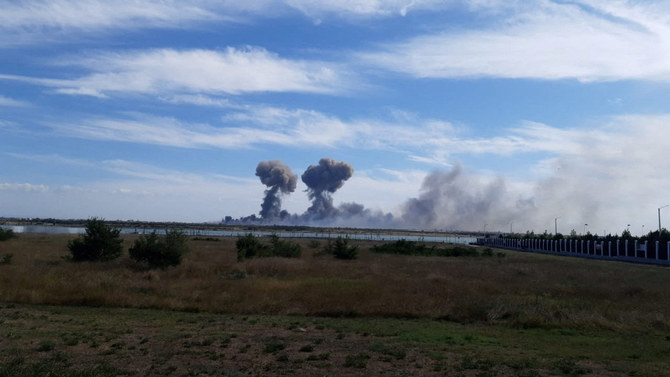
Rising smoke can be seen from a beach at Saki Air Base after explosions were heard from the direction of a russian airbase near Novofedorivka, Crimea. (AP)
2 / 4
Smoke rises after explosions were heard from the direction of a Russian military airbase near Novofedorivka, Crimea, in this still image obtained by Reuters on August 9, 2022.(Reuters)
3 / 4
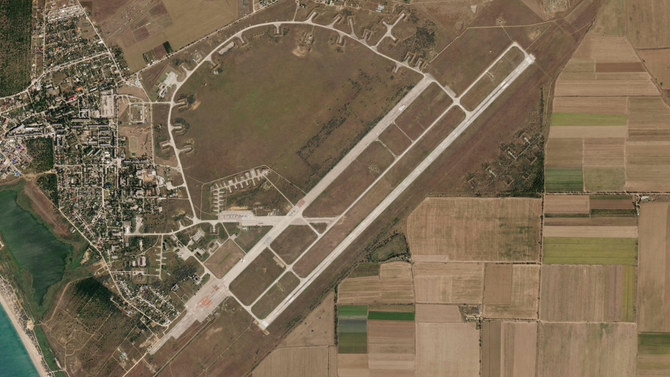
A satellite image by Planet Labs PBC shows Saki Air Base before an explosion on Aug. 9, 2022, in the Crimean Peninsula, the Black Sea peninsula seized from Ukraine by Russia and annexed in March 2014. (AP)
4 / 4
This satellite image provided by Planet Labs PBC shows destroyed Russian aircraft at Saki Air Base after an explosion on Aug. 9, 2022, in the Crimean Peninsula. (AP)
Short Url
Updated 11 August 2022
Follow

9 Russian planes destroyed in ‘first Ukraine attack’ on Crimea

  • Strike on occupied territory is major escalation
  • Kyiv officially silent but military say ‘it was us’

KYIV: Ukraine’s air force said on Wednesday that nine Russian warplanes were destroyed in a deadly string of explosions at an air base in Crimea, amid speculation of a Ukrainian attack that would be a significant escalation in the war.

Russia denied any aircraft were damaged in Tuesday’s blasts, or that an attack even took place. But Ukrainian officials mocked Russia’s explanation that a careless smoker might have caused ammunition at the Saki air base to catch fire and blow up. Analysts also said that explanation made no sense and that the Ukrainians could have used anti-ship missiles to strike the base.

“Officially Kyiv has kept mum about it, but unofficially the military acknowledges that it was a Ukrainian strike,” military analyst Oleh Zhdanov said.

If Ukrainian forces were responsible for the blasts, it would be the first known major attack on a Russian military site on the Crimean Peninsula, which was seized from Ukraine by the Kremlin in 2014.

Crimea holds huge strategic and symbolic significance for both sides. The Kremlin’s demand that Ukraine recognize the peninsula as part of Russia has been one of its key conditions for ending the fighting, while Ukraine has vowed to drive the Russians out of all occupied territories.
After the blasts, Ukrainian President Volodymyr Zelensky said: “This Russian war against Ukraine and against all of free Europe began with Crimea and must end with Crimea — its liberation.”

The explosions, which killed one person and injured 14, sent tourists fleeing in panic as plumes of smoke rose over the coastline near by. Video showed shattered windows and holes in the brickwork of some buildings.
One visitor, Natalia Lipovaya, said: “The earth was gone from under my feet … I was so scared.” Sergey Milochinsky, a local resident, recalled hearing a roar and seeing a mushroom cloud from his window. "Everything began to fall around, collapse,” he said.
The base on the Black Sea peninsula is at least 200 kilometers from the closest Ukrainian position and beyond the range of missiles supplied by the West for use in HIMARS launchers.
Ukraine has repeatedly asked for longer-range missiles for HIMARS that can strike targets up to 300 kilometers away. The explosions raised speculation that it had finally obtained them.
Zhdanov said Ukrainian forces could also have struck the air base with Neptune or Harpoon anti-ship missiles.
The Washington-based Institute for the Study of War said simultaneous blasts in two places at the base probably ruled out an accidental fire, but not sabotage or a missile attack. “The Kremlin has little incentive to accuse Ukraine of conducting strikes that caused the damage since such strikes would demonstrate the ineffectiveness of Russian air defense systems,” it said.


‘I admire Vision 2030’: Bangladesh’s new PM aims for stronger Saudi, GCC ties

Updated 4 sec ago
Follow

‘I admire Vision 2030’: Bangladesh’s new PM aims for stronger Saudi, GCC ties

  • Saudi Arabia congratulates Tarique Rahman on assuming Bangladesh’s top office
  • Relations between Bangladesh and Kingdom were formalized during his father’s rule

DHAKA: After 17 years in exile, Tarique Rahman has taken office as prime minister of Bangladesh, inheriting his parents’ political legacy and facing immediate economic and political challenges.

Rahman led his Bangladesh Nationalist Party to a landslide victory in the Feb. 12 general election, winning an absolute majority with 209 of 300 parliamentary seats and marking the party’s return to power after two decades.

The BNP was founded by his father, former President Ziaur Rahman, a 1971 Liberation War hero. After his assassination in 1981, Rahman’s mother, Khaleda Zia, took over the party’s helm and served two full terms as prime minister — in 1991 and 2001.

Rahman and his cabinet, whose members were sworn in alongside him on Tuesday, take over from an interim administration which governed Bangladesh for 18 months after former premier Sheikh Hasina — the BNP’s archrival who ruled consecutively for 15 years — was toppled in the 2024 student-led uprising.

As he begins his term, the new prime minister’s first tasks will be to rebuild the economy — weakened by uncertainty during the interim administration — and to restore political stability. Relations with the Middle East, particularly Saudi Arabia and other GCC states, are also high on his agenda.

“Saudi Arabia is one of our long-standing friends,” Rahman told Arab News at his office in Dhaka, two days before his historic election win.

“I admire the Saudi Vision 2030, and I am sincerely looking forward to working with the leadership of the Kingdom of Saudi Arabia. BNP always had a great relationship with the Muslim world, especially GCC nations — UAE, Qatar, Bahrain, Kuwait and Oman — and I look forward to working closely with GCC countries and their leadership to build a long-term trusting partnership with mutual interest,” Rahman said.

The Saudi government congratulated him on assuming the top office on Tuesday, wishing prosperity to the Bangladeshi people. 

Bangladesh and Saudi Arabia established formal diplomatic relations in August 1975, and the first Bangladeshi ambassador presented his credentials in late 1976, after Rahman’s father rose to power. That year, Bangladesh also started sending laborers, engineers, doctors, and teachers to work in the Kingdom.

Today, more than 3 million Bangladeshis live and work in Saudi Arabia — the largest expat group in the Kingdom and the biggest Bangladeshi community outside the country.

“I recall that when my father, President Ziaur Rahman, was in office, bilateral relations between our two nations were initiated,” Rahman said. “During the tenure of my mother, the late Begum Khaleda Zia, as prime minister, those relations became even stronger.”

Over the decades, Saudi Arabia has not only emerged as the main destination for Bangladesh’s migrant workers but also one of its largest development and emergency aid donors.

Weeks after Rahman’s mother began her first term as prime minister in 1991, Bangladesh was struck by one of the deadliest tropical cyclones in its history. Riyadh was among the first who offered assistance, and Zia visited Saudi Arabia on her earliest foreign tour and performed Hajj in June 1991.

For Rahman, who had been living in London since 2008 and returned to Bangladesh in December — just days before his mother’s death — the Kingdom will also be one of the first countries he plans to visit.

“I would definitely like to visit Saudi Arabia early in my term,” he said. “Personally, I also wish to visit the holy mosque, Al-Masjid Al-Haram, Makkah, to perform Umrah.”