

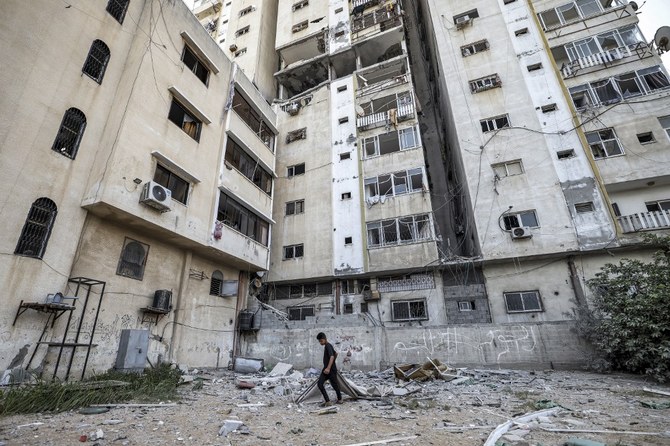

LONDON: An Israeli missile strike on a block of offices and apartments in Gaza City destroyed homes and killed innocents, the Daily Telegraph reported on Wednesday.
The newspaper’s on-the-ground correspondents James Rothwell and Siham Shamalakh reported from Palestine Tower, where residents were forced to “move in darkness” following an Israeli airstrike on Friday that left death and destruction.
The reporters found “clothes, sofas and other fragments of their lives … buried under collapsed walls.”
They added: “In one room, which belonged to a family of eight, blood is smeared across a wall. The air is heavy with smoke and an acrid, chemical smell which residents suspect was left by the missiles.”
The destruction came as Israel launched its biggest attack on the Palestinian territory since May 2021. The missile strike on Friday assassinated Tayseer Al-Jabari, a commander with Islamic Jihad.
Khalil Kanoon, who lives in the tower, told the Telegraph that he and his family were sitting down for lunch when the missiles hit. He reported seven missiles slamming into the building, where he lives with his family.
“My mother, my wife and I were in the kitchen and my children were playing in the bedroom,” said Kanoon.
“I was telling my wife that it seemed Israel was about to strike Gaza, and before I finished the sentence we heard a very big explosion and the windows blew out. There were screams and we heard explosions from every direction.”
Kanoon told the Telegraph that he and his family escaped the destruction, running through shattered glass barefoot, but his mother was wounded in the hand.
He added that the residents, left homeless and with little hope of urgent rehousing, were unaware that Al-Jabari was in the tower and were not pre-warned of the attack.
The airstrike on the tower was the opening attack in a three-day bombardment that killed 44 Palestinians, including 15 children, and injured hundreds.
Israel said it had intelligence of imminent attacks so had to launch the airstrike to stop Islamic Jihad from assaulting Israeli towns near the Gaza Strip.
The ceasefire, introduced on Sunday night, has done little to calm the frayed nerves of the tower’s residents.
Kanoon told the Telegraph: “We condemn this unjustified Israeli strike with so many bombs targeting civilians on a weekend, where they were not pre-warned. We are calling for the buildings to be rebuilt so we can go back to our apartments.”
He added: “The situation is very hard, some families will have to rent (elsewhere), some are staying with relatives and some have nowhere to go. We also want psychological support.”
The Telegraph also visited Shifa hospital in Gaza City, where doctors told the reporters that they were mostly treating lower-limb wounds and head injuries.
“The healthcare system is exposed to collapse, even if there had been no aggression. Every year it is worse,” said Dr. Hani Sami Al-Haytham, chairman of Shifa’s accident and emergency department.
He added: “The ultrasound was donated by the Red Cross, but it is out of order and we have no alternative because of the repeated power cuts ... If the power keeps going off this causes malfunctions.”
The Telegraph said several children had been left with life-changing injuries, including 11-year-old Rahaf Suleiman, whose feet and arm had to be amputated.
Ghassan Abu Ramadan, a 65-year-old retired engineer who was injured in the strikes, said: “You can’t imagine the explosion. We can’t believe we survived.”


