

Macro snapshot — Lending in China likely to slow down; German economy to lose $265bn

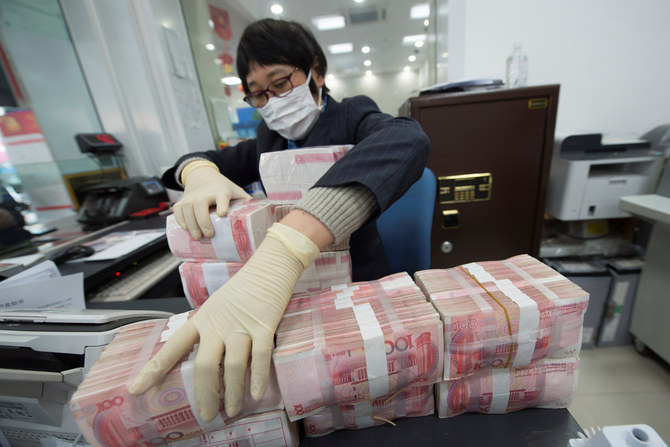
Chinese banks are estimated to have issued 1.10 trillion yuan ($162.81 billion) in net new yuan loans last month, less than half the 2.81 trillion yuan in June.
Short Url
Updated 09 August 2022
Follow

Macro snapshot — Lending in China likely to slow down; German economy to lose $265bn

CAIRO: China’s new yuan loans are expected to fall back in July after record lending in the first half, a Reuters poll showed, but they are still likely to exceed the year earlier amount as the central bank seeks to underpin the economic recovery.

Chinese banks are estimated to have issued 1.10 trillion yuan ($162.81 billion) in net new yuan loans last month, less than half the 2.81 trillion yuan in June, according to the median estimate in the survey of 23 economists.

It would still be higher than the 1.08 trillion yuan issued in the same month a year earlier.

German economy to lose $265bn

Germany’s economy will lose more than €260 billion ($265 billion) in added value by 2030 due to the Ukraine war and high energy prices, spelling negative effects for the labor market, according to a study by the Institute for Employment Research.

In comparison with expectations for a peaceful Europe, Germany’s price-adjusted gross domestic product will be 1.7 percent lower next year and there will be about 240,000 fewer people in employment, said the study published on Tuesday.

Romania inflation forecasts

Romania’s central bank has raised its annual inflation forecast for this year and next, but it should still be on a downward trend from the fourth quarter of 2022, Gov. Mugur Isarescu said on Tuesday.

Inflation is being driven primarily by supply-side shocks amplified by the war in Ukraine, he said.

The bank expects inflation to be at 13.9 percent in December, compared with a previous forecast of 12.5 percent.

Inflation hit 15.05 percent in June, a near 19-year high. Isarescu said inflation will start falling from the fourth quarter of this year and return to the bank’s 1.5 percent-3.5 percent target range in the second quarter of 2024.


(With input from Reuters) 


Saudi Arabia’s FMF concludes with over $26.6bn in agreements  

Updated 4 sec ago
Follow

Saudi Arabia’s FMF concludes with over $26.6bn in agreements  

RIYADH: Saudi Arabia said it secured more than SR100 billion ($26.6 billion) in agreements and memorandums of understanding at the fifth edition of the Future Minerals Forum, underscoring the Kingdom’s push to position mining as a key pillar of its economic diversification strategy. 

The forum, held in Riyadh under the patronage of King Salman bin Abdulaziz Al Saud, drew representatives from around 100 countries and attracted about 21,500 participants, according to the Ministry of Industry and Mineral Resources.  

The government has identified mining as a priority sector as it seeks to reduce reliance on oil and strengthen global supply chains for critical minerals. 

The agreements signed during the forum span the full mining value chain, including exploration, extraction, and mineral processing, as well as manufacturing, research and development, innovation, and sustainability.  

The ministry said the breadth of the deals highlights efforts to accelerate sector development while attracting long-term domestic and foreign investment.   

Participants included ministers, senior government officials, executives from major global mining companies, and investors, as well as academics and technical experts. More than 450 speakers took part in ministerial roundtables, panel discussions and technical sessions.  

An international exhibition formed a key part of the event, featuring 274 exhibitors from 13 countries, including Australia, the US, and the UK, as well as France, Germany, and several emerging mining markets.   

The exhibition was organized across four main zones covering exploration and mining, processing and manufacturing, advanced technologies and innovation, and investment and partnerships.  

Forum discussions focused on strengthening cross-border cooperation across mineral supply chains, accelerating exploration activity, and improving access to financing, as well as promoting sustainable and responsible mining practices.   

Sessions also examined the growing role of digital tools, automation and artificial intelligence in enhancing operational efficiency and decision-making in the sector.  

The ministry said the scale of agreements announced at the forum provides a foundation for sustained growth and supports the Kingdom’s long-term objective of becoming a global hub for mining and mineral processing, at a time of rising international demand for critical and strategic minerals.  

The ministry also highlighted the rapid evolution of the Future Minerals Forum over its five editions, describing it as a platform that has transitioned from a regional gathering into a global convening point for policymakers and industry leaders.