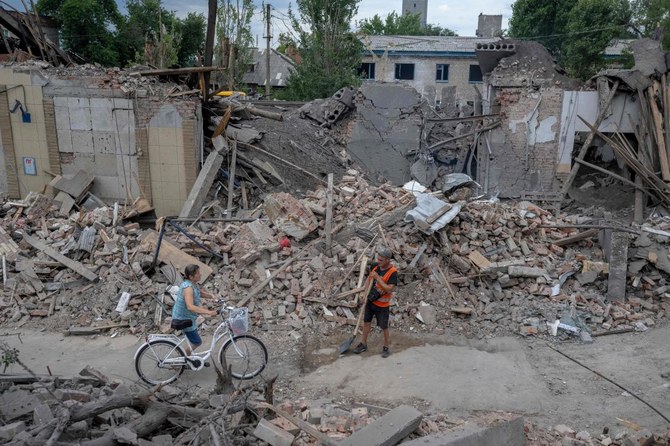
KYIV, Ukraine: Russian forces began an assault Saturday on two key cities in the eastern Donetsk region and kept up rocket and shelling attacks on other Ukrainian cities, including one close to Europe’s largest nuclear power plant, Ukraine’s military and local officials said.
Both cities of Bakhmut and Avdiivka have been considered key targets of Russia’s ongoing offensive across Ukraine’s east, with analysts saying Moscow needs to take Bakhmut if it is to advance on the regional hubs of Sloviansk and Kramatorsk.
“In the Donetsk direction, the enemy is conducting an offensive operation, concentrating its main efforts on the Bakhmut and Avdiivka directions. It uses ground attack and army aviation,” the Ukrainian General Staff said on Facebook.
The last Russian strike on Sloviansk was July 30, but Ukrainian forces are fortifying their positions around the city in expectation of new fighting.
“I think it won’t be calm for long. Eventually, there will be an assault,” Col. Yurii Bereza, head of the volunteer national guard regiment, told The Associated Press.
Russian shelling killed five civilians and injured 14 others in the Donetsk region in the last day, Donetsk governor Pavlo Kyrylenko wrote Saturday on Telegram, saying two people were killed in Poprosny, and one each in Avdiivka, Soledar and Pervomaiskiy.
The governor of the eastern Dnipropetrovsk region said three civilians were injured after Russian rockets fell on a residential neighborhood in Nikopol, a city across the Dnieper River from the Zaporizhzhia nuclear power station. The nuclear plant has been under Russian control since Moscow’s troops seized it early in the war.
“After midnight, the Russian army struck the Nikopol area with (Soviet-era) Grad rockets, and the Kryvyi Rih area from barrel artillery,” Valentyn Reznichenko wrote on Telegram.
Another Russian missile attack overnight damaged unspecified infrastructure in the regional capital of Zaporizhzhia. On Thursday, Russia fired 60 rockets at Nikopol, damaging 50 residential buildings in the city of 107,000 and leaving residents without electricity.
Rafael Grossi, head of the International Atomic Energy Agency, warned this week that the situation was becoming more perilous day by day at the Zaporizhzhia plant.
“Every principle of nuclear safety has been violated” at the plant, he said. “What is at stake is extremely serious.”
He expressed concern about the way the plant is being operated and the danger posed by the fighting going on around it. Experts at the US-based Institute for the Study of War said Russia is shelling the area intentionally, “putting Ukraine in a difficult position.”
The Ukrainian company operating the nuclear power station said Saturday that Russian troops are using the plant’s basement to hide from Ukrainian shelling and have barred its Ukrainian staff from going there.
“Ukrainian personnel do not yet have access to these premises, so in the event of new shelling, people have no shelter and are in danger,” Enerhoatom, a Ukrainian state enterprise, said on its Telegram channel.
Enerhoatom said Friday that Russian rockets had damaged the plant’s facilities, including a nitrogen-oxygen unit and a high-voltage power line. Local Russian-appointed officials acknowledged the damage, but blamed it on the Ukrainians.


Russian forces begin assault on two eastern Ukraine cities
https://arab.news/g26db
Russian forces begin assault on two eastern Ukraine cities

- The last Russian strike on Sloviansk was July 30, but Ukrainian forces are fortifying their positions around the city in expectation of new fighting


Modi’s rooftop solar push slowed by reluctant lenders, states
- The shortfalls represent the latest challenge to India’s efforts to nearly double clean energy capacity to 500 gigawatts by 2030
SINGAPORE/MUMBAI/BHUBANESWAR, India: Indian Prime Minister Narendra Modi’s push to accelerate the rollout of rooftop solar power is falling short of targets despite heavy subsidies due to loan delays and limited support from state utilities, vendors and analysts say.
The shortfalls represent the latest challenge to India’s efforts to nearly double clean energy capacity to 500 gigawatts by 2030, and come as the government plans to suspend clean energy tendering targets amid a mounting backlog of awarded projects yet to be built.
Challenges to plans to increase solar uptake may mean India maintains its reliance on coal-fired power.
India’s Ministry for New and Renewable Energy created its subsidy program for residential solar panel installations in February 2024, covering up to 40 percent of the costs.
But residential installations at 2.36 million are well below the ministry’s target of 4 million by March, according to data from the program’s website.
“Banks’ reluctance to lend and states’ hesitance to promote the schemes could derail India’s efforts to transition away from coal,” said Shreya Jai, the lead energy analyst at research firm Climate Trends in New Delhi.
Roughly three in five rooftop solar applications filed on the scheme’s website are yet to be approved while about 7 percent have been rejected, according to government data on the program, known as the PM Surya Ghar.
In a statement to Reuters about the pending applications, the renewable energy ministry pointed to accelerating installations which have benefited over 3 million households, and said the scheme enables state-owned utilities to reduce subsidy payouts to keep residential power bills in check.
“The loan rejection rate varies across states,” the statement said.
Under PM Surya Ghar, consumers apply and select a vendor who handles paperwork and arranges bank financing for solar panels. After loan approval and installation, the vendor submits proof, after which the government subsidy is credited to the bank.
BANK DELAYS
However, banks have been rejecting or delaying loans for numerous reasons including lack of documentation, which they say is necessary to protect public funds.
“We are working with the government to push for some standard documentation, because it is necessary to avoid bad loans. Currently if loans go bad, banks can take away these panels but what will we do with these panels?” said a senior official at a major government-owned bank.
Chamrulal Mishra, a solar vendor in the eastern Indian state of Odisha, said applications are often rejected because the customer has missed electricity payments or because land records are still in the name of deceased relatives.
Residents there dispute the claims that they have missed payments, which they attribute to administrative errors after a change in utility ownership decades prior.
A spokesperson for India’s Department of Financial Services, which regulates the country’s banks, said they have responded to consumer feedback to allow co-applicants for loans to clear up title claims and the simplification of documentation requirements.
The Renewable Energy Association of Rajasthan said some banks are making collateral demands for loans under 200,000 Indian rupees ($2,208.87), despite scheme guidelines not requiring them to, which is constraining solar power additions.
State Bank of India and Punjab National Bank, some of the country’s largest lenders, did not reply to requests for comment on the matter.
State-owned utilities are also not promoting rooftop solar as much, as they are concerned about the loss of revenue as sales move off the electric grid.
“Wealthier households typically have high electricity consumption, tariffs and reliable roof access. When they shift from the grid, it leaves a larger financial burden,” said Niteesh Shanbog, an analyst at Rystad Energy.