

Pakistan imposes ‘monsoon emergency’ as rains kill over 550 since mid-June

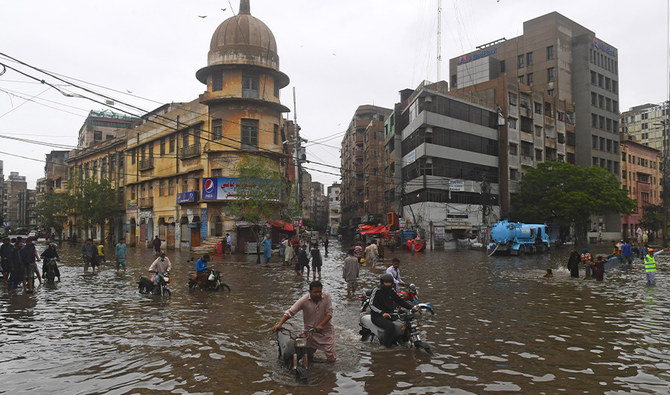
People wade across a flooded street after heavy monsoon rainfall in Karachi on July 25, 2022. (AFP)
Short Url
Updated 18 August 2022
Follow

Pakistan imposes ‘monsoon emergency’ as rains kill over 550 since mid-June

  • The country’s meteorological department has predicted more downpour for the coming week
  • Data show Pakistan received 133 percent more rain in recent weeks than its 30-year average

ISLAMABAD: The government has announced “monsoon emergency” in Pakistan after the country experienced heavy rainfall in recent weeks and witnessed flash floods in different areas that claimed hundreds of lives and destroyed infrastructure.
According to the official statistics compiled by the National Disaster Management Authority (NDMA), at least 550 people have lost their lives in rains since the beginning of the monsoon season in mid-June.
The Pakistan Meteorological Department (PMD) also announced on Saturday the country was likely to be lashed with more rains in the coming weeks that were going to trigger floods in several areas, including the southwestern Balochistan province and Karachi city.
“Pakistan’s cabinet has declared a monsoon emergency but now we need to brace for the next round of rain torrents,” federal minister for climate change Sherry Rehman said in a Twitter post on Friday night.
She informed the decision was going to be implemented from Saturday.
“All provinces and district administrations, NDMA & PDMAs need to act now to take as many preventive measures as possible,” Rehman added.

The climate change minister urged people to be cautious while going out in rain.
“Travelers and tourists too should plan their trips according to updates from PMD,” she noted. “Many areas of Balochistan, Sindh [are] still waterlogged. Rain may also trigger landslides in hilly areas like Kashmir, Murree, KP [Khyber Pakhtunkhwa].”

The NDMA said in a Twitter post on Friday 133 percent more rainfall was witnessed across the country in comparison to its 30-year average record.
Mentioning the worst hit areas in the country, it said that Balochistan and Sindh received 305 and 218 percent more rain, respectively, during the ongoing monsoon season.
The Pakistan army and other government agencies have set up aid and relief camps in flood-affection regions where they have been relocating families to safer places.
The country also witnessed heavy rains and floods in 2010 which affected the lives of nearly 20 million in the country. The damage to the national infrastructure ran into billions of dollars back then. Huge swathes of crops were also destroyed as one-fifth of the country was inundated.


Pakistan PM calls for faster CPEC implementation, pledges security for Chinese workers

Updated 27 February 2026
Follow

Pakistan PM calls for faster CPEC implementation, pledges security for Chinese workers

  • Shehbaz Sharif pushes expanded cooperation in agriculture, IT and mining under CPEC phase two
  • Chinese envoy reaffirms Beijing’s support for Pakistan’s sovereignty and economic development

ISLAMABAD: Prime Minister Shehbaz Sharif on Friday called for speeding up projects under the China-Pakistan Economic Corridor (CPEC) and pledged stronger security guarantees for Chinese workers and investments, during a meeting with China’s ambassador in Islamabad.

Sharif made the remarks as the two countries strive to launch the second phase of CPEC, a multibillion-dollar infrastructure and energy initiative launched in 2015 as part of China’s Belt and Road Initiative (BRI).

CPEC’s first phase focused largely on power generation and transport infrastructure aimed at easing Pakistan’s chronic energy shortages and improving connectivity. The second phase seeks to expand cooperation into industrial development, with an emphasis on special economic zones and export-oriented growth.

“While highlighting the importance of accelerating ongoing CPEC projects, the Prime Minister stressed on the need to enhance cooperation in agriculture and IT and mining & minerals,” said a statement circulated by the PM Office after the meeting.

“He also underscored Pakistan’s resolve to provide a secure and conducive environment for Chinese personnel, investments, and institutions in Pakistan,” it added.

Chinese nationals and projects in Pakistan have faced security threats in the past, including attacks by militant groups targeting infrastructure sites and convoys. Islamabad has repeatedly vowed to tighten security and has deployed special protection units for Chinese workers.

China is Pakistan’s closest ally in the region and a key economic partner, with CPEC widely regarded by Islamabad as central to long-term economic growth.

During the meeting, the prime minister conveyed greetings to Chinese President Xi Jinping and Premier Li Qiang, particularly on the occasion of the Chinese New Year.

China’s Ambassador to Pakistan, Jiang Zaidong, reiterated Beijing’s support for Pakistan’s sovereignty and socioeconomic development, according to the statement. Both sides also exchanged views on regional and international issues and agreed to maintain close coordination.