Marcos says Taiwan tension underscores importance of Philippines-US ties as Blinken visits

1 / 2
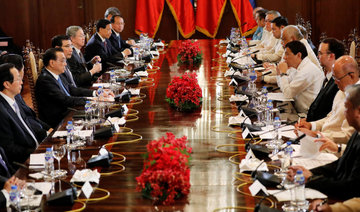
US Secretary of State Antony Blinken meets with Philippine President Ferdinand Marcos Jr. at the Malacanang Palace in Manila on Aug. 6, 2022. (Andrew Harnik/Pool via REUTERS)
2 / 2
Philippine President Ferdinand Marcos Jr. welcomes US Secretary of State Antony Blinken (R) at Malacanang Palace in Manila on Aug. 6, 2022. (Photo by Andrew Harnik / POOL / AFP)
Short Url
Updated 06 August 2022
Follow

Marcos says Taiwan tension underscores importance of Philippines-US ties as Blinken visits

  • Philippines foreign minister says country can ill-afford escalating tension in region
  • US Secretary of State said America is committed to defense pact with Manila

MANILA: President Ferdinand Marcos Jr. said on Saturday that Philippines-US ties are important in the face of a “volatile” geopolitical situation, as he hosted US Secretary of State Anthony Blinken in Manila amid rising tensions in the region.

Blinken, the highest-ranking American official to visit the Philippines since Marcos took office on June 30, was on a visit to the Southeast Asian country just days after US House Speaker Nancy Pelosi visited Taiwan earlier this week, a move that had further strained US-China relations and led to fresh tensions in the Indo-Pacific.

Following Pelosi’s controversial visit to the self-ruled island, which is just north of the archipelago nation, the Philippine government had urged restraint and reiterated its adherence to the One-China policy, a diplomatic acknowledgement of China’s position that there is only one Chinese government.

As Marcos welcomed Blinken at the presidential palace in Manila, the Philippine leader touched on Pelosi’s visit and the war in Ukraine, which he said demonstrated “how volatile the international diplomatic scene” has been across the globe.

“This just points to the fact of the importance of the relationship between the United States and the Republic of the Philippines,” Marcos said.

“I hope that we will continue to evolve that relationship in the face of all the changes that we have been seeing.”

Blinken’s trip was timely, the president added, with Pelosi’s visit to Taiwan conveying the intensity of the situation.

“I do not think, to be perfectly candid — I did not think it raised the intensity; it just demonstrated how the intensity of the conflict has been,” he said.

Beijing, which viewed Pelosi’s visit as “a gross interference in China’s internal affairs,” had launched military exercises just off Taiwan’s coast on Thursday, and later cut off contacts with the US on vital issues, including military and climate cooperation.

The Philippines is Taiwan’s second-closest neighbor after China.

Manila has maintained close business and cultural ties with the island over the years, though formal diplomatic relations were severed in 1975.

Marcos also said that the Philippines-US Mutual Defense Treaty is in “constant evolution,” referring to a 70-year-old defense pact stipulating that Manila and Washington would support each other in the events that either were attacked by an external party.

The US is committed to the pact and hopes to deepen economic relations with the Philippines, Blinken said, especially considering the impacts of the COVID-19 pandemic.

“The alliance is strong, and I believe can grow even stronger,” he said. “We’re committed to the Mutual Defense Treaty. We’re committed to working with you on shared challenges.”

The Philippines has had a history of strained ties with China over territorial disputes in the South China Sea, with former President Rodrigo Duterte having embraced a Beijing-friendly direction while attempting to distance the Philippines from its colonial master the US during his six-year term in office.

As both powers attempt to boost influence in the region, in July China’s Foreign Minister Wang Yi was the first top foreign official to make a working trip to Manila since Marcos took office.

A visit to Washington to meet US President Joe Biden might be happening in the near future for Marcos, Philippine Secretary of Foreign Affairs Enrique A. Manalo said, as officials are in the middle of hashing out details for the potential trip.

The Philippines has looked “to the big powers to calm the waters and keep the peace,” Manalo said, as he touched on the importance of maintaining lines of communication “as a way of trying to prevent matters from escalating and reducing tensions” in the Taiwan strait.

“We can ill afford further escalation of tensions in the region,” Manalo said.


AI reshaping the battle over the narrative of Maduro’s US capture

Updated 7 sec ago
Follow

AI reshaping the battle over the narrative of Maduro’s US capture

  • Since the US captured Venezuelan leader Nicolas Maduro in early January, pictures and videos chronicling the events have been crowded out by those generated with artificial intelligence
CARACAS: Since the US captured Venezuelan leader Nicolas Maduro in early January, pictures and videos chronicling the events have been crowded out by those generated with artificial intelligence, blurring the lines between fiction and reality.
The endless stream of content ranges from comedic memes to dramatic retellings.
In one, a courtroom illustration of Maduro in a New York courthouse springs to life and announces: “I consider myself a prisoner of war.”
In another, an AI-generated Maduro attempts to escape a US prison through an air duct, only to find himself in a courtroom with US President Donald Trump, where they dance with a judge and an FBI agent to a song by American rapper Ice Spice.
Maduro was captured alongside his wife Cilia Flores during US strikes in the Venezuelan capital of Caracas on January 3.
They have since been taken to a prison in New York where they are being held on drug trafficking charges.
While some have celebrated Maduro’s ouster, the “Chavismo” movement he leads — named after his predecessor Hugo Chavez — has worked to reframe what his fall means for Venezuela’s future.
- ‘ Confuse, combat, and silence’ -
Leon Hernandez, a researcher at Andres Bello Catholic University, told AFP that with AI’s rapid creation of content, we see development of “disinformation labs” that flood social media platforms.
“There were things that circulated that were not real during the capture (of Maduro), and things that circulated which were real that generated doubt,” Hernandez said.
“That was the idea: to create confusion and generate skepticism at the base level by distorting certain elements of real things.”
The goal, he added, is for the content to overwhelm audiences so they cannot follow it.
Even legacy media such as the Venezuelan VTV television channel are in on it, with the broadcaster playing an AI-animated video narrated by a child recounting Maduro’s capture.
“AI has become the new instrument of power for autocrats to confuse, combat, and silence dissent,” said Elena Block, a professor of political communication and strategy at the University of Queensland in Australia.
- ‘Greatest threat to democracy’ -
Block pointed out the use of cartoons, specifically, had been a medium of propaganda used in both authoritarian and democratic states.
Long before his arrest, Maduro was depicted as the illustrated superhero “Super Bigote” or “Super Mustache,” donning a Superman-like suit and fighting monsters like “extremists” and the “North American empire.”
The cartoon’s popularity spawned toys that have been carried by Maduro’s supporters during rallies advocating for his return.
And much like his predecessor, Maduro continued a practice of “media domination” to stave off traditional media outlets from airing criticism of Chavismo.
“With censorship and the disappearance or weakening of news media, social media has emerged as one of the only spaces for information,” Block said.
Maduro is not the only leader to use AI propaganda — Trump has frequently posted AI-generated pictures and videos of himself with “antagonistic, aggressive, and divisive language.”
“These digital and AI tools end up trivializing politics: you don’t explain it, you diminish it,” Block said. “AI today is the greatest threat to democracy.”