

US condemns as ‘provocative’ China’s firing of missiles around Taiwan over Pelosi visit

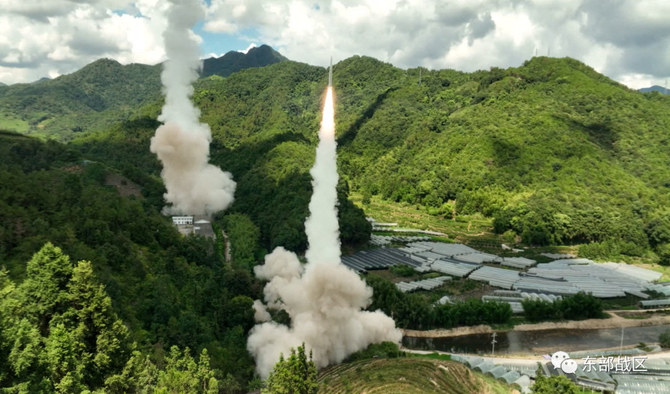
China's army fires missile into the waters off the eastern coast of Taiwan from an undisclosed location in this handout released on Aug. 4, 2022. (REUTERS)
Short Url
Updated 05 August 2022
Follow

US condemns as ‘provocative’ China’s firing of missiles around Taiwan over Pelosi visit

  • Tokyo lodges diplomatic protest with Beijing, saying five of the missiles reached Japanese exclusive economic zone
  • Taiwan said the Chinese military fired 11 ballistic missiles “in several batches”

PINGTAN, China: The US on Thursday denounced as an "overreaction" and "provocative China's show of force after the Asian superpower fired ballistic missiles and deployed fighter jets around Taiwan, in an angry response over the visit of US House Speaker Nancy Pelosi to the island.

“China has chosen to overreact and use the speaker’s visit as a pretext to increase provocative military activity in and around the Taiwan Strait,” White House spokesman John Kirby told reporters.

“The temperature’s pretty high,” but tensions “can come down very easily by just having the Chinese stop these very aggressive military drills,” he added.

China launched a series of exercises in multiple zones around Taiwan, straddling some of the busiest shipping lanes in the world and at some points just 20 kilometers (12 miles) from the island’s shore on Thursday following Pelosi's stunt.

The US House speaker was the highest-profile US official to visit Taiwan in years, defying a series of stark threats from Beijing, which views the self-ruled island as its territory.

The drills began around 12 noon local time (0400 GMT), and involved a “conventional missile firepower assault” in waters to the east of Taiwan, the Chinese military said.

Taiwan said the Chinese military fired 11 Dongfeng-class ballistic missiles “in several batches” and condemned the exercises as “irrational actions that undermine regional peace.”
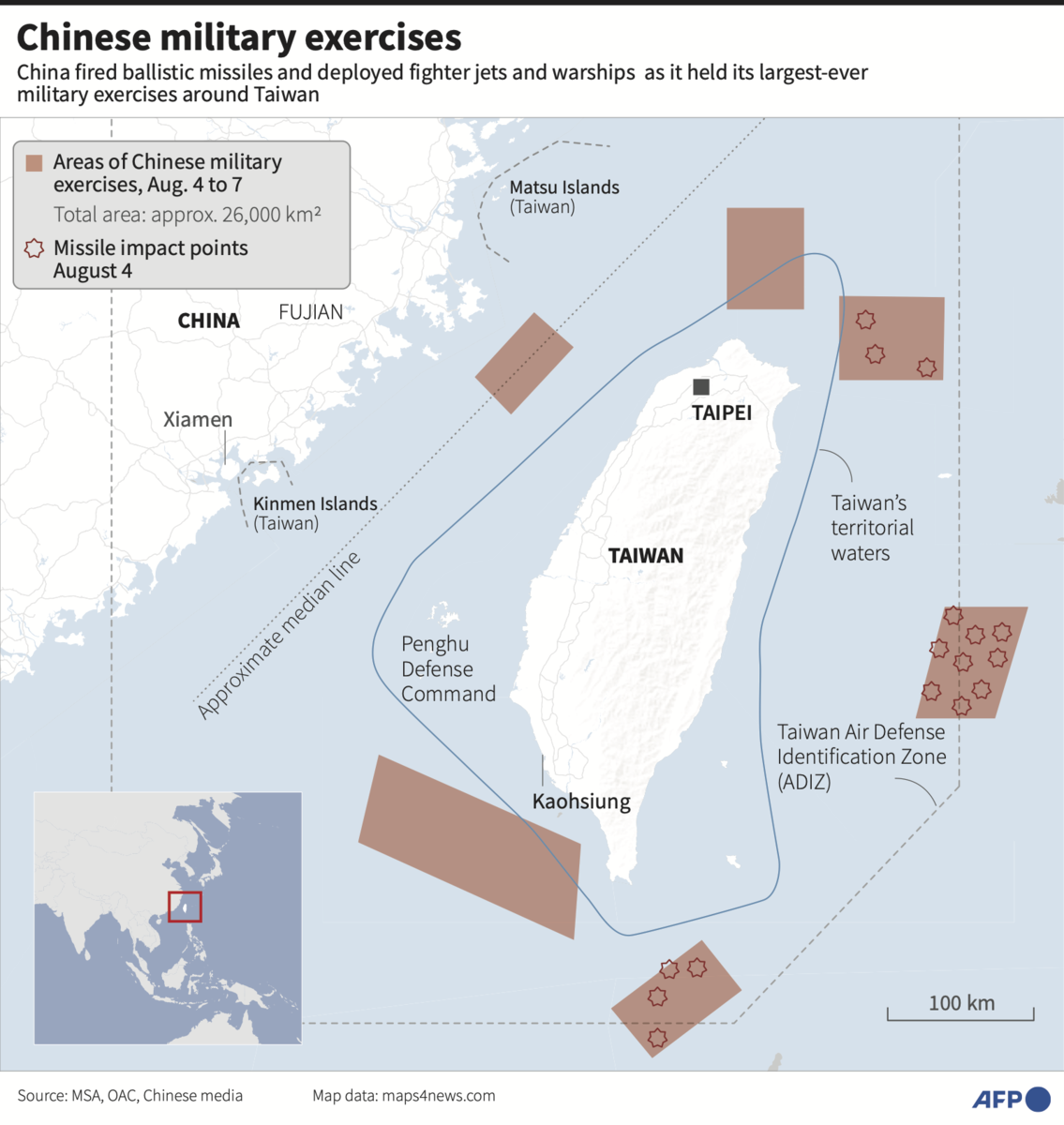
Taipei did not say where the missiles landed or whether they flew over the island.

But Japan, a key US ally, said that of the nine missiles it had detected, four were “believed to have flown over Taiwan’s main island.”

Tokyo has lodged a diplomatic protest with Beijing over the exercises, with Defense Minister Nobuo Kishi saying five of the missiles were believed to have landed in his country’s exclusive economic zone.

Taipei’s defense ministry said it had detected 22 Chinese fighter jets briefly crossing the Taiwan Strait’s “median line” during Thursday’s exercises.

AFP journalists on the border island of Pingtan saw several small projectiles flying into the sky followed by plumes of white smoke and loud booming sounds.

On the mainland, at what is said to be China’s closest point to Taiwan, AFP saw a batch of five military helicopters flying at a relatively low altitude near a popular tourist spot.

Beijing has said the drills will last until midday on Sunday.

Beijing has defended the drills as “necessary and just,” pinning the blame for the escalation on the United States and its allies.
“In the face of this blatant provocation, we have to take legitimate and necessary countermeasures to safeguard the country’s sovereignty and territorial integrity,” foreign ministry spokeswoman Hua Chunying said at a regular briefing Thursday.
Military analysts told Beijing’s state broadcaster CCTV that the goal was to practice a possible blockade of the island and contain its pro-independence forces.
“The purpose is to show that the PLA is capable of controlling all the exits of the Taiwan Island, which will be a great deterrent to ‘Taiwan independence’ secessionist forces,” said Zhang Junshe, a senior researcher at China’s Naval Research Institute.
US Secretary of State Antony Blinken said Washington had contacted Beijing “at every level of government” in recent days to call for calm and stability.
“I hope very much that Beijing will not manufacture a crisis or seek a pretext to increase its aggressive military activity,” Blinken told ministers from the 10-member Association of Southeast Asian Nations (ASEAN) in Phnom Penh.

'Stop it', says Japan

Speaking at the same meeting, Japan’s foreign minister called for an “immediate stop” to China’s military drills near Taiwan.
“China’s actions this time have a serious impact on the peace and stability of the region and the international community,” Yoshimasa Hayashi told reporters.
The manoeuvers are taking place along some of the busiest shipping routes on the planet, used to supply vital semiconductors and electronic equipment produced in East Asian factory hubs to global markets.
Taiwan’s Maritime and Port Bureau has issued warnings to ships to avoid the areas being used for the Chinese drills.
The Taiwanese cabinet said the drills would disrupt 18 international routes passing through its flight information region (FIR).
Taiwan’s 23 million people have long lived with the possibility of an invasion, but that threat has intensified under President Xi Jinping, China’s most assertive ruler in a generation.
Analysts said the Chinese leadership is keen to project strength ahead of a crucial ruling party meeting this autumn at which Xi is expected to be given an unprecedented third term, but that China is not aiming to escalate the situation beyond its control — at least for now.
Titus Chen, an associate professor of political science at the National Sun Yat-Sen University in Taiwan, said: “The last thing Xi wants is an accidental war.”


Venezuela begins ‘large’ prisoner release amid US pressure

Updated 4 sec ago
Follow

Venezuela begins ‘large’ prisoner release amid US pressure

  • The releases are the first since Maduro’s former deputy Delcy Rodriguez took over, with the backing of President Donald Trump
  • The releases were announced by Rodriguez’s brother, parliament speaker Jorge Rodriguez

CARACAS: Venezuela on Thursday began releasing a “large number” of political prisoners, including several foreigners, in an apparent concession to the United States after its ouster of ruler Nicolas Maduro.
The releases are the first since Maduro’s former deputy Delcy Rodriguez took over, with the backing of President Donald Trump, who says he is content to let her govern as long as she gives Washington access to oil.
The White House credited Trump with securing the prisoners’ freedom.
“This is one example of how the president is using maximum leverage to do right by the American and Venezuelan people,” Deputy Press Secretary Anna Kelly said in a statement to AFP.
The releases were announced by Rodriguez’s brother, parliament speaker Jorge Rodriguez, a key figure in “chavismo,” the anti-US socialist movement founded by Maduro’s predecessor Hugo Chavez.
He said “a large number of Venezuelan and foreign nationals” were being immediately freed for the sake of “peaceful coexistence.”
He did not say which prisoners would be released, nor how many or from where.
Renowned Spanish-Venezuelan activist Rocio San Miguel, imprisoned since February 2024 over a purported plot to assassinate Maduro, was among five Spanish citizens freed, according to Spain’s foreign ministry.
Security was stepped up Thursday afternoon outside the notorious El Helicoide detention center in Caracas, used by the intelligence services to jail political and other prisoners.
Miguel was held in El Helicoide after her arrest.
Leading opposition figure Alfredo Diaz, who died in December in custody, was also held at the facility.
Families gathered outside on Thursday for news of their loved ones.
“I’m nervous. Please God may it be reality,” the mother of a detained activist from the party of opposition leader Maria Corina Machado told AFP.
On Tuesday, Trump had told Republican lawmakers that Rodriguez’s administration was closing a torture chamber “in the middle of Caracas” but gave no further details.
His remarks had sparked speculation that Venezuelan authorities had agreed to close El Helicoide.
Venezuelan rights NGO Foro Penal estimates over 800 political prisoners are languishing in the country’s jails.
It welcomed the government’s plans to liberate some of them but was still verifying releases.
As tensions with Washington climaxed in the past month Venezuela had already released dozens of dissenters in two phases.

- Trump rebuked by Senate -

Thursday’s move by Caracas came as Trump suggested the United States could run Venezuela and tap into its oil reserves for years.
Shortly after Maduro’s seizure in US airstrikes and a special forces raid that left 100 people dead, according to Caracas, Trump announced that the US would “run” the Caribbean country for a transitional period.
“Only time will tell” how long Washington will demand direct oversight of the country, he told The New York Times in an interview published Thursday.
When asked whether that meant three months, six months or a year, he replied: “I would say much longer.”
Meanwhile, the US Senate on Thursday took a major step toward passing a resolution to rein in military actions against Venezuela.
The Democratic-led legislation, expected to pass a vote next week, reflects widespread disquiet among lawmakers over Saturday’s secretive capture of Maduro, conducted without their express approval.
It is expected to face resistance in the Republican-dominated House, however.

- Millions of barrels of crude -

Oil has emerged as the key to US control over Venezuela, which has the world’s largest proven reserves.
Trump announced a plan earlier this week for the United States to sell between 30 million and 50 million barrels of Venezuelan crude, with Caracas then using the money to buy US-made products.
Delcy Rodriguez on Wednesday called the US attack to depose Maduro, who was taken to New York with his wife to face trial on drugs charges, a “stain” on relations with the United States.
But she also defended the planned oil sales to Washington.
On the streets of Caracas, opinions remain mixed about the plan.
“I feel we’ll have more opportunities if the oil is in the hands of the United States than in the hands of the government,” said Jose Antonio Blanco, 26.
The Wall Street Journal reported that Trump, who will meet oil executives on Friday, is also considering a plan for the US to exert control over Venezuela’s state oil company PDVSA.
Trump has warned Rodriguez she will pay “a very big price, probably bigger than Maduro” if she does not comply with his agenda.
“Her power comes from Washington, not from the internal structure. If Trump decides she’s no longer useful, she’ll go like Maduro,” Venezuela’s former information minister Andres Izarra told AFP in an email.