

Sri Lanka leader proposes plan to rebuild bankrupt economy by 2048

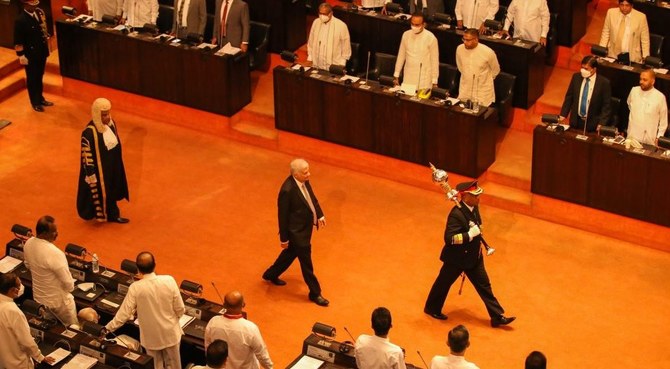
Sri Lankan President Ranil Wickremesinghe along with Speaker Mahinda Yapa Abeywardena at a session of Parliament in Colombo, Aug. 3, 2022. (AFP)
Short Url
Updated 03 August 2022
Follow

Sri Lanka leader proposes plan to rebuild bankrupt economy by 2048

  • Ranil Wickremesinghe gives first policy statement since taking office last month
  • President says Sri Lanka facing ‘unprecedented situation,’ country ‘in great danger’

COLOMBO: Sri Lanka’s president announced on Wednesday a national policy to rebuild the bankrupt economy by 2048, at a time when rampant food inflation and chronic shortages are making daily life a battle for millions of the country’s citizens.

The south Asian nation is bankrupt and in April suspended repayments on its $51 billion foreign loans, as the inflation rate continued to soar. It surged to a record 60.8 percent in July, with a 90.9 percent climb in food inflation, according to government data.

President Ranil Wickremesinghe, 73, announced the plan in his first policy statement since taking office last month, after his predecessor, Gotabaya Rajapaksa, fled the country and then quit following mass protests over the worst economic meltdown since the 22 million-populated nation’s independence from Britain 1948.

As he announced his Cabinet’s economic policy, Wickremesinghe said Sri Lanka was facing an “unprecedented situation” unlike anything in recent history and was “in great danger.”

“We have examined this situation in depth. As a remedy, we are preparing a national economic policy for the next 25 years,” he told parliament. “If we build the country, the nation, and the economy through the national economic policy, we would be able to become a fully developed country by the year 2048, when we celebrate the 100th anniversary of independence.”

The economic policy, he said, “lays the foundation for a social market economic system, securing development for the poor and underprivileged groups and encouraging small and medium entrepreneurs.

“Our aim is to create a surplus in the primary budget by the year 2025. Our effort is to raise the economic growth rate to a stable stage, in order to establish a solid economic foundation by the year 2026. Currently, public debt is 140 percent of gross domestic product. Our plan is to bring this down to less than 100 percent by the year 2032.”

The plan did not focus on immediate relief to millions of people who since March have been taking to the streets to protest daily power cuts and shortages of basic commodities such as fuel, food, and medicines, as the country had run out of foreign currency reserves, leaving it unable to pay for imports.

Murtaza Jafferjee, economist and chairman of the Colombo-based think tank Advocata Institute, described the president’s 25-year policy as more of an “aspirational plan.”

“The need of the hour is macro stabilization but what he is implying is that we should not look only for short-term fixes but fundamentally change the way the economy works so that it can catalyze a virtual cycle of growth,” Jafferjee told Arab News.

“He did say that they will try to address the most acute shortages but warned not to expect quick results, for example, the availability of fuel. It will take a few years before we get back to normalcy, but things will slowly improve.”

S.A. Azeez, ACMA chartered accountant and management consultant, told Arab News that he was skeptical as to whether any immediate relief would be seen soon.

“I don’t think that people will get any immediate relief with such plans. In the short-term, implementation of such plans will be painful though long term would be beneficial to the country,” he said, adding that any country should have a long-term economic policy framework.

“Though late, it is good even now to initiate such a policy framework and long-term economic plans. The implementations may be very challenging in the present context since the need of the hour is providing necessities to society and keep the economy running.”

The government has been in bailout talks with the International Monetary Fund but has so far reached no agreement as it is still setting out its debt restructuring plan. Wickremesinghe said the plan would be submitted to the IMF “in the near future” with negotiation scheduled for this month.


Indian writer Arundhati Roy pulls out of Berlin Film Festival over Gaza row

Updated 4 sec ago
Follow

Indian writer Arundhati Roy pulls out of Berlin Film Festival over Gaza row

  • Writer pulls out after jury president Wim Wenders said cinema should 'stay out of politics' when asked about Gaza
  • Booker Prize winner describes Israel’s actions in Gaza as 'a genocide of the Palestinian people'
BERLIN: Award-winning Indian writer Arundhati Roy said Friday she was withdrawing from the Berlin Film Festival over jury president Wim Wenders’s comments that cinema should “stay out of politics” when he was asked about Gaza.
Roy said in a statement sent to AFP that she was “shocked and disgusted” by Wenders’s response to a question about the Palestinian territory at a press conference on Thursday.
Roy, whose novel “The God of Small Things” won the 1997 Booker Prize, had been announced as a festival guest to present a restored version of the 1989 film “In Which Annie Gives It Those Ones,” in which she starred and wrote the screenplay.
However, she said that the “unconscionable” statements by Wenders and other jury members had led her to reconsider, “with deep regret.”
When asked about Germany’s support for Israel at a press conference on Thursday, Wenders said: “We cannot really enter the field of politics,” describing filmmakers as “the counterweight to politics.”
Fellow jury member Ewa Puszczynska said it was a “little bit unfair” to expect the jury to take a direct stance on the issue.
Roy said in her statement that “to hear them say that art should not be political is jaw-dropping.”
She described Israel’s actions in Gaza as “a genocide of the Palestinian people by the State of Israel.”
“If the greatest film makers and artists of our time cannot stand up and say so, they should know that history will judge them,” she said.
Roy is one of India’s most famous living authors and is a trenchant critic of Prime Minister Narendra Modi’s government, as well as a firm supporter of the Palestinian cause.

Shying away from politics

The Berlinale traditionally has a reputation for topical, progressive programming, but so far this year’s edition has seen several stars shy away from taking a stance on the big political issues of the day.
US actor Neil Patrick Harris, who stars in the film “Sunny Dancer” being shown in the festival’s Generation section, was asked on Friday if he considered his art to be political and if it could help “fight the rise of fascism.”
He replied that he was “interested in doing things that are apolitical” and which could help people find connection in our “strangely algorithmic and divided world.”
This year’s Honorary Golden Bear recipient, Malaysian actor Michelle Yeoh, also demurred when asked to comment on US politics in a press conference on Friday, saying she “cannot presume to say I understand” the situation there.
This isn’t the first edition of the festival to run into controversy over the Gaza war.
In 2024 the festival’s documentary award went to “No Other Land,” a portrayal of the dispossession of Palestinian communities in the Israeli-occupied West Bank.
German government officials criticized “one-sided” remarks about Gaza by the directors of that film and others at that year’s awards ceremony.
The war in Gaza was sparked by Hamas’s October 7, 2023 attack on Israel, which resulted in the deaths of 1,221 people, according to an AFP tally based on official Israeli figures.
Israel’s retaliation has left at least 71,000 people dead in Gaza, according to the health ministry in the Hamas-run territory, whose figures the UN considers reliable.