Sri Lanka cracks down on protesters under emergency rule

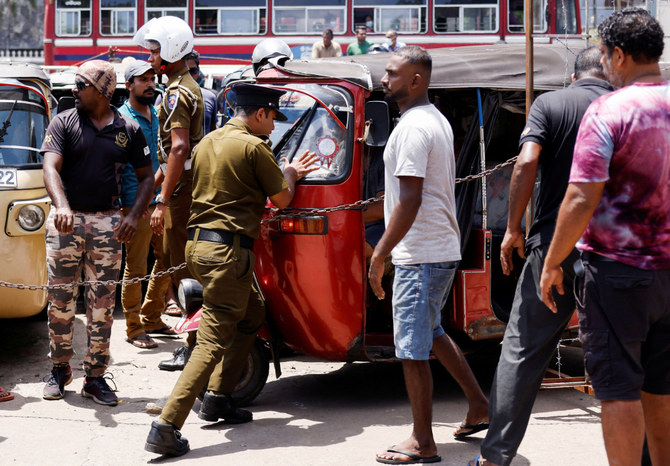
A police officer pushes back a three-wheeler which tries to break the rule to get into a fuel station from outside, amid the country's economic crisis, in Colombo, Sri Lanka, July 26, 2022. (REUTERS)
Short Url
Updated 29 July 2022
Follow

Sri Lanka cracks down on protesters under emergency rule

  • 23 face charges of theft, property damage, obstructing government offices Activists accuse President Ranil Wickremesinghe of trying to crush dissent

COLOMBO: Security forces in Colombo have arrested 23 protesters in the past two days, police said on Friday, after parliament extended a state of emergency giving troops sweeping powers to question and detain people.

Anti-government protests in the island nation of 22 million started in March and have spread across the country.

People are struggling with daily power cuts and shortages of basic commodities such as fuel, food and medicines, as Sri Lanka runs out of foreign currency reserves, leaving it unable to pay for imports.

Former President Gotabaya Rajapaksa fled the country earlier this month, after protesters stormed his home and presidential offices, demanding his resignation. His successor, Ranil Wickremesinghe, has been viewed as an ally of Rajapaksa, and his appointment has triggered more protests.

Wickremesinghe set out emergency rule orders when he assumed office last week — a move that lawmakers kept in place on Wednesday.

“We have arrested 23 people so far, everyone was produced before court,” Nihal Thalduwa, Sri Lanka police spokesperson, told Arab News.

He said the suspects have been charged with damaging property, obstructing government offices and theft.

“We don’t arrest peaceful protesters since they are well within the law. We have arrested the people who have exceeded their limits and committed various other offenses.”

The crackdown and emergency laws come after Wickremesinghe had sworn in a new government last week, retaining previous ministers in his new Cabinet despite an earlier promise to reach a consensus on the establishment of an all-party interim administration.

The military has since raided and dismantled camps the protesters had set up for more than 100 days opposite the president’s office — the main site of demonstrations.

Protesters continued to come onto the streets in different areas of Colombo and said their agitation has been peaceful, with the recent arrests not taking place at the demonstration sites.

“There were no clashes with the government forces,” Namal Jayaweera, a leader of the protest movement, told Arab News.

“They go home and arrest certain protesters.”

The new president was “using all his executive powers to crush the protesters,” Jayaweera alleged.

“Ranil (Wickremesinghe) is only a deal maker, we cannot accept him unless he forms an all-party interim government.”

Sri Lanka is bankrupt and has suspended repayment on its $51 billion foreign loans, as the inflation rate continues to soar.

It surged to a record 60.8 percent in July, with a 90.9 percent climb in food inflation, the statistics department said on Friday.

The government is in the process of preparing a debt restructuring plan, a condition for an International Monetary Fund bailout.


Morocco's cereals harvest expected to double after wet winter

Updated 13 sec ago
Follow

Morocco's cereals harvest expected to double after wet winter

RABAT: Moroccan grains traders and millers ‌expect Morocco to double its cereals harvest this season after abundant winter rains, with limited impact from floods in the northwestern plains of the North African country, which is ​a major grains importer.
Industry leaders plan to add domestic wheat to strategic reserves this year "without compromising imports", said Moulay Abdelkader Alaoui, head of the federation of industrial millers FNM, who expects a domestic harvest of 6 million metric tons.
"We expect a good cereals harvest this year of 8 to 9 million tons, including around 5 million tons of soft wheat," Omar Yacoubi, head of Morocco's wheat trading federation FNCL, told Reuters. The previous harvest was ‌4.4 million ‌tons, including 2.4 million tons of soft wheat.
Morocco traditionally ​cancels ‌its ⁠wheat ​import subsidy ⁠and reinstates customs duties to protect the local harvest.
But this year importers, millers and traders have asked the government to extend the subsidy window to June 1, instead of May 1, to compensate for costs incurred due to bad weather.
Rainfall this winter was 34% above the 30-year average and triple the previous year's levels, while dam filling rates improved to 70% from about 25%, ⁠agriculture ministry data shows, while the total grain-planted area rose ‌to 3.7 million hectares, from 2.6 million the ‌year before.
Flooding in the fertile northwestern plains, ​which destroyed 110,000 hectares, had a "localised" ‌impact, Yacoubi said, with wheat losses to be offset by higher yields ‌in larger plains.
DELAYED SHIPPING
Large swells and storms since mid-December have disrupted port operations at Casablanca and Jorf Lasfar, which handle 80% of Morocco's wheat imports.
Shipping delays have weighed heavily on importers, even as international wheat prices remain below the subsidy eligibility threshold, Yacoubi ‌said, adding that as of this week, 70 ships carrying 1 million tons of wheat were queued outside ⁠ports, leading to low ⁠stock levels.
Moroccan importers are paying about $20,000 per day for ships waiting offshore, pushing them to request an extension of the government subsidy programme.
Traditionally, only half of Morocco's harvest reaches industrial mills because small farmers retain wheat for their own use, but Alaoui said this year's plentiful rainfall should improve crop quality and encourage more collection.
French exporters expect to supply about two-thirds of Morocco's soft wheat import needs, or 3.5 million tons.
From June 2025 to January 2026, Morocco imported 7 million tons of grains, up 12% year-on-year, including 3.2 million tons of soft wheat.
During the same period, France topped Morocco's soft ​wheat suppliers with 2.26 million tons, ​followed by Argentina with 233,144 tons, Russia with 227,070 tons, Germany with 120,084 tons and the U.S. with 94,688 tons.