

Voting set to begin in race to become UK prime minister

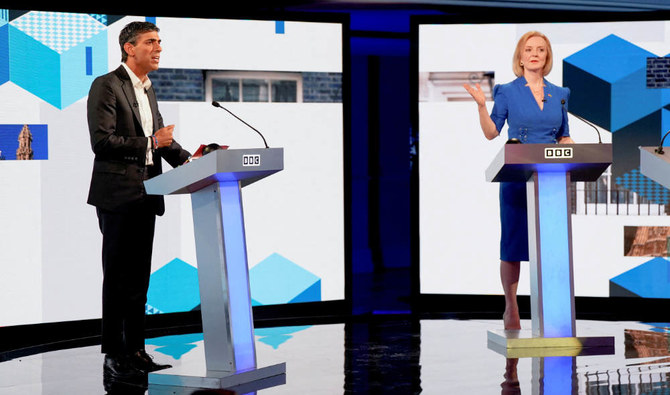
Candidates Rishi Sunak and Liz Truss take part in the BBC Conservative party leadership debate at Victoria Hall in Hanley, Stoke-on-Trent, Britain, July 25, 2022. (REUTERS)
Short Url
Updated 01 August 2022
Follow

Voting set to begin in race to become UK prime minister

  • The pair faced their first grilling in front of members on Thursday, the first of 12 nationwide events before Johnson’s successor is announced on September 5

LONDON: The bruising race between Rishi Sunak and Liz Truss to become Britain’s next prime minister steps up a gear on Monday with the mailing out of ballots to Conservative party members.
With voting set to begin to find Boris Johnson’s replacement, bookmakers have Foreign Secretary Truss as heavy favorite ahead of former finance minister Sunak.
The pair have already spent a fractious two weeks on the campaign trail, where they have clashed repeatedly, particularly over their economic plans.
Truss has promised to slash taxes in an attempt to revive Britain’s spluttering economy and ease the burden of spiralling prices.
Sunak, who steered the UK economy through the pandemic, said Truss’s plans were “fantasy economics” that would fuel inflation and heap further strain on public finances struggling to recover from the pandemic.
But trailing in polls with the all-important party members, Sunak last week performed a significant U-turn by announcing a plan to scrap VAT on energy bills.
And on Sunday he promised to cut the basic rate of income tax by 20 percent before the end of the next parliament, which would be December 2029, at the latest.
He promised grassroot Tories over the weekend that he would stop “woke nonsense” and “end the brainwashing” if he becomes prime minister, although added he has “zero interest in fighting a so-called culture war.”
The 42-year-old also unveiled plans to revive the country’s ailing town centers.
“I want to slash the number of empty shops by 2025 and make sure that they are turned into thriving local assets,” he said.
“I will also crack down on anti-social behavior, graffiti and littering — through extended police powers and increased fines.”

The pair faced their first grilling in front of members on Thursday, the first of 12 nationwide events before Johnson’s successor is announced on September 5.
Truss received a boost on Friday when Defense Secretary Ben Wallace, well regarded among party members for his handling of the Ukraine crisis, pledged his support, saying she was the “only candidate who has both the breadth and depth of experience needed.”
Her tax pledges also helped her secure the support of former leadership contender Tom Tugendhat, who holds sway among the party’s centrists.
Despite the high-level endorsements, Truss insisted it remained a “very, very close race.”
Sunak, whose resignation from Johnson’s scandal-hit government played a key role in bringing about the prime minister’s downfall, has admitted that he is the “underdog” in the contest.
The pair’s two televised head-to-head debates have both been combative, and the race has often turned personal.
Wealthy former financier Sunak hit back at caustic attacks from the Truss camp about his expensive tastes in fashion, which purportedly show that he is out of touch with the ordinary public in hard times.
“This is not about what shoes I wear or what suit I’m wearing.
“This is about what I’m going to do for the country,” Sunak told members, earning applause, although he was also accused by one questioner of “stabbing Boris Johnson in the back.”
Sunak’s campaign has also complained of dirty tricks, calling for “full and proper investigations” into the “continued and deliberate leaking of government documents” that have dogged his bis bid.
Truss meanwhile was reminded at the hustings of her opposition to Brexit in 2016, and her student leadership of the Liberal Democrats at the University of Oxford, when she called for the abolition of the monarchy.
“Almost as soon as I made the (monarchy) speech, I regretted it,” she said. “I was a bit of a teenage controversialist.”


94 million need cataract surgery, but access lacking: WHO

A Somali patient undergoes free cataract surgery at Al Nuur eye Hospital in Mogadishu, on February 16, 2015. (AFP)
Updated 6 sec ago
Follow

94 million need cataract surgery, but access lacking: WHO

  • Of the 94 million affected, fewer than 20 percent are blind, while the rest suffer from impaired vision

GENEVA: More than 94 million people suffer from cataracts, but half of them do not have access to the surgery needed to fix it, the World Health Organization said Wednesday.
Cataracts — the clouding of the eye’s lens that causes blurred vision and can lead to blindness — are on the rise as populations get older, with age being the main risk factor.
“Cataract surgery — a simple, 15-minute procedure — is one of the most cost-effective medical procedures, providing immediate and lasting restoration of sight,” the WHO said.
It is one of the most frequently performed surgeries undertaken in high-income countries.
However, “half of the world’s population in need of cataract surgery don’t have access to it,” said Stuart Keel, the UN health agency’s technical lead for eye care.
The situation is worst in the WHO’s Africa region, where three in four people needing cataract surgery remain untreated.
In Kenya, at the current rate, 77 percent of people needing cataract surgery are likely to die with their cataract blindness or vision impairment, said Keel.
Across all regions, women consistently experience lower access to care than men.
Of the 94 million affected, fewer than 20 percent are blind, while the rest suffer from impaired vision.

- 2030 vision -

The WHO said that over the past two decades, global cataract surgery coverage had increased by 15 percent.

In 2021, WHO member states set a target of a 30-percent increase by 2030.
However, current modelling predicts that cataract surgery coverage will rise by only about 8.4 percent this decade.
To close the gap, the WHO urged countries to integrate eye examinations into primary health care and invest in the required surgical equipment.
States should also expand the eye-care workforce, training surgeons in a standardised manner and then distributing them throughout the country, notably outside major cities.
The WHO was on Wednesday launching new guidance for countries on how to provide quality cataract surgery services.
It will also issue guidance to help support workforce development.
Keel said the main issue was capacity and financing.
“We do need money invested to get rid of this backlog, which is nearly 100 million people,” he told a press conference.
While age is the primary risk factor for cataracts, others include prolonged UV-B light exposure, tobacco use, prolonged corticosteroid use and diabetes.
Keel urged people to keep up regular eye checks as they get older, with most problems able to be either prevented or diagnosed and treated.
The cost of the new lens that goes inside the eye can be under $100.
However, out-of-pocket costs can be higher when not covered by health insurance.
“Cataract surgery is one of the most powerful tools we have to restore vision and transform lives,” said Devora Kestel, head of the WHO’s noncommunicable diseases and mental health department.
“When people regain their sight, they regain independence, dignity, and opportunity.”