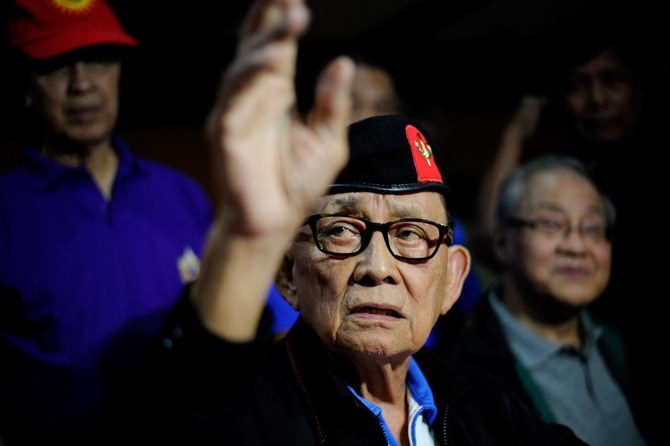
MANILA: Philippines former President Fidel Valdez Ramos, who died on Sunday, was a fighter during wars in Korea and Vietnam and a survivor in the political arena, emerging from a high-ranking security role during the dictatorship of Ferdinand Marcos Sr to win the vote for the nation's highest office. He was 94.
Ramos became a hero to many for defecting from Marcos' government, where he led the national police force, spurring the dictator's downfall during the 1986 popular uprising against his rule.
Others, though, would not forgive or forget his role in enforcing martial law under the Marcos regime.
Ramos narrowly won a contested election in 1992 to replace the People Power leader Corazon Aquino who unseated Marcos. Though he gained less than 23% of the vote, Ramos soon polled at 66% support and his presidency was remembered for a period of peace, stability and economic growth.
"It is with great sorrow that we learn of the passing of former President Fidel V. Ramos," said Trixie Cruz-Angeles, press secretary for the dictator's son, the recently elected Ferdinand Marcos Jr.
"He leaves behind a colourful legacy and a secure place in history for his participation in the great changes of our country, both as military officer and chief executive."
Known as FVR, Ramos attended the U.S. Military Academy at West Point and fought in the Korean war in the 1950s as a platoon leader. He served in the late 1960s in Vietnam as a leader of the Philippine Civil Action Group.
Ramos held every rank in the Philippine army from second lieutenant to commander-in chief.
He never lost that military bearing and swagger, bragging many times "No soft jobs for Ramos."
The former diplomat's son became the only Methodist leader of the mainly Roman Catholic country.
His six-year administration opened the country's economy to foreign investments through deregulation and liberalisation policies.
Ramos broke up monopolies in the transportation and communications sectors. Through special powers granted by the Congress he restored the ailing electricity sector, ending debilitating 12-hour power outages that plagued the country.
During his tenure, the Philippine economy surged and poverty rates fell to 31% from 39% through his Social Reform Agenda.
Ramos fought right-wing, leftist and Islamic rebels during his time in the military, but later held peace talks with all "enemies of the state", including rogue soldiers who attempted nearly a dozen times to unseat Aquino during her tenure.
He eventually signed a peace agreement with the Islamic separatists of the Moro National Liberation Front in 1996 and succeeded in shrinking the number of Maoist-led guerrillas to more than 5,400 rebels from a high of 25,000 in early 1986.
Ramos was a multi-tasking workaholic and athletic leader. When he was military chief, he would play golf and jog at the same time, running after his ball. His early morning jog was legendary among his staff officers and even at 80, he would jump to reenact what he did during revolt in 1986.

Philippine ex-President Fidel Ramos, warrior and survivor, dies at 94
https://arab.news/8ks26
Philippine ex-President Fidel Ramos, warrior and survivor, dies at 94
- Ramos held every rank in the Philippine army from second lieutenant to commander-in chief
- His six-year administration opened the country's economy to foreign investments
Afghanistan says it thwarted Pakistani airstrike on Bagram Air Base as fighting enters fourth day
- The fighting has been the most severe between the neighbors for years
- Pakistan accuses Taliban government of harboring militant groups that stage attacks against it
KABUL: Afghanistan thwarted attempted airstrikes on Bagram Air Base, the former US military base north of Kabul, authorities said Sunday, while cross-border fighting between Pakistan and Afghanistan stretched into a fourth day.
The fighting has been the most severe between the neighbors for years, with Pakistan declaring that it’s in “open war” with Afghanistan.
The conflict has alarmed the international community, particularly as the area is one where other militant organizations, including Al-Qaeda and the Daesh group, still have a presence and have been trying to resurface.
Pakistan accuses Afghanistan’s Taliban government of harboring militant groups that stage attacks against it and also of allying with its archrival India.
Border clashes in October killed dozens of soldiers, civilians and suspected militants until a Qatari-mediated ceasefire ended the intense fighting. But several rounds of peace talks in Turkiye in November failed to produce a lasting agreement, and the two sides have occasionally traded fire since then.
On Sunday, the police headquarters of Parwan province, where Bagram is located, said in a statement that several Pakistani military jets had entered Afghan airspace “and attempted to bomb Bagram Air Base” at around 5 a.m.
The statement said Afghan forces responded with “anti-aircraft and missile defense systems” and had managed to thwart the attack.
There was no immediate response from Pakistan’s military or government regarding Kabul’s claim of attempted airstrikes on Bagram or the ongoing fighting.
Bagram was the United States’ largest military base in Afghanistan. It was taken over by the Taliban as they swept across the country and took control in the wake of the chaotic US withdrawal from the country in 2021. Last year, US President Donald Trump suggested he wanted to reestablish a US presence at the base.
The current fighting began when Afghanistan launched a broad cross-border attack on Thursday night, saying it was in retaliation for Pakistani airstrikes the previous Sunday.
Pakistan had said its airstrike had targeted the outlawed Pakistani Taliban, also known as Tehreek-e-Taliban Pakistan, or TTP. Afghanistan had said only civilians were killed.
The TTP militant group, which is separate but closely allied with Afghanistan’s ruling Taliban, operates inside Pakistan, where it has been blamed for hundreds of deaths in bombings and other attacks over the years.
Pakistan accuses Afghanistan’s Taliban government of providing a safe haven within Afghanistan for the TTP, an accusation that Afghanistan denies.
After Thursday’s Afghan attack, Pakistani Defense Minister Khawaja Mohammad Asif declared that “our patience has now run out. Now it is open war between us.”
In the ongoing fighting, each side claims to have killed hundreds of the other side’s forces — and both governments put their own casualties at drastically lower numbers.
Two Pakistani security officials said that Pakistani ground forces were still in control on Sunday of a key Afghan post and a 32-square-kilometer area in the southern Zhob sector near Kandahar province, after having seized it during fighting Friday. The captured post and surrounding area remain under Pakistani control, they added. The officials spoke on condition of anonymity, because they weren’t authorized to speak publicly.
In Kabul, the Afghan government rejected Pakistan’s claims. Deputy government spokesman Hamdullah Fitrat called the reports “baseless.”
Afghan officials said that fighting had continued overnight and into Sunday in the border areas.
The police command spokesman for Nangarhar province, Said Tayyeb Hammad, said that anti-aircraft missiles were used from the provincial capital, Jalalabad, and surrounding areas on Pakistani fighter jets flying overhead Sunday morning.
Defense Ministry spokesman Enayatulah Khowarazmi said that Afghan forces had launched counterattacks with snipers across the border from Nangarhar, Paktia, Khost and Kandahar provinces overnight. He said that two Pakistani drones had been shot down and dozens of Pakistani soldiers had been killed.
Fitrat said that Pakistani drone attacks hit civilian homes in Nangarhar province late Saturday, killing a woman and a child, while mortar fire killed another civilian when it hit a home in Paktia province.
There was no immediate response to the claims from Pakistani officials.