Norwegian woman summits Pakistan’s Broad Peak mountain in pursuit of ‘super peaks’ record

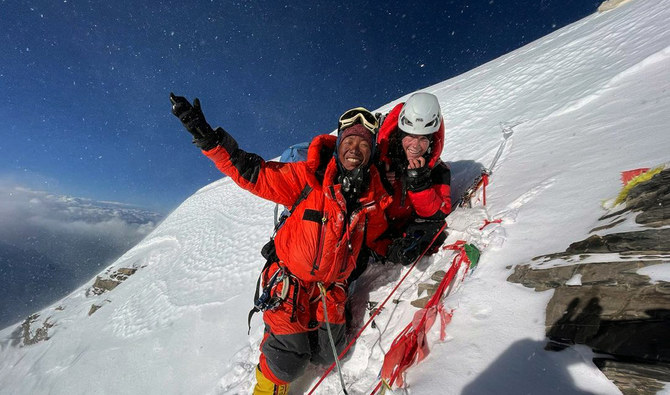
Norwegian mountaineer Kristin Harila (R) summited Broad Peak, the ninth mountain, on her quest to climb the world's 14 super peaks on July 29, 2022 in Pakistan. (Instagram/kristin.harila)
Short Url
Updated 29 July 2022
Follow

Norwegian woman summits Pakistan’s Broad Peak mountain in pursuit of ‘super peaks’ record

  • A record number of climbers are attempting to summit Pakistan’s peaks this year
  • Pakistan is home to five of the world’s 14 super peaks

ISLAMABAD: A Norwegian woman remains on course to climb the world’s 14 “super peaks” in the shortest time ever, her Instagram account said, after she summited Pakistan’s Broad Peak, the ninth mountain on her quest.

Pakistan is home to five of the world’s 14 super peaks — those over 8,000 meters (26,246 feet). Climbing them all is considered the ultimate achievement by mountaineers.

Kristin Harila is taking on Nepali adventurer Nirmal Purja’s 2019 record of six months and six days for climbing all 14.

On Thursday, day 76 of her pursuit, she scaled Broad Peak, the twelfth highest, a message on her Instagram page said.

Officials from the Alpine Club of Pakistan were not immediately available to confirm the 36-year-old’s latest feat, but it comes just six days after they said she had summitted K2, the world’s second highest peak.

“She is now descending to base camp, and then heading toward the two last mountains in the second phase of this project, Gasherbrum I and II,” the Instagram message read.

A record number of climbers are tackling Pakistan’s peaks this year, but the mountains have taken their toll — with six people missing and feared dead since the season began in June, including four foreigners.

Canadian Richard Cartier, Australian Matthew Eakin, Afghan Ali Akbar and Pakistani Sharif Sadpara are feared dead on K2, officials from the Gilgit-Baltistan tourism department said.

Briton Gordon Henderson was lost climbing Broad Peak, and Pakistani Iman Karim on Gasherbrum II.

Pakistan officials ordinarily don’t list missing climbers as dead until their bodies have been recovered.

Records have tumbled on Pakistan’s mountains this year, according to the Alpine Club, with over 140 people summiting the 8,611-meter K2 — including 20 women.

Until this year, it had been scaled just 425 times, whereas Everest — the world’s highest — has been conquered by more than 6,000 people since Edmund Hillary and Tenzing Norgay first reached the top in 1953.

Last week, Sanu Sherpa, from Nepal, became the first person to complete the double summit of all 14 super peaks after reaching the top of Gasherbrum II.


At ulema conference, Pakistan PM urges clerics’ help to curb militancy, sectarianism

Updated 4 sec ago
Follow

At ulema conference, Pakistan PM urges clerics’ help to curb militancy, sectarianism

  • Shehbaz Sharif urges religious scholars to play role in promoting unity among all schools of thought
  • His appeal comes amid a surge in separatist and extremist violence targeting civilians and soldiers

ISLAMABAD: Prime Minister Shehbaz Sharif on Wednesday called for the eradication of militancy and sectarianism, saying the country could not progress without promoting unity and cohesion.

His remarks came while addressing religious scholars at the National Ulema Convention in the federal capital, urging them to play a proactive role in promoting brotherhood and harmony among all schools of thought.

The prime minister's plea comes at a time when the country has witnessed a surge in separatist and extremist violence, with militant groups such as the Balochistan Liberation Army (BLA) and the Tehreek-e-Taliban Pakistan (TTP) carrying out attacks on police and security forces in the northwestern Khyber Pakhtunkhwa and southwestern Balochistan provinces.

"I believe that the most important thing agreed upon in this gathering today should be this that unless we establish an atmosphere of unity and cohesion among the nation in general, this country cannot progress," Sharif said in his address.

"If this country is to progress, the elimination of terrorism is absolutely essential," he added. "To protect this country, the political and military leadership together has worked tirelessly."

He also called for the elimination of sectarianism from the country.

The prime minister lambasted Afghanistan for sending militants to Pakistan who target civilians and security forces, highlighting that Pakistani soldiers were being killed everyday in KP and Balochistan.

The administration in Kabul denies sheltering or facilitating armed factions, describing Pakistan's security challenges as its internal problem.