

At ulema conference, Pakistan PM urges clerics’ help to curb militancy, sectarianism

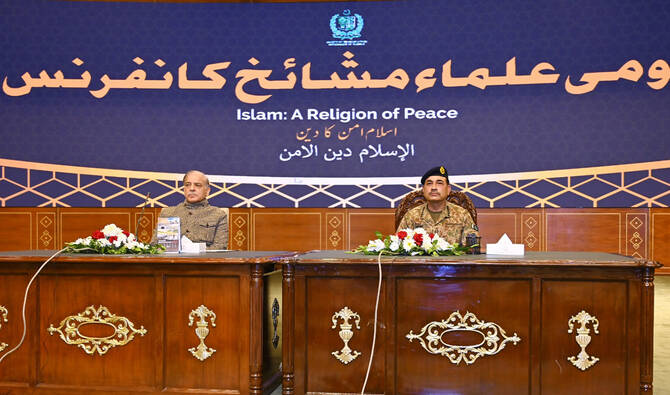
Prime Minister Shehbaz Sharif and Chief of the Army Staff and Chief of Defence Forces Field Marshal Syed Asim Munir at the National Ulema Conference in Islamabad on December 11, 2025. (PMO)
Short Url
Updated 10 December 2025
Follow

At ulema conference, Pakistan PM urges clerics’ help to curb militancy, sectarianism

  • Shehbaz Sharif urges religious scholars to play role in promoting unity among all schools of thought
  • His appeal comes amid a surge in separatist and extremist violence targeting civilians and soldiers

ISLAMABAD: Prime Minister Shehbaz Sharif on Wednesday called for the eradication of militancy and sectarianism, saying the country could not progress without promoting unity and cohesion.

His remarks came while addressing religious scholars at the National Ulema Convention in the federal capital, urging them to play a proactive role in promoting brotherhood and harmony among all schools of thought.

The prime minister's plea comes at a time when the country has witnessed a surge in separatist and extremist violence, with militant groups such as the Balochistan Liberation Army (BLA) and the Tehreek-e-Taliban Pakistan (TTP) carrying out attacks on police and security forces in the northwestern Khyber Pakhtunkhwa and southwestern Balochistan provinces.

"I believe that the most important thing agreed upon in this gathering today should be this that unless we establish an atmosphere of unity and cohesion among the nation in general, this country cannot progress," Sharif said in his address.

"If this country is to progress, the elimination of terrorism is absolutely essential," he added. "To protect this country, the political and military leadership together has worked tirelessly."

He also called for the elimination of sectarianism from the country.

The prime minister lambasted Afghanistan for sending militants to Pakistan who target civilians and security forces, highlighting that Pakistani soldiers were being killed everyday in KP and Balochistan.

The administration in Kabul denies sheltering or facilitating armed factions, describing Pakistan's security challenges as its internal problem.


Pakistan Navy launches fourth Hangor-class submarine ‘Ghazi’ in China 

Updated 6 sec ago
Follow

Pakistan Navy launches fourth Hangor-class submarine ‘Ghazi’ in China 

  • As per Islamabad’s agreement with Beijing, four of eight submarines will be built in China and the rest in Pakistan
  • Navy says all four submarines under construction in China undergoing sea trials, in final stages of being handed over

ISLAMABAD: The Pakistan Navy announced on Wednesday it has launched the fourth Hangor-class submarine named “Ghazi” at a Chinese shipyard in Wuhan, saying the development will help maintain peace in the region.

Pakistan’s government signed an agreement with China for the acquisition of eight Hangor-class submarines, the navy said in its press release. Under the contract, four submarines are being built in China while the remaining four will be constructed in Pakistan by the Karachi Shipyard and Engineering Works Ltd. company.

“With the launching of GHAZI, Pakistan Navy has achieved another significant milestone where all four submarines under construction in China are now undergoing rigorous sea trials and are in the final stages of being handed over to Pakistan,” the navy said. 

It further said that these submarines will be fitted with advanced weapons and sensors capable of engaging targets at standoff ranges. 

“Hangor-class submarines will be pivotal in maintaining peace and stability in the region,” the navy added. 

Pakistan’s agreement with China is set to strengthen its naval defenses, especially as ties with arch-rival India remain tense. 

India and Pakistan were involved in a four-day military confrontation in May this year before Washington intervened and brokered a ceasefire. Four days of confrontation saw the two countries pound each other with fighter jets, exchange artillery fire, missiles and drone strikes before peace prevailed. 

Pakistan’s air force used Chinese-made J-10 fighter jets in May to shoot down an Indian Air Force Rafale aircraft, made by France.

The altercation between the nuclear-armed neighbors surprised many in the military community and raised questions over the superiority of Western hardware over Chinese alternatives.

Islamabad has long been Beijing’s top arms customer, and over the 2020-2024 period bought over 60 percent of China’s weapons exports, according to data from the Stockholm International Peace Research Institute.