KYIV, Ukraine: Russian forces launched a missile attack on the Kyiv area for the first time in weeks Thursday and pounded the northern Chernihiv region as well, in what Ukraine said was revenge for standing up to the Kremlin.
Ukrainian officials, meanwhile, announced a counteroffensive to take back the occupied Kherson region in the country’s south, territory seized by Russian President Vladimir Putin’s forces early in the war.
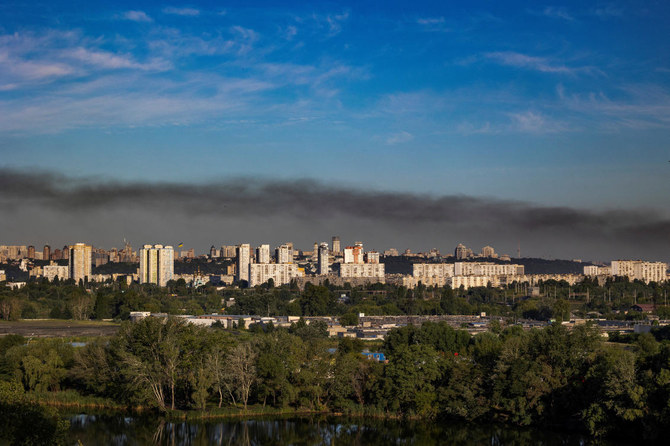
The Vyshgorod district on the outskirts of Kyiv was targeted early in the morning, and an “infrastructure object” was hit, regional Gov. Oleksiy Kuleba said on Telegram. There was no immediate word on any casualties. Vyshgorod is 20 kilometers (12 miles) north of the capital’s center.
Kuleba linked the strikes to the Day of Statehood, a commemoration that President Volodymyr Zelensky instituted last year and Ukraine marked for the time on Thursday.
“Russia, with the help of missiles, is mounting revenge for the widespread popular resistance, which the Ukrainians were able to organize precisely because of their statehood,” Kuleba told Ukrainian television. “Ukraine has already broken Russia’s plans and will continue to defend itself.”
Chernihiv regional Gov. Vyacheslav Chaus reported that the Russians also fired missiles from the territory of Belarus at the village of Honcharivska. The Chernihiv region had not been targeted in weeks.
Russian troops withdrew from the Kyiv and Chernihiv regions months ago after failing to capture either. The renewed strikes come a day after the leader of pro-Kremlin separatists in the east, Denis Pushilin, urged Russian forces to “liberate Russian cities founded by the Russian people — Kyiv, Chernihiv, Poltava, Odesa, Dnipropetrovsk, Kharkiv, Zaporizhzhia, Lutsk.”
Kharkiv, Ukraine’s second-largest city, also came under a barrage of shelling overnight, according to the mayor. The southern city of Mykolaiv was fired on as well, with one person reported injured.
Meanwhile, the Ukrainian military kept up a counterattack in the Kherson region, knocking out of commission a key bridge over the Dnieper River on Wednesday.
Ukrainian media quoted Ukrainian presidential adviser Oleksiy Arestovich as saying the operation to liberate Kherson is underway, with Kyiv’s forces planning to isolate Russian troops and leave them with three options — “retreat, if possible, surrender or be destroyed.”
Oleksiy Danilov, secretary of Ukraine’s National Security and Defense Council, said the Russians are concentrating maximum forces in the direction of Kherson, warning: “A very large-scale movement of their troops has begun.”
The British military said Ukraine has used its new, Western-supplied long-range artillery to damage at least three of the bridges across the Dnieper that Russia relies on to supply its forces.
Ukraine’s presidential office said Thursday morning that Russian shelling of cities and villages over the past 24 hours killed at least five civilians, all of them in the eastern Donetsk province, and wounded nine.
Fighting in recent weeks has focused on Donetsk province. It has intensified in recent days as Russian forces appeared to emerge from a reported “operational pause” after capturing neighboring Luhansk province.
A missile struck a residential building in Toretsk early Thursday morning, destroying two floors.
“Missile terror again. We will not give up. ... We will not be intimidated,” Donetsk regional Gov. Pavlo Kyrylenko said on Telegram.
Military analysts believe Russian forces are focusing their efforts on capturing the cities of Bakhmut and Siversk in Donetsk province.
Zelensky instituted the Day of Statehood to remind Ukrainians about the country’s history as an independent state. The commemoration honors Prince Vladimir, who made Christianity the official religion of the medieval state of Kyivan Rus more than 1,000 years ago.
The Kremlin also lays claim to the heritage of Kyivan Rus. In 2016, Putin erected a monument to Prince Vladimir near the Kremlin.


![]()

Russia attacks Kyiv area for the first time in weeks
Short Url
https://arab.news/pysx4
Russia attacks Kyiv area for the first time in weeks
- Ukrainian officials, meanwhile, announced a counteroffensive to take back the occupied Kherson region
- The Vyshgorod district on the outskirts of Kyiv was targeted early in the morning, and an “infrastructure object” was hit


Latest updates


© 2026 SAUDI RESEARCH & PUBLISHING COMPANY, All Rights Reserved And subject to Terms of Use Agreement.