

King Faisal Specialist Hospital & Research Center announces new approach to diagnosis of glandular and prostatic tumors

1 / 3
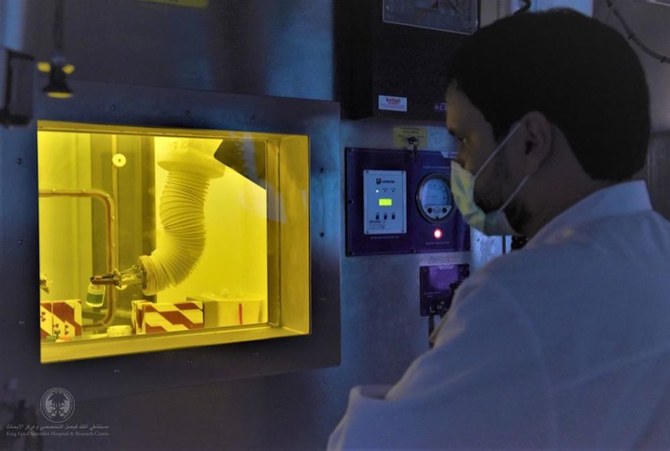
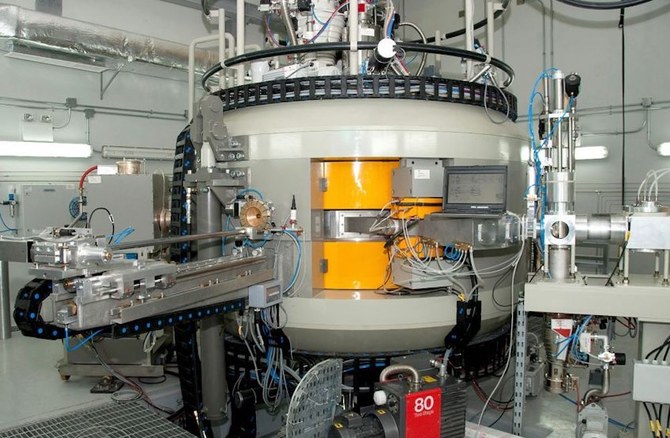
A team at King Faisal Specialist Hospital & Research Center developed a novel way to produce large quantities of highly purified radioactive isotope gallium-68 used in cancer diagnosis. (Supplied)
2 / 3
A team at King Faisal Specialist Hospital & Research Center developed a novel way to produce large quantities of highly purified radioactive isotope gallium-68 used in cancer diagnosis. (Supplied)
3 / 3
A team at King Faisal Specialist Hospital & Research Center developed a novel way to produce large quantities of highly purified radioactive isotope gallium-68 used in cancer diagnosis. (Supplied)
Short Url
Updated 28 July 2022
Follow

King Faisal Specialist Hospital & Research Center announces new approach to diagnosis of glandular and prostatic tumors

A research team at the Department of Cyclotron and Radiopharmaceuticals at King Faisal Specialist Hospital & Research Center has succeeded in developing a novel technique of producing large quantities of the highly purified radioactive isotope gallium-68 used in cancer diagnosis. The development is also expected to end the dependence on expensive Gallium-68 generators. In addition, this achievement will contribute to improving the diagnostic and therapeutic quality of cancer patients and will increase the availability of radiopharmaceuticals throughout the Kingdom.

Dr. Ibrahim Al-Jammaz, chairman of the Department of Cyclotron and Radiopharmaceuticals at KFSH&RC, explained that the radioactive gallium isotope was produced locally by means of a novel process using proton irradiation technology via nuclear accelerators for solid targets plated with Zinc 68. He added that the radioactive gallium-68 is used as a raw material for producing radioactive clinical pharmaceuticals (Ga-68 DOTATATE and Ga-68-PSMA), which are used in diagnosing several types of tumors, particularly adenocarcinomas and prostate cancer.

Dr. Al-Jammaz said that the project, carried out under the supervision of the International Atomic Energy Agency, will expand to include the new isotope gallium-68’s techniques including using liquid targets, which could completely replace the gallium generator.

For the past four decades, KFSH&RC has been regarded as the leading Middle Eastern hospital in the production of isotopes and radiopharmaceuticals used in advanced medical applications. The hospital is recognized by the IAEA as a global center for nuclear-medicine production, research and development. Every year, it produces around 30,000 doses of radioactive pharmaceuticals, which are used in diagnosing many diseases and treating malignant tumors. This achievement is in line with the hospital’s ambitious vision to meet the needs of the Kingdom and achieve self-sufficiency in the production of radiopharmaceuticals, which contribute to the provision of reliable and high-quality health care, as well as the financial sustainability of KFSH&RC in privatizing the health sector.


Muzz helps GCC to embrace modern marriage without compromising faith

Updated 18 December 2025
Follow

Muzz helps GCC to embrace modern marriage without compromising faith

In an era where digital platforms shape nearly every aspect of modern life, many Muslims across the world are turning to technology not for casual interactions, but for something far more meaningful: marriage. Among the platforms leading this shift is Muzz, the world’s largest Muslim marriage app, which has established itself as a trusted space for young professionals, families, and faith-minded individuals seeking genuine, value-aligned connections.

With a global community of more than 15 million members and over 600,000 marriages facilitated through the platform, Muzz has redefined how Muslims meet and communicate while honoring cultural expectations and Islamic principles. Its rapid growth reflects an increasing demand for tools that offer modern convenience without compromising traditional values.

Muzz’s origins trace back to 2011, when founder Shahzad Younas created a simple website from his London bedroom. What started as a small personal project soon evolved into a pioneering venture. In 2017, the platform became the first Muslim-focused startup to be accepted into Y Combinator, the Silicon Valley accelerator known for backing giants such as Airbnb and Dropbox. This milestone marked a turning point that propelled Muzz from a grassroots idea into a global technology brand.

Today, the company operates with more than 150 employees across several regions, serving diverse Muslim communities throughout the Middle East, Southeast Asia, Europe, and North America. Despite its global footprint, the platform remains rooted in a clear mission: to offer Muslims a safe, respectful, and intentional way to pursue marriage.

In contrast to mainstream dating apps that cater largely to casual relationships, Muzz’s guiding philosophy is that “Muslims don’t date — they marry.” This principle shapes the platform’s user experience and distinguishes it from competitors. The app incorporates features designed specifically to reflect Islamic values, including privacy tools, optional chaperone modes, verified profiles, and a strong emphasis on safety and conduct. These elements resonate particularly strongly with users in the GCC, where cultural expectations around courtship remain firmly tied to modesty, family involvement, and serious intentions.

“We built Muzz to empower Muslims with a tool that fits their lives and their values,” said CEO Younas. “Our users want modern convenience, but they also seek sincerity and intention. Muzz brings both together.”

Beyond impressive numbers and global reach, the platform’s impact is evident in the personal stories shared by couples who found each other through it. Omar and Noura, a Saudi–Jordanian couple who married last year, credit Muzz for creating the opportunity that brought them together. Living in different countries, they never expected their paths to cross naturally. “Conversations on Muzz felt sincere from the start,” Omar said. “Within weeks, we realized this was something real.”

For individuals like Sara, a single mother from the Gulf region, the app provided a renewed chance at companionship after years of hesitation. Concerns about trust and privacy initially held her back, but the platform’s respectful environment helped her feel comfortable enough to explore the process. “Muzz felt intentional,” she said. “I met someone who understood my journey, someone I didn’t expect to find.”

Stories like these, now numbering in the hundreds of thousands, highlight how thoughtfully designed technology can support tradition rather than undermine it. The platform’s growing adoption in Saudi Arabia and the UAE reflects this balance, combining technological ease with the cultural sensitivity deeply valued in the region. According to a spokesperson for the company, this growth demonstrates a widespread desire for tools that honor authenticity and respect while offering users an accessible way to pursue marriage.

In addition to its role as a matchmaking platform, Muzz has emerged as a socially conscious brand committed to humanitarian initiatives. The company has raised more than $1.2 million in charitable contributions, supporting essential projects in Sudan, Pakistan, Türkiye, Palestine, and other regions. Its donations have helped fund bakeries, mobile clinics, temporary shelters, and emergency relief efforts, reinforcing its commitment to community support and ethical responsibility.

As digital tools continue to influence how people work, communicate, and build relationships, Muzz’s success illustrates how technology can harmonize with religious and cultural values. By offering a platform grounded in sincerity, safety, and faith-centered design, Muzz is shaping a new chapter in Muslim matchmaking, one where innovation and tradition work hand in hand to help people build lasting connections.