

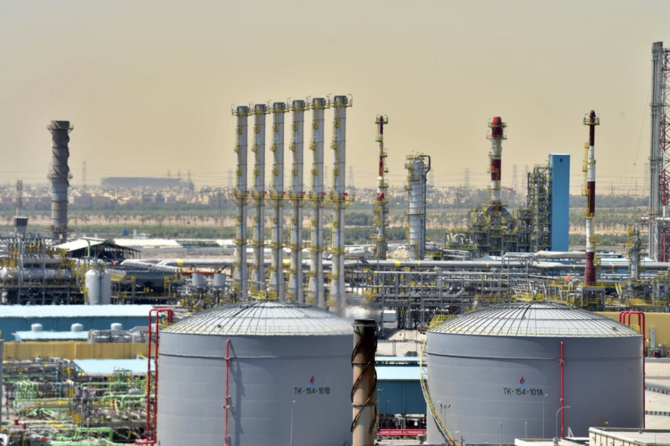

KUWAIT: The Clean Fuels Project is one of the largest and most significant projects in the history of the Kuwaiti oil sector as it will position Kuwait among major exporters of high-quality and eco-friendly products, the Kuwait News Agency reported.
The project is part of Kuwait’s effort to become a regional economic attraction hub and represents a historic milestone that will strengthen Kuwait’s position as an influential and competitive state capable of meeting stringent conditions in various global markets, as well as its global position in the oil refining industry by expanding and upgrading the Mina Abdullah and Mina Al-Ahmadi refineries.
In addition to advanced conversion capabilities, the operational excellence, reliability, safety performance and energy efficiency of the two refineries have been greatly improved.
Their clean products meet US, European, and Asian standards, including Euro-4 and Euro-5.
The equipment and technology used in the execution of this massive project were developed by 199 companies from 23 countries.
Kuwait National Petroleum Co. Deputy CEO for Administrative and Commercial Affairs and Official Spokesman Ahed Al-Khurayif stated that due to global oil industry advancement and variables in different environmental requirements locally and globally, the company has carried out the CFP, which has helped revamp product specifications in line with the required global standards.
According to KUNA, the project reflects the company’s overall strategic vision to become one of the most competitive and advanced refining companies in the world and manifests the optimal use of the country’s oil resources as one of the Kuwait Petroleum Corp.’s top strategic goals.
Al-Khurayif estimates that the CFP’s capex would be KD 4.68 billion (around $15.2 billion), citing the financing process as the largest in Kuwait’s oil industry history.
According to the company’s official, the KPC funded 30 percent of the project’s capex, while the remaining 70 percent was financed by foreign sources.
Because of the project’s massive size, it was divided into three major parts, each of which was carried out by a consortium of international companies, Al-Khurayif said.
Following the project’s successful completion, the refining capacity of the Mina Abdullah and Mina Al-Ahmadi refineries has increased to 454,000 and 346,000 barrels per day, respectively, according to the official.
The 800,000-bpd quantity, combined with Al-Zour oil refinery’s expected 600,000-bpd production capacity, will bring the refined oil total to 1.4 million bpd, achieving the best value added and highest possible revenue from hydrocarbon resources, Al-Khurayif boasted.
One of the project’s primary goals is to increase the conversion capacity of the company’s refineries by converting heavy low-quality products into high-quality ones.
As a result of the products meeting Euro-4/Euro-5 standards, the environmental impact is greatly reduced due to the significantly lower content of SOx, NOx and other pollutants.
Sulfur content in gasoline, for example, will be reduced from 500 ppm to 10 ppm, and in gasoil from 5,000 ppm to 10 ppm, he added.
Furthermore, the KNPC is now prepared to produce ship fuel oil containing 0.5 percent sulfur, in accordance with the International Maritime Organization’s 2020 requirements, he added.
Al-Khurayif stated that the CFP is one of the strategic projects that serve Kuwait’s Vision 2035 by providing job opportunities to Kuwaiti nationals.
Since its inception, the project has created approximately 800 jobs for Kuwaiti nationals while also developing their capabilities and skills, he said, adding that internal and external training courses were held for approximately 650 newly recruited employees. Nationals make up at least 30 percent of the workforce per contract.
Local spending was one of the project’s key aspects, Al-Khurayif said, with its contractors spending a total of KD 1.1 billion in the local market during all execution phases.
In terms of environmental significance, he said that the company’s products meet the most stringent global environmental specifications and that the project meets the needs of local power plants for clean low-sulfur fuel, thereby reducing environmental hazards.




