

UK Defense Ministry offers independent inquiry into handling of SAS killing claims

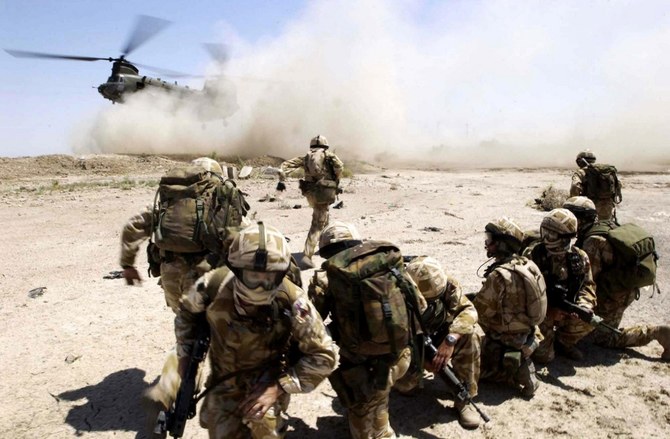
The Royal Military Police investigated allegations that a single Special Air Service unit in 2010-2011 unlawfully executed 54 Afghans. (AFP file photo)
Short Url
Updated 27 July 2022
Follow

UK Defense Ministry offers independent inquiry into handling of SAS killing claims

  • Court filings show Royal Military Police officer tasked with probe was ‘close friend’ of SAS officer
  • Deputy faced ‘political pressure’ to avoid investigating elite unit, court hears

LONDON: The UK Defense Ministry has offered to launch an independent inquiry into its handling of claims that Britain’s elite Special Air Service killed unarmed civilians during the war in Afghanistan, BBC News reported.

Amid a legal case brought against Defense Minister Ben Wallace, court filings suggest that there were significant flaws in the ministry’s initial investigation, led by the Royal Military Police.

The RMP investigated allegations that a single SAS unit in 2010-2011 unlawfully executed 54 Afghans.

But documents show that the senior officer in charge of the RMP probe, Brig. David Neal, was suspected of attempting to shut down investigations.

Neal was reportedly a “close friend” of the SAS officer in charge of the unit at the center of the claims.

The RMP official allegedly shut down investigations into eight separate cases of potential unlawful execution.

Neal’s deputy claimed, according to court documents, that he was placed under “political pressure” to avoid progressing investigations into senior SAS members involved in the unit.

The Defense Ministry’s legal chief, Peter Ryan, said in 2020 that the SAS’ explanations over the killings were “highly questionable, if not actually implausible.”

He warned that the RMP investigation was “unduly narrowly focused given the strength of insider concerns.

“Only a proportion of the large-scale shooting incidents over the six-month period in 2010-2011 were investigated in any detail.

“And there have been no investigations of earlier special forces deployments, during at least some of which even more Afghans were killed, again with relatively few weapons being recovered.”

Relatives of four men killed in a 2011 raid in Afghanistan reject the findings of the RMP probe and are engaged in a legal case against Wallace.

The ministry’s proposed new investigation into the way the allegations were handled would be led by a senior judge.

It would only examine the handling of the subsequent claims, however, as opposed to the legality of the killings, the ministry said, noting that the initial investigation had failed to find grounds for prosecution.

If prior investigations are found to be flawed, it could pave the way for the reopening of an investigation into the killings.

John Healey, UK shadow defense secretary, said that the proposed fresh inquiry was a “welcome first step.”

He added: “Australian special forces were investigated fully by a properly resourced inquiry backed by privacy and military expertise. There is no reason why this shouldn’t be possible in Britain.”

However, Tessa Gregory, who is representing an Afghan family in the case against Wallace, described the ministry’s proposed review as “so limited in what it can look at that it cannot bring the truth to light.

“Our clients desperately need answers to why their loved ones died and any investigation must fearlessly examine the underlying allegations of extrajudicial killings.”

A Defense Ministry spokesperson said: “The defense minister has decided to propose an independent review to be led by a senior judge into issues arising from the handling of allegations of misconduct that are the subject of these proceedings.

“The review will consider what lessons can be learned and make any recommendations for the future.”


Backlash as Australia kills dingoes after backpacker death

Updated 58 min 43 sec ago
Follow

Backlash as Australia kills dingoes after backpacker death

  • The euthanization program has stirred debate about how to manage the local population of dingoes
  • Wildlife experts said killing the animals was the wrong response and may threaten the island’s dingo population

SYDNEY: Australian authorities have sparked a backlash by killing a group of dingoes linked to the death of a young Canadian woman on an island in the country’s east.
The Queensland government said six animals were put down after 19-year-old backpacker Piper James’s body was found on January 19 at a beach on the World Heritage-listed island of K’gari.
The euthanization program has stirred debate about how to manage the local population of dingoes, a sandy-colored canine believed to have first arrived in Australia 4,000 to 5,000 years ago.
An autopsy conducted on James’ body found evidence “consistent with drowning” but also detected injuries corresponding to dingo bites.
“Pre-mortem dingo bite marks are not likely to have caused immediate death,” said a spokesperson for the Coroners Court of Queensland.
The coroner’s investigation into the cause of death was expected to take several weeks.
In response, the Queensland government said a pack of 10 dingoes involved would be euthanized after rangers had observed some “aggressive behavior.”
Six of the dingoes had already been euthanized, the state’s environment minister, Andrew Powell, told reporters Sunday.
“Obviously, the operation will continue,” he said.
The traditional owners of K’gari, the Butchulla people, said the state’s failure to consult with them before euthanizing the dingoes — or wongari in their language — was “unexpected and disappointing.”
“Once again, it feels as though economic priorities are being placed above the voices of the people and traditional owners, which is frustrating and difficult to accept,” the Butchulla Aboriginal Corporation said in a statement to Australian media this week.
‘You are food’
Wildlife experts said killing the animals was the wrong response and may threaten the island’s dingo population, estimated at just 70-200 animals.
Given their small numbers, killing a pack of 10 animals would harm the population’s genetic diversity, said Mathew Crowther, professor of quantitative conservation biology at the University of Sydney.
“There’s no moral from the dingoes’ point of view. They’re just being wild animals, doing wild things,” Crowther said.
Dingoes tend to lose their fear of people as they interact with tourists, some of whom defy advice against feeding the animals.
“That’s the worst thing you can do to a wild animal,” Crowther said.
“They just relate humans to food, and if you don’t give them food, well, you are food — that’s basically how it is.”
Dingoes are wild, predatory animals and need to be treated with respect, said Bill Bateman, associate professor in the school of molecular and life sciences at Curtin University.
The canines are more likely to attack children or people who are alone, and may be triggered when people turn their backs or run, he said.
“These are important animals, and therefore we need to change the way we deal with them, otherwise we’re just going to keep reacting to these attacks and driving the population of dingoes down,” Bateman said.
Wildlife managers, rangers, Indigenous people and tourism operators need to work together so that humans and dingoes can coexist on the island, he said.
Todd James, the father of Piper, has described on social media how his family’s hearts were “shattered” by her death.
News of the dingoes’ euthanization was “heart-wrenching,” he told Australian media, adding however that he recognized it may be necessary for safety because of the pack’s behavior.