

SAS behind alleged unlawful killings ‘not above law’: UK PM

1 / 2
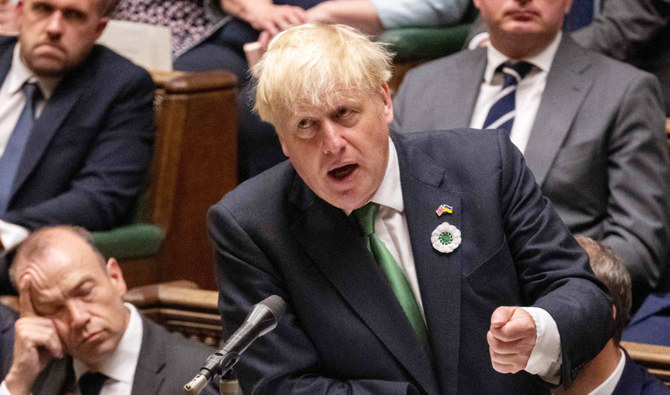
Britain's Prime Minister Boris Johnson gesturing and speaking during the weekly session of Prime Minister's Questions (PMQs) at the House of Commons in London on July 13, 2022. (AFP)
2 / 2
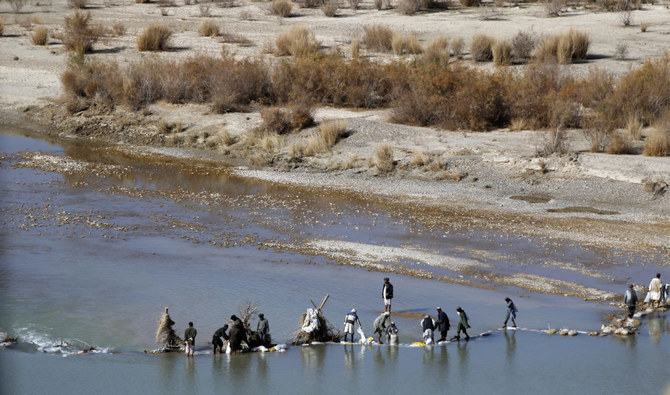
Afghans try to repair a dam on a river as seen from the British forces forward operating base Sterga II at Helmand province in southern Afghanistan, Dec. 16, 2013. (AP)
Short Url
Updated 13 July 2022
Follow

SAS behind alleged unlawful killings ‘not above law’: UK PM

  • Elite troops killed unarmed Afghans in night raids, witnesses tell BBC

LONDON: British military personnel are not above the law, Prime Minister Boris Johnson told Parliament in the wake of a BBC investigation that alleged hundreds of people were unlawfully killed in Afghanistan by Britain’s elite Special Air Service.

Opposition parties have demanded an official investigation into the allegations, first put forward on the BBC’s “Panorama” program.

The program claimed that more than 50 people in Afghanistan may have been killed unlawfully by members of a single SAS unit.

Scottish National Party defense spokesman Stewart Malcolm McDonald said in Parliament that Britain’s Ministry of Defense was “determined to sweep under the carpet” unlawful killings by British forces when the matter had been raised previously.

He pressed Johnson on the potential for an independent inquiry into the allegations, but the prime minister said it was “longstanding practice” to avoid commenting on SAS activities.

However, Johnson added: “On the other hand … it does not mean that anybody who serves in Her Majesty’s Armed Forces is above the law.”

Armed forces minister James Heappey said that some claims featured in the “Panorama” episode had previously been investigated twice, but were found to be below the “evidential threshold.”

But he added that any new allegations would be investigated.

Reports analyzed by “Panorama” include details of more than a dozen night operations that followed a “kill or capture” ethos conducted by one SAS unit in 2010-11.

Witnesses who served with the unit told the BBC that they saw operatives kill unarmed people during the raids.

Operatives also allegedly planted AK-47 “drop weapons” around unarmed detainees to justify the killings.

Several SAS units competed with one another to record the highest number of kills, witnesses said.


Zimbabwe pulls out of US health aid talks

Updated 50 sec ago
Follow

Zimbabwe pulls out of US health aid talks

HARARE: Zimbabwe has pulled out of negotiations with the United States on a new health deal intended to replace the aid program disbanded by President Donald Trump, the US embassy in Harare has said.
The US has been striking new health?aid agreements across Africa after Trump tore down the long?standing USAID agency and curtailed the role of NGOs.
But critics say the deals give Washington broad access to health data and risk shifting control of disease?response systems away from national authorities.
The embassy confirmed in a statement on Tuesday that Zimbabwe had ended the talks.
“We believe this collaboration would have delivered extraordinary benefits for Zimbabwean communities especially the 1.2 million men, women and children currently receiving HIV treatment through US-supported programs,” ambassador Pamela Tremont was quoted as saying.
“We will now turn to the difficult and regrettable task of winding down our health assistance in Zimbabwe.”
The deal would have provided $367 million in funding over five years, according to the statement.
AFP also obtained a letter late Tuesday from the secretary for foreign affairs, dated December 23, stating that Zimbabwe President Emmerson Mnangagwa had directed officials to halt the negotiations because the terms threatened the country’s autonomy.
“Zimbabwe must discontinue any negotiation, with the USA, on the clearly lop-sided MoU that blatantly compromises and undermines the sovereignty and independence of Zimbabwe,” said the letter, which had not previously been made public.
The US last year began pursuing one?on?one health agreements under its “America First” strategy, aiming to counter China’s influence on the continent — where Beijing’s spending has long centered on large infrastructure projects financed through loans.
The first pact was signed with Kenya in December but has since been challenged in court by a Kenyan senator alleging constitutional breaches.
More than a dozen countries have signed on including Rwanda, Uganda, Lesotho and Eswatini.