Toyota, Suzuki to partially shut Pakistan output over forex, shortage issues

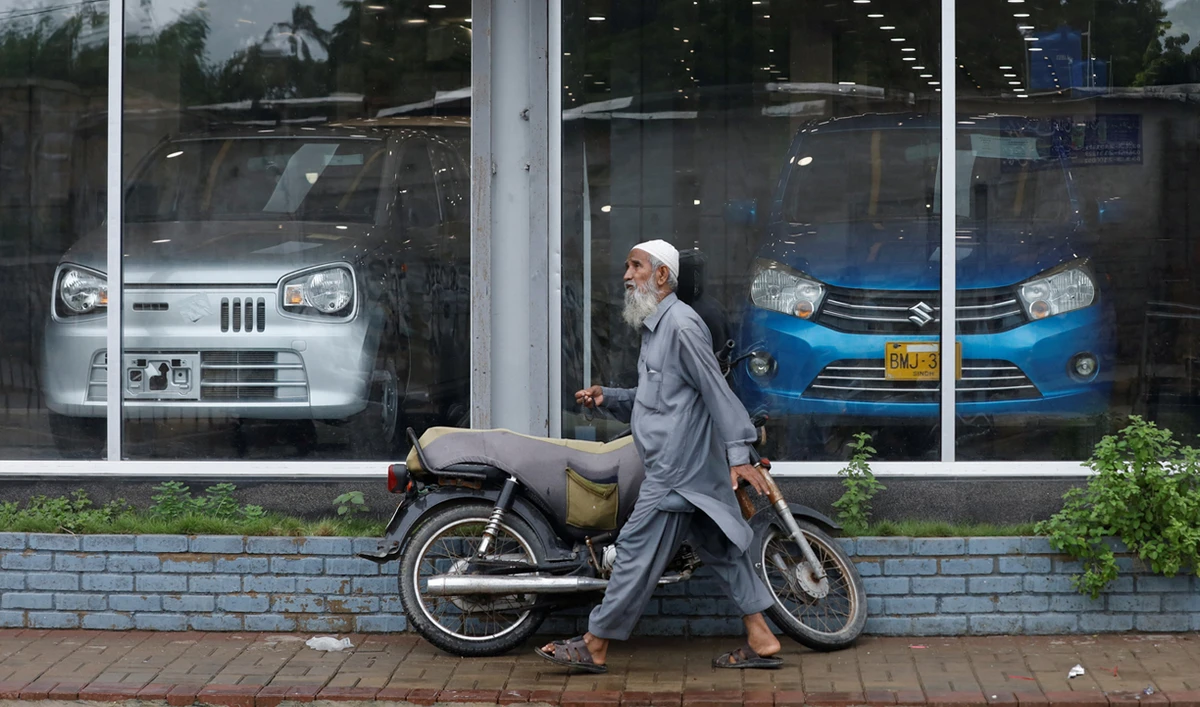
A man walks past a Suzuki outlet, displaying cars in Karachi, Pakistan, July 27, 2022. (REUTERS)
Short Url
Updated 27 July 2022
Follow

Toyota, Suzuki to partially shut Pakistan output over forex, shortage issues

  • Government in recent weeks has attempted to curb imports in the face of depleting foreign reserves
  • Due to widening current account deficit, the Pakistani rupee has lost over 20% of its value this year

KARACHI: Pakistan’s two leading car assemblers, Toyota and Suzuki, plan partial plant shutdowns next month due to unavailability of raw material amid import restrictions and exchange rate volatility, officials at both companies said on Wednesday.

The government in recent weeks has attempted to curb imports in the face of fast depleting foreign reserves, a declining currency and a widening current account deficit, because of which the rupee has lost over 20 percent of its value this year.

The move has had a cascading effect on industries that rely on imports to complete finished goods as they say the central bank has delayed the clearance of letters of credit with banks facing a shortage of dollars, affecting their ability to import materials.

“There will be 10 working days next month, only if central bank allows us to open letter of credit based on the quota they promised,” Ali Asghar Jamali, chief executive at Indus Motor Company Ltd. which assembles Toyota vehicles in Pakistan, told Reuters.

He said the company was offering refunds to customers facing delays and markups on their payments, with deliveries likely to be delayed by at least three months and prices to be revised as the country does not have dollars available.

Reserves with the central bank have fallen to as low as $9.3 billion, enough to cover less than two months of imports. The current account deficit for the last financial year touched 5 percent of GDP with imports hitting record highs.

Pak Suzuki, which assembles Suzuki vehicles locally, echoed the sentiment, citing the central bank’s new mechanism for prior approval for imports.

“Restrictions had adversely impacted clearance of import consignments from ports,” the head of public relations for Pak Suzuki Motors, Shafiq A. Shaikh, said.

He said the unavailability of materials may result in a plant shutdown in August.

“If the same situation continues, then from August 2022 we have big problems,” Shaikh said.

State Bank of Pakistan did not respond to requests for comment.

The sale of locally assembled cars in Pakistan surged by around 50 percent from July 2021 to May 2022 compared with the same period of the previous year, according to the data of Pakistan Automotive Manufactures Association.

Pakistan denies reports army ordered ‘depopulation’ in Tirah Valley ahead of anti-militant operation

Updated 5 sec ago
Follow

Pakistan denies reports army ordered ‘depopulation’ in Tirah Valley ahead of anti-militant operation

  • Tirah Valley residents started fleeing homes this month ahead of a planned military operation against militants
  • Reports aimed at creating alarm among public, disinformation against security institutions, says information ministry

ISLAMABAD: Pakistan’s information ministry on Sunday denied reports the army has ordered depopulation in the northwestern Tirah Valley ahead of a planned anti-militant offensive, stating that any movement of residents from the area is voluntary. 

The denial from the government comes as residents of Tirah Valley in Pakistan’s northwestern Khyber Pakhtunkhwa (KP) province bordering Afghanistan flee their homes ahead of a planned military operation by the army against militants, particularly the Tehreek-e-Taliban Pakistan (TTP) group. 

Despite major military operations in the mid-2010s, Tirah Valley has remained a stronghold for insurgents, prompting authorities to plan what they describe as a targeted clearance.

“The government has taken notice of misleading claims in circulation regarding alleged ‘depopulation’ from Tirah Valley on the orders of the Army,” the Ministry of Information and Broadcasting (MoIB) said in a statement on Sunday. 

“These assertions are baseless, malicious, and driven by ulterior motives aimed at creating alarm among the public, disinformation against security institutions and furthering vested political interest.”

The ministry said Pakistan’s federal government and the armed forces had not issued directives for any such depopulation of the territory. It clarified that law enforcement agencies are “routinely conducting targeted, intelligence-based operations strictly against terrorist elements” with care to avoid disruption to peaceful civilian life. 

It said locals are increasingly concerned over presence of the “khawarij,” a term the military and government frequently use for the TTP, in Tirah Valley and desire peace and stability in the area.

The information ministry mentioned that the Khyber Pakhtunkhwa Relief, Rehabilitation and Resettlement Department issued a notification on Dec. 26 last year for the release of funds, reportedly Rs4 billion [$14.24 million], for the “anticipated temporary and voluntary movement of population from certain localities of Tirah.”

Families load their belongings onto vehicles in Pakistan’s Tirah Valley on January 15, 2026. (AN photo)

It also said that the notification mentioned that the deputy commissioner of Khyber District, where Tirah Valley is located, said the voluntary movement of people reflects the views of the local population articulated through a jirga at the district level. 

“Hence any stated position of the Provincial Government or their officials being conveyed to media that the said migration has anything to do with the Armed Forces is false and fabricated,” the information ministry said. 

“Given with malafide intent to gain political capital and unfortunately malign security institutions and therefore highly regrettable.”

The evacuation has exposed tensions between the provincial government, run by former prime minister Imran Khan’s Pakistan Tehreek-e-Insaf (PTI) party, and the military establishment over the use of force in the region.

“We have neither allowed the operation nor will we ever allow the operation,” KP Law Minister Aftab Alam Afridi said earlier this month, arguing that past military campaigns had failed to deliver lasting stability.

Pakistan military spokesperson Lt. Gen. Ahmed Shareef Chaudhry has previously defended security operations as necessary as militant attacks surge in the country. 

In a recent briefing, Chaudhry said security forces carried out 75,175 intelligence-based operations nationwide last year, including more than 14,000 in Khyber Pakhtunkhwa, attributing the surge in violence to what he described as a “politically conducive environment” for militants.