PARIS/HAMBURG: Traders bought up to seven shipments of French wheat aimed for Pakistan as part of a 300,000 tonne tender last week, European traders said on Tuesday, in a further sign that importing countries are turning to western Europe to fill a gap left by missing Black Sea grain.
A severe drought in Pakistan and the impact of higher fertiliser prices have led the country to make large purchases on the world market where supplies have tightened since Russia's invasion of Ukraine.
"It looks like most Pakistan sales made earlier last week are being covered from France, whereas it would have been a typical Black Sea business under normal circumstances but France looks competitive now," a trader said.
The Trading Corporation of Pakistan (TCP) in its international tender last week is reported to have bought 240,000 tonnes from trading house Viterra and 60,000 tonnes from Aston, all at $404.86 c&f free out. Shipment was sought between Aug. 1-25.
China also made a large purchase of French wheat last week, with latest trade estimates putting the volume at between seven and 10 shipments.
"This is another confirmation of France’s good export prospects as the war in Ukraine continues to make Black Sea exports difficult," a second trader said.
Traders, however, said it still could not be ruled out that some Russian wheat could be supplied in the tenders.
"As the purchases are optional origin, you can never make an absolutely categorical statement on this matter," a third trader said.
TCP is tendering again this week to purchase an additional 200,000 tonnes of wheat for shipment between Sept. 1-16.
The lowest offer in the tender which closed on Monday was believed to be $407.49 a tonne c&f, European traders said in initial assessments on Tuesday.
TCP is undertaking its usual policy of asking more trading houses participating in this week's tender to match the lowest price offered, traders said. This could take until Thursday when the Pakistani government will be asked to approve the purchase.


Traders turn to French wheat aimed for Pakistan as Black Sea supplies tighten

https://arab.news/rma5h
Traders turn to French wheat aimed for Pakistan as Black Sea supplies tighten

- A severe drought in Pakistan and the impact of higher fertiliser prices have led the country to make large purchases
- Traders said it still could not be ruled out that some Russian wheat could be supplied in the tenders
‘Historic moment’: Pakistani satellite bound for orbit in Chinese high-stakes moon mission
- Chang’e 6 is a planned robotic Chinese and Pakistani lunar exploration mission that will attempt China’s second sample return mission
- Around 100 students from Pakistan’s Institute of Space Technology have contributed to the satellite set for launch on Friday
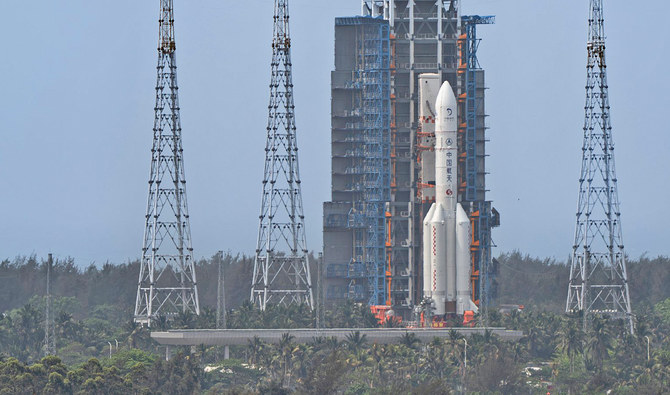
ISLAMABAD: The developers of ‘ICUBE-Qamar’ (ICUBE-Q), a cube satellite poised to become Pakistan’s first entry into lunar orbit as part of China’s Chang’e-6 mission tomorrow, Friday, have described it as a “historic moment” that will open new avenues for future deep space missions from the South Asian nation.
Chang’e 6 is a planned robotic Chinese and Pakistani lunar exploration mission that will attempt Beijing’s second sample return mission and aims to obtain the first-ever soil and rock samples from the lunar far side and return them to earth. The samples will contain material ejected from the lunar mantle and will be used to provide insight into the history of the moon, earth, and the solar system.
The primary phase of the mission is expected to last about 53 days. Like its predecessors, the spacecraft is named after the Chinese moon goddess Chang’e.
Around 100 students from Pakistan’s Institute of Space Technology (IST) have contributed to developing the satellite, scheduled to launch into lunar orbit at 12:50 PM PST on Friday, May 3, 2024, from the Wenchang space launch site in Hainan, China.
“This is Pakistan’s first deep space mission which is indeed a historic moment and following that maybe in the future other deep space missions can be planned,” Khurram Khurshid, the head of the electrical engineering and computer science department at IST and a co-lead on the satellite project, told Arab News.
Pakistan’s proposal to build the satellite was accepted by the China National Space Agency (CNSA) from plans submitted by eight member states of the Asia-Pacific Space Cooperation Organization (APSCO).
“In the first month of 2022, out of all the proposals from the APSCO member states, the Chinese space agency thoroughly evaluated and selected one, which happened to be ours which was a significant moment for us as our proposal was chosen in deep space mission.”
The design, development, and qualification of the ICUBE-Q satellite were spearheaded by faculty members and students of the IST in collaboration with China’s Shanghai Jiao Tong University (SJTU), with support from Pakistan’s National Space Agency, SUPARCO.
“Along with faculty members, around 100 students contributed to various aspects of the satellite, including electrical engineering for electronics, aerospace engineering for control systems, computer science for software, and mechanical/materials engineering for identifying materials suitable for the moon’s harsh environment,” Khurshid said.
The ICUBE-Q has two cameras as payload for taking images of the lunar surface that will be transmitted back to earth for analysis, the official said.
Khurshid said after selection in 2022, it took two years of round-the-clock work by students and researchers to complete the project within the deadline.
“The design and development of the satellite were finished approximately eight months ago after rigorous qualification tests, some conducted in-house and others by SPARCO,” he said.
The satellite was then sent to China eight months back for further verification to ensure it met all requirements.
“China’s stringent standards meant even minor discrepancies could result in rejection, emphasizing the importance of successful qualification tests,” he added, “and once these tests were successfully completed, it marked a significant milestone as it validated our designs and confirmed the satellite’s readiness for the mission.”
The major cost in such missions was the substantial funding required to launch a satellite, Khurshid said, adding that the cost of manufacturing the satellite was not high and was funded by SUPARCO:
“It is a small satellite, like a 7 kg satellite, so it was not a big cost as major cost required for launching a satellite will be provided free by China.”
After securing the free launch opportunity, all the faculty and students involved “got very excited and devoted their efforts to this project,” Khurshid said.
Four of the Pakistan team members are in China to witness the historic launching.
Pakistan double landmine blasts kill one person, wound at least 18
- First mine exploded when a truck was passing through a valley in coal-rich Duki district in Balochistan province
- Second detonated when counter-terrorism officials and civilians were examining initial blast site, police said
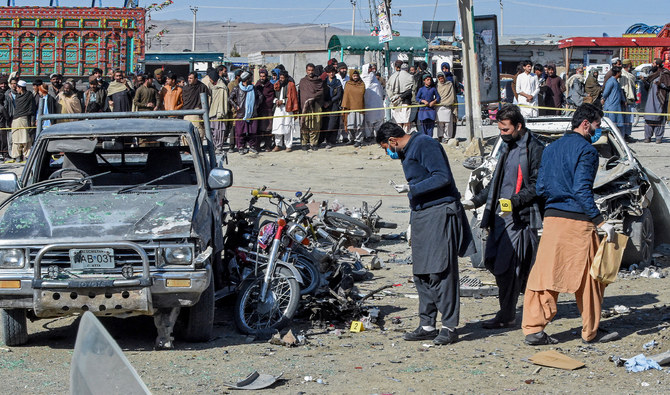
QUETTA, Pakistan: Double landmine blasts killed one person and wounded at least 18 on Thursday in Pakistan’s southwest, a police officer said.
The first mine exploded when a truck was passing through a valley in coal-rich Duki district in Balochistan province. The second detonated when counter-terrorism officials and civilians were examining the initial blast site, said district police officer Asif Haleem.
No one immediately claimed responsibility for the blast. But Baloch separatist groups have previously struck security personnel or infrastructure in the southwest.
They initially wanted a greater share of provincial resources, but later initiated an insurgency for independence from the central government.
Also on Thursday, an Islamabad-based think tank said that militant assaults killed 70 people nationwide in April, mostly in northwest Khyber Pakhtunkhwa province.
The Pakistan Institute for Conflict and Security Studies also said the country experienced 323 militant attacks in the first four months of the year, resulting in 324 deaths.
Such incidents are unusual in eastern Punjab province, but police said militants from banned groups are responsible for killing three uniformed officers in Lahore city during the past 10 days.
Inspector General of Punjab Usman Anwar urged people to report any suspicious activity.
A report issued in January by another think tank, the Pak Institute for Peace Studies, said there were 306 attacks last year, killing 693 people.
Volunteers who helped with rescue work during UAE rains honored by Pakistani consulate
- Last month UAE received heaviest rains in the 75 years that records have been kept
- Rains brought much of the country to a standstill and caused significant damage
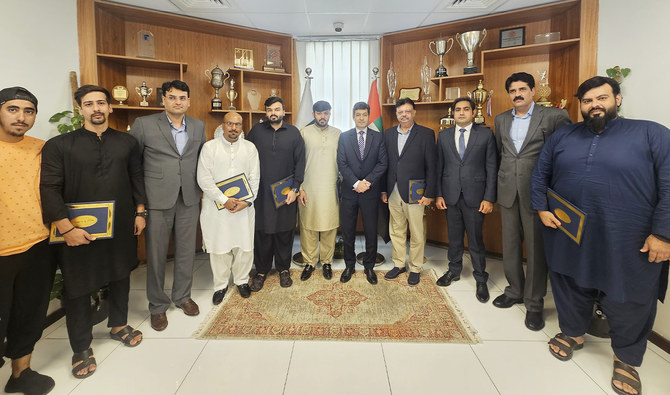
ISLAMABAD: A team of Pakistani volunteers who helped rescue hundreds of people and dozens of vehicles during last month’s record-breaking rains and flooding in the UAE have been honored by the Consulate General of Pakistan in Dubai, a press statement from the mission said on Thursday.
Last month, Dubai was hit by unprecedented storms that paralyzed the Emirates for days. The downpours brought much of the country to a standstill and caused significant damage, flooding trapped residents in traffic, offices and homes and overrunning malls and roads.
“The volunteers were honored with certificates of appreciation by the Consul General in recognition of their unmatched services. Other officers and officials of the consulate were also present on the occasion,” the consulate’s statement said.
“We are immensely proud of the Pakistani volunteers who demonstrated exceptional courage and compassion during the recent heavy rains in the UAE. Their selfless dedication to rescuing those in need reflects the true spirit of humanity … We salute these volunteers for their unwavering commitment to serving others, and their actions serve as an inspiration to us all.”
One volunteer, Tanvir Athar, said their efforts had also inspired others.
“After our services in the recent rains, a number of volunteers have connected us and offered their services for any such efforts in future,” Athar was quoted in the statement as saying.
He said the group of volunteers had been rescuing people stuck in deserts and developed a mobile application to receive requests for assistance.
Last month, Dubai had to endure the towering task of clearing its water clogged roads and drying out flooded homes after a record storm saw a year’s rainfall in a day. Dubai International Airport, a major travel hub, also struggled for days to clear a backlog of flights and many roads were still flooded in the aftermath of the deluge.
The rains were the heaviest experienced by the United Arab Emirates in the 75 years that records have been kept.
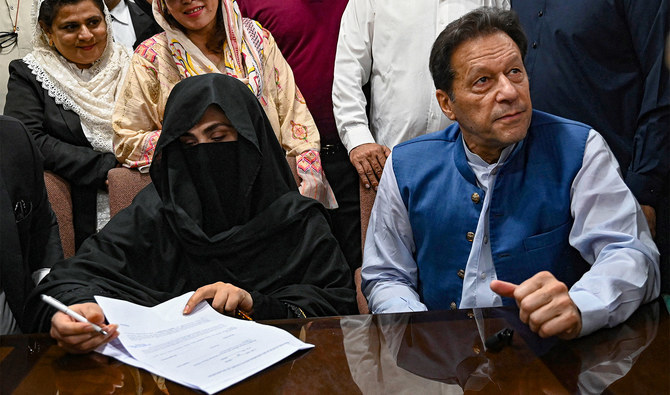
Pakistan court reserves verdict on plea by Imran Khan’s wife to be moved out of house arrest
- Bushra Bibi has requested court to shift her from Bani Gala home to Adiala Jail where Khan is also imprisoned
- Bushra has been handed two sentences, 14 years in graft case and 7 years for violating Pakistan's marriage law
ISLAMABAD: The Islamabad High Court (IHC) on Thursday reserved its verdict on a petition filed by ex-premier Imran Khan’s wife Bushra Bibi seeking her transfer form her Banigala residence, declared a sub-jail, to Adiala Jail, where her husband is incarcerated.
Bushra has been living under house arrest at her husband's sprawling Bani Gala mansion in Islamabad since Jan. 31 when both were sentenced to 14 years in prison in a case that relates to accusations they undervalued gifts from a state repository and gained profits from selling them while Khan was prime minister from 2018-22. Khan is jailed at Rawalpindi's Adiala Jail.
In February, Khan and his wife were also sentenced to seven years on charges they violated the country's marriage law when they wed in 2018 - the fourth sentence for Khan and the second for his wife.
During Thursday’s hearing, Bushra’s lawyer Usman Gill said after her sentencing in the state repository case by the trial court, his client went to Adiala Jail as per the trial court order’s which was also forwarded to the jail superintendent. But on the orders of the interior ministry, the chief commissioner issued an “illegal notification for transfer,” the lawyer argued.
“There was no instruction from the authorities concerned regarding the transfer from Adiala Jail to Banigala,” he said.
“Neither the provincial government nor did the Punjab prisons inspector general issue any such directive [for transfer] … The place of imprisonment was to be determined by the trial court and not the chief commissioner.”
The state’s counsel argued that Bushra was moved to Bani Gala because of security threats.
“Were the 141 women who were brought to Adiala after Bushra less privileged?” the judge hearing the case asked, saying they too should be imprisoned at their houses then.
“Sometimes you say that [you] cannot present her [Bushra] in the court as there are threats and at times, you say that the jail is not secure. Are you secure?” the judge quipped. “If I am confined in my home by my own will, I would be very happy but how can a prisoner’s property be turned into a sub-jail against his will?”
The IHC subsequently reserved its verdict on the petition.
In a separate petition to the court filed last month, Bushar, a deeply religious woman widely believed to be Khan’s spiritual guide, alleged she was being poisoned through contaminated food and subjected to “mental and physical torture which is becoming a serious threat to her health and life.” She also alleged that her room and bathroom had been bugged and multiple hidden cameras installed in a “blatant violation of her privacy, dignity and honor.”
The petition said Bushra was only given ten minutes for meetings with family members and lawyers, with five jail staff supervising at all times.
Khan was first jailed after being handed a three-year prison sentence in August 2023 by the Election Commission for not declaring assets earned from selling gifts worth more than 140 million rupees ($501,000) in state possession and received during his premiership. In January, Khan and Bushra were handed 14-year jail terms following a separate investigation by the country’s top anti-graft body into the same charges involving state gifts.
An anti-graft court in Islamabad also handed Khan a 10-year jail term in January for revealing state secrets, a week before national elections on Feb. 8. The ruling on his marriage to Bushra and a seven-year sentence each for both also came ahead of the polls.
Khan has also been indicted under Pakistan's anti-terrorism law in connection with violence against the military that erupted following his brief arrest related to the Al-Qadir case on May 9. A section of Pakistan's 1997 anti-terrorism act prescribes the death penalty as maximum punishment. Khan has denied the charges under the anti-terrorism law, saying he was in detention when the violence took place.
Khan’s convictions, which mean he is banned from holding public office, ruled the 71-year-old out of general elections held earlier this year. Arguably Pakistan's most popular politician, Khan says all cases against him are motivated to keep him out of politics.

Pakistan PM’s recent Saudi visit ‘most successful in decades’ — information minister
- Shehbaz Sharif was in Saudi Arabia from April 27-30 where he met crown prince, several top Saudi ministers
- “High-powered” delegation of Saudi businessmen due in Pakistan in “few days” to discuss private sector investments
ISLAMABAD: Pakistani Information Minister Attaullah Tarar said on Friday Prime Minister Shehbaz Sharif’s recent visit to Saudi Arabia was the most successful tour to the Kingdom in decades by a Pakistani leader, with the premier holding at least twelve meetings, including with the crown prince.
Sharif was in Riyadh from Apr. 27-30 to attend a special two-day meeting of the World Economic Forum on global collaboration, growth and energy. On the sidelines of the WEF conference, Sharif met and discussed bilateral investment and economic partnerships with Crown Prince Mohammed bin Salman and various top officials from the Kingdom.
This was Sharif’s second meeting with the crown prince in a month. Before that he also met him when he last traveled to the Kindom on April 6-8.
“Such a successful tour of Saudi Arabia has not been seen in decades,” Tarar told a press briefing on Friday, speaking about Sharif’s recent trip to Riyadh for the WEF special meeting. “With Saudi ministers, the process of meetings went on for two days.”
Among those Sharif met were the Saudi ministers of finance, industries, investment, energy, climate and economy and planning, the adviser of the Saudi-Pakistan Supreme Coordination Council and the presidents of the Saudi central bank and Islamic Development Bank.
“PM had twelve meetings in two days which has not happened in history,” Tarar said. “And in the meetings every minister came and told us that it was the order of Crown Prince Mohammed bin Salman that they had to do efforts for Pakistan and cooperate with Pakistan and we have come to tell you we will do whatever we can for investments in Pakistan.”
Tarar said a “high-powered” delegation of Saudi business people and heads of major Saudi companies would be in Islamabad in the “next few days.”
“Delegation is coming to islamabad and we have planned a big program for investment in the private sector,” the information minister added.
Pakistan and Saudi Arabia enjoy strong trade, defense and cultural ties. The Kingdom is home to over 2.7 million Pakistani expatriates and serves as the top source of remittances to the cash-strapped South Asian country.
Both Pakistan and Saudi Arabia have been closely working to increase bilateral trade and investment deals in recent weeks, and the Kingdom recently reaffirmed its commitment to expedite an investment package worth $5 billion.
Cash-strapped Pakistan desperately needs to shore up its foreign reserves and signal to the International Monetary Fund (IMF) that it can continue to meet requirements for foreign financing which has been a key demand in previous bailout packages.
Saudi Arabia has often come to Pakistan’s aid in the past, regularly providing it oil on deferred payments and offering direct financial support to help stabilize its economy and shore up forex reserves.