

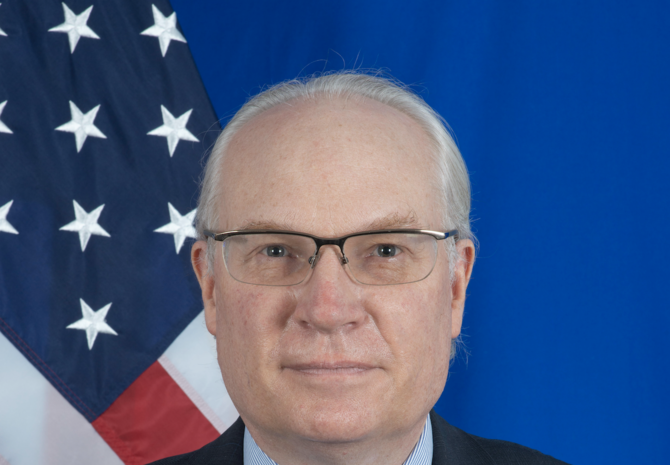
US special envoy for Yemen travels to Saudi Arabia, Jordan

US special envoy for Yemen Tim Lenderking is traveling to Saudi Arabia and Jordan to continue diplomatic efforts in support of the truce in Yemen. (Supplied) 
Short Url
Updated 25 July 2022
Follow

US special envoy for Yemen travels to Saudi Arabia, Jordan

  • The trip follows Biden’s recent visit to Jeddah during which Yemen figured prominently in discussions

RIYADH: US special envoy for Yemen Tim Lenderking is traveling to the capitals of Saudi Arabia and Jordan to continue diplomatic efforts in support of the truce in Yemen.

The trip, starting on Monday, follows US President Joe Biden’s recent visit to Jeddah during which Yemen figured prominently in discussions, the US State Department said in a statement.

“In close coordination with the UN special envoy and our regional and Yemeni partners, special envoy Lenderking will continue our efforts to help advance peace,” the statement said.

The envoy’s engagements will focus on “expanding, extending, and renewing the current truce agreement that will further the tangible benefits already reaching Yemenis and build towards a more comprehensive, inclusive peace process and permanent ceasefire.”

The truce in Yemen first came into effect in April and was then extended for a two-month period in June. It ends on August 2 and the international community is keen for it to be extended.

The US called on “all parties to choose peace and recovery over continued war and destruction for the sake of the Yemeni people.”


Turkiye’s Kurdish party says Syria deal leaves Ankara ‘no excuses’ on peace process

Updated 2 sec ago
Follow

Turkiye’s Kurdish party says Syria deal leaves Ankara ‘no excuses’ on peace process

ANKARA: Turkiye’s pro-Kurdish DEM Party said on Monday that the Turkish government had no more “excuses” to delay a peace process with the Kurdistan Workers Party (PKK) now that a landmark integration deal was achieved in neighboring Syria.
On Sunday in Syria, the Kurdish-led Syrian Democratic Forces (SDF) agreed to come under the control of authorities in Damascus — a move that Ankara had long sought as integral to ‌its own peace ‌effort with the PKK. “For more than a ‌year, ⁠the ​government ‌has presented the SDF’s integration with Damascus as the biggest obstacle to the process,” Tuncer Bakirhan, co-leader of the DEM Party, told Reuters, in some of the party’s first public comments on the deal in Syria.
“The government will no longer have any excuses left. Now it is the government’s turn to take concrete steps.” Bakirhan cautioned President Tayyip Erdogan’s ⁠government against concluding that the rolling back Kurdish territorial gains in Syria negated the need ‌for a peace process in Turkiye. “If the ‍government calculates that ‘we have weakened ‍the Kurds in Syria, so there is no longer a ‍need for a process in Turkiye,’ it would be making a historic mistake,” he said in the interview.
Turkish officials said earlier on Monday that the Syrian integration deal, if implemented, could
advance the more than year-long process with the ​PKK, which is based in northern Iraq. Erdogan urged
swift integration of Kurdish fighters into Syria’s armed forces. Turkiye, the strongest ⁠foreign backer of Damascus, has since 2016 repeatedly sent forces into northern Syria to curb the gains of the SDF — which after the 2011–2024 civil war had controlled more than a quarter of Syria while fighting Islamic State with strong US backing.
The United States has built close ties with Damascus over the last year and was closely involved in mediation between it and the SDF toward the deal.
Bakirhan said progress required recognition of Kurdish rights on both sides of the border.
“What needs to be done is clear: Kurdish rights must be recognized ‌in both Turkiye and Syria, democratic regimes must be established, and freedoms must be guaranteed,” he said.