

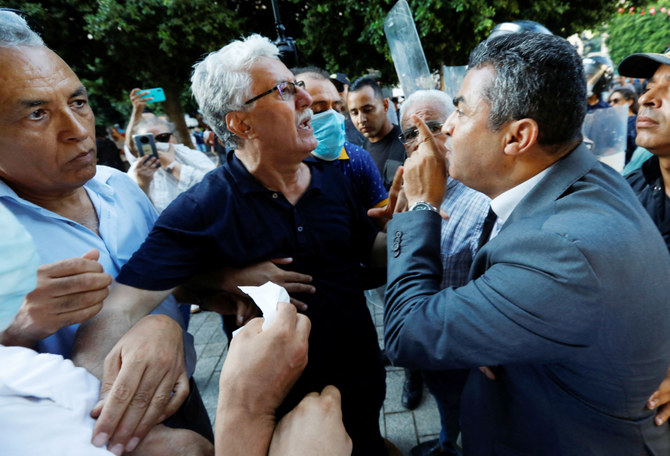

TUNIS: Hamma Al-Hammami knows the peril Tunisia risks if it slides back into autocracy, as he and opposition parties warn it may do if President Kais Saied passes his draft constitution in a referendum on Monday.
Hammami, a leftist political leader, was repeatedly imprisoned and tortured from 1972 until the 2011 revolution that brought democracy to Tunisia — a moment he experienced from inside an Interior Ministry cell hearing the crowd roar outside.
Now, he says, the struggle for freedom must resume after a decade in which Tunisians could say what they pleased, criticize their leaders and vote in fair elections.
“He is a sultan, not a president,” he said of Saied.
“The struggle for freedom and dignity will start again.”
Saied says his moves since last year to dismiss the parliament, take over government, rule by decree and rewrite the constitution — which his critics call a coup — were necessary to save Tunisia from years of stagnation.
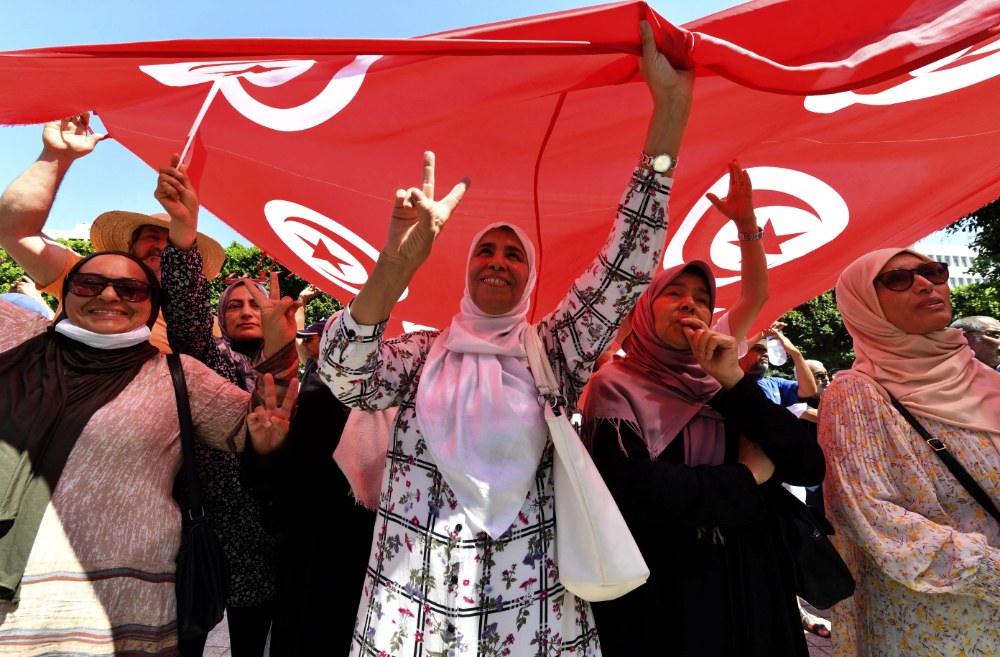
Tunisian protesters raise a flag on July 23, 2022, during a demonstration along Habib Bourguiba avenue in the capital Tunis, against their president and the upcoming July 25 constitutional referendum. (AFP)
While Tunisians have embraced the rights they won in 2011, they have suffered from economic decline, corruption and political in-fighting.
Saied has repeatedly vowed not to become a dictator and has said he will uphold the rights and freedoms secured after the 2011 revolution when autocratic leader Zine Al-Abidine Ben Ali was ousted.
However, his draft constitution brings nearly all powers under the president, removing most checks on his authority. While it guarantees freedoms in one clause, it makes them subject to new laws or undefined security needs in another.
There has been no widespread crackdown on dissent, banning of press or mass arrests of Saied’s opponents, but rights groups have concerns.
Last week Amnesty International warned against what it called an “alarming backsliding on human rights,” while a UN rapporteur on judicial independence also warned this month that Saied’s moves to bring the body overseeing judges under his control has raised concerns over the right to a fair trial.
TORTURE
Now 70, Hammami has been a political activist since his student days when he was arrested in 1972 under Tunisia’s first leader after independence, Habib Bourguiba, for protesting against state control of university organizations.
Accused of conspiring against state security, he was trussed “like a chicken,” beaten repeatedly including on the head and genitals, and burned with cigarettes, for hours, he said.
After a month of solitary confinement, torture and execution threats, including being thrown into an open grave with soil flung onto his body, he was released onto the streets of the capital.
Walking down the central Habib Bourguiba Avenue, where the Interior Ministry is located and where most major protests have taken place, he decided to devote himself to political activism.
Rising in Tunisia’s Communist movement, eventually becoming head of the Workers’ Party, he was imprisoned and tortured during 1974-80.
Though Bourguiba later publicly acknowledged that Hammami had been tortured, the persecution continued after Ben Ali seized power in 1987 as he spent years alternately in prison or in hiding, constantly changing his appearance and location.
When Tunisians rose up in December 2010 and January 2011, outraged by the self-immolation of a street seller, Hammami was again detained and taken to the same Interior Ministry cells.
“I heard the people like waves in the sea,” he said, tears pricking his eyes, of the tens of thousands rushing down Habib Bourguiba Avenue the day Ben Ali fled as Hammami listened from the cells.
The revolution began a new phase of his life. His wife, human rights lawyer Radhia Nasraoui, was feted by foreign countries and he was offered positions in the new democratic governments.
He turned them down and remained a vocal critic of successive governments, particularly of the Islamist Ennahda party that is now also a leading foe of Saied and the new constitution.
On Friday evening Hammami joined a small protest of political figures and civil society organizations against the referendum.
“Shut down Kais Saied,” Hammami chanted with the others, marching down Habib Bourguiba Avenue toward the Interior Ministry where he had so often been imprisoned.
Hours after Hammami told Reuters the struggle for freedom would start again, the police set upon his group of protesters, using pepper spray, sticks and arrests to disperse the demonstration.


