

Jordanian King condemns border attacks by ‘Iran-tied militias’

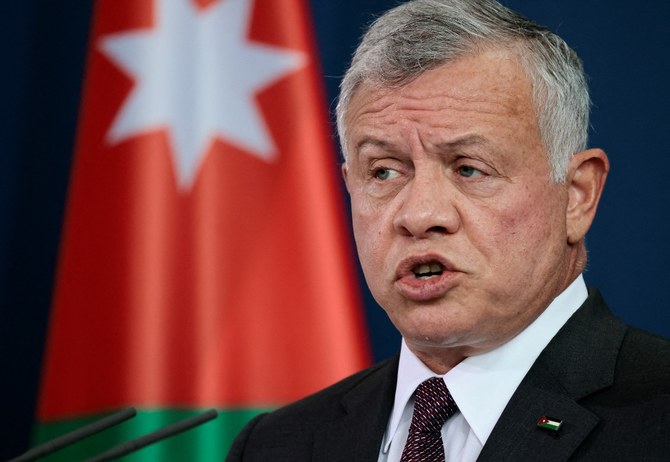
The remarks by Jordan’s King refer to incidents of deadly clashes with drug smugglers on the frontier with Syria. (File/AFP)
Short Url
Updated 24 July 2022
Follow

Jordanian King condemns border attacks by ‘Iran-tied militias’

  • King Abdullah called for “a change of behavior by Iran”
  • The King reassured the public that Jordan continues to coordinate with other countries in order to counter this threat

DUBAI: King Abdullah II protested on Sunday what he described as regular attacks occurring near Jordan’s borders by “militias linked to Iran”, in an interview with Al-Rai newspaper.   

King Abdullah called for “a change of behavior by Iran” and said that Jordan “does not want tensions in the region.” The remarks by Jordan’s King refer to incidents of deadly clashes with drug smugglers on the frontier with Syria.

“Jordan, like the rest of the Arab countries, seeks good relations with Iran, with mutual respect, good neighbourliness, respect for the sovereignty of other states and non-interference in their affairs,” the king said in the interview, published on the state news agency Petra.   

“Drug and arms smuggling operations are a threat to us and to fellow Arab countries. Smuggling operations have reached Arab and European countries,” he added.  

“Our security agencies are alert, professional, and dedicated; and Jordan is capable of thwarting any threat on its borders,” the king continued.   

King Abdullah II reassured the public that Jordan continues to coordinate with other countries in order to counter this threat, which is both a regional and global issue.   

He added that the ramifications stemming out of the Syrian crisis are many and disastrous and will need a strategic approach.   

“Resolving it requires reaching a comprehensive political solution that addresses all its implications, ends the suffering of the Syrian people, creates the conditions to allow for the voluntary return of refugees, and restores security and stability in Syria,” explained King Abdullah II.   

 The Jordanian army conducts regular anti-smuggling operations on the border with Syria, where Iran-backed fighters support the Damascus regime in a civil war that erupted in 2011.

On January 27, Amman said its forces killed 27 drug traffickers supported by armed groups, seizing a large quantity of drugs. An officer and a border guard were killed in a similar clash earlier the same month. 

According to organizations which monitor drug trafficking, the increasingly popular amphetamine-style stimulant captagon is produced in government-controlled areas of Syria and marketed almost exclusively in the Middle East.  

King Abudllah II touched on topics such as Jordan’s handling of the COVID-19 pandemic, the conflict between Russia and Ukraine, the country’s overall economy and the Palestinian cause.   

He also congratulated Saudi Arabia on the Jeddah Summit during his interview because it “reflected the centrality of the Palestinian cause as a priority, and the level of coordination among Arab countries.”

(with AFP)


Sudanese paramilitary forces kill at least 28 people in an attack in Darfur, medical group says

Updated 6 sec ago
Follow

Sudanese paramilitary forces kill at least 28 people in an attack in Darfur, medical group says

  • At least 39 people, including 10 women, were wounded in the attack, the medical group said
  • Emergency Lawyers said RSF fighters torched many houses in the town, forcing people to flee to nearby villages

CAIRO: An attack by Sudanese paramilitary forces on a stronghold of a Darfur tribal leader left at least 28 people dead, a doctors group said Tuesday, the latest in a devastating war with no resolution in sight.
The paramilitary Rapid Support Forces on Monday rampaged through the town of Misteriha in North Darfur province, according to the Sudan Doctors Network, which tracks the country’s ongoing war.
The town is a stronghold of Arab tribal leader Musa Hilal who also hails from the Rizeigat Arab tribe as the majority of the members of the paramilitary RSF.
At least 39 people, including 10 women, were wounded in the attack, the medical group said.
There was no immediate comment from the RSF and motives for the attack were not immediately known.


Sudan’s war erupted in 2023 after tensions between the Sudanese army and the rival RSF escalated into fighting that began in Khartoum, the country’s capital, and spread nationwide. The conflict has killed thousands and triggered mass displacement, disease outbreaks and severe food insecurity. Aid workers have been frequently targeted.
The medical group said RSF shelling hit the town’s health care center on Monday, after which the paramilitary fighters assaulted medical staff and detained at least one of them.
The RSF fighters had begun their offensive on the town over the weekend with drone strikes that hit Hilal’s guesthouse. On Monday, they launched a major ground offensive and took over the town.
Emergency Lawyers, an independent group documenting atrocities in Sudan, said RSF fighters torched many houses in the town, forcing people to flee to nearby villages.
The seizure of Misteriha would likely assert RSF control of Darfur. However, it risks escalating tribal tensions in an area long known for violence and war.
Monday’s attack came four months after the RSF overran el-Fasher, the provincial capital of North Darfur after 18 months of siege. The paramilitaries killed more than 6,000 people between Oct. 25 and Oct. 27 in the city. The attack was marked by atrocities that UN-backed experts said bore ” the hallmarks of genocide.”
The war has created the world’s largest humanitarian crisis, with over 14 million forced to flee their homes. It has fueled disease outbreaks and pushed parts of the country into famine that still spreads as fighting shows no sign of abating.
The latest report by the Integrated Food Security Phase Classification earlier this month warned that severe acute malnutrition, the most dangerous and deadly form of malnutrition, is expected to increase to 800,000 cases, up 4 percent from 2025.
Aid groups have long struggled to meet the growing needs of displaced people across the country and called for a ceasefire to secure aid delivery to remote areas in Darfur and Kordofan — another hotbed in the war.
“The main thing that needs to happen is, of course, a ceasefire,” said Zia Salik, interim UK director of Islamic Relief, an aid group working in Sudan. “Ultimately, that is what’s causing the pain and the difficulty for all of the civilians that are caught in the crosshairs.”