

Pakistan teams up with PETA to stop tests and surgeries on live animals

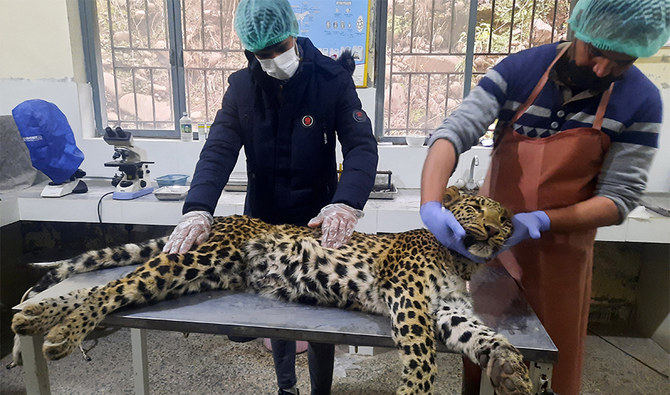
Vets examine the body of a dead female leopard killed by villagers after it reportedly attacked the village people living in Jhelum Valley, Muzaffarabad on February 8, 2022. (AFP/FILE)
Short Url
Updated 23 July 2022
Follow

Pakistan teams up with PETA to stop tests and surgeries on live animals

  • Reforms include replacing animals in medical training, dissection exercises, and biomedical research with superior methods 
  • Move comes after outrage in Pakistan over videos showing animals in states of distress after allegedly being operated upon 

ISLAMABAD: Pakistani authorities and a global animal rights advocacy group, PETA, will be working on replacing animals in medical training, classroom dissection exercises and setting up a national non-animal research method database in the South Asian country, the animal rights group said on Friday. 

The statement came after a meeting of PETA officials and Salman Sufi, head of Pakistan Prime Minister Shehbaz Sharif’s strategic reforms unit, to discuss several potential collaboration topics relating to animal rights in Pakistan. 

These topics included helping Pakistani provinces and universities transition to using more effective, ethical and economical non-animal simulation models for veterinary education, implementing an education program to help children and adults better appreciate how to share the world with animals, and assisting with repatriation efforts for non-native species who have been cruelly trafficked into Pakistan to be kept as household pets and decorations. 

“PETA will be sending follow-up information to Mr. Sufi for his consideration in implementing other strategic important reforms — including replacing the use of animals in medical training, classroom dissection exercises, and biomedical research with superior, state-of-the art methods, as well as setting up a national non-animal research methods database and working to implement PETA’s Research Modernization Deal in Pakistan,” the animal rights group said in a statement. 

“We look forward to a long and productive collaboration that will benefit animals, advance human health, and boost Pakistan’s status on the world stage.” 

In a rare move to ensure animal rights in Pakistan, the government on June 30 banned testing and surgeries on live animals at veterinary schools and industrial complexes in the federal capital, Islamabad, and announced a 15,000 rupee ($65) fine and jail term for animal cruelty offenders. 

The move came after widespread outrage in Pakistan over videos that went viral in May showing animals in various states of distress after allegedly being operated upon by veterinary students. Activists and members of the public widely condemned the practices and demanded action. 

Arab News last month interviewed about a dozen veterinary students belonging to Arid Agriculture University in Rawalpindi, the University of Veterinary and Animal Sciences in Lahore, Riphah International University in Islamabad and Sindh Agriculture University, Tandojam. The students and graduates said they were aware that surgeries and experiments were performed at their institute on live animals but that anesthesia was administered. 

At veterinary schools around the world, the practice of using live animals to teach surgery has been on the decline in the last decade, but an Arab News investigation published on June 10 quoted students and university management saying live animals were being used to teach surgical skills, though they added proper procedures were followed. 

On July 18, PETA also wrote to Riphah International University in Islamabad, citing the June 10 article published by Arab News and seeking a response to the investigation suggesting that the institution required students to obtain stray dogs for harmful surgical practice training. 

The animal rights group urged Riphah International University campuses to immediately implement Sufi’s policy ban on the use of live animals in testing and surgical veterinary training as well as use superior and humane simulation models in veterinary and zoology training. 


Pakistan joins regional talks on Afghanistan in Iran as Kabul stays away

Updated 15 December 2025
Follow

Pakistan joins regional talks on Afghanistan in Iran as Kabul stays away

  • China, Pakistan, Pakistan, Tajikistan, Uzbekistan, Turkmenistan all joined talks organized by Iran, as did Russia
  • Afghanistan was invited but decided not to attend, Taliban-led government was tight-lipped on the reasons

TEHRAN, Iran: Afghanistan’s neighbors met in Iran and agreed to deepen regional coordination to address political, economic and security challenges, as well as calling for sanctions on Afghanistan to be lifted. 

The only absent party? Afghanistan itself.

China, Pakistan, Pakistan, Tajikistan, Uzbekistan and Turkmenistan all joined the talks organized by Iran, as did Russia, according to a statement released after the meeting on Sunday.

Afghanistan was invited but decided not to attend. Its Taliban-led government was tight-lipped on the reasons, with the foreign ministry saying only that it would not participate because Afghanistan “currently maintains active engagement with regional countries through existing regional organizations and formats, and has made good progress in this regard.”

The statement from the talks in Iran stressed the importance of maintaining economic and trade ties with Afghanistan to improve living conditions and called for the country’s integration into regional political and economic processes.

The Taliban were isolated after they retook power in Afghanistan in August 2021, but in the past year, they have developed diplomatic ties. They now raise several billion dollars every year in tax revenues to keep the lights on.

However, Afghanistan is still struggling economically. Millions rely on aid for survival, and the struggling economy has been further impacted by the international community not recognizing the Taliban government’s seizure of power in the wake of the chaotic withdrawal of US-led troops in 2021. Natural disasters and the flow of Afghans fleeing Pakistan under pressure to return home have underlined Afghanistan’s reliance on foreign aid to meet essential needs.

The countries at the talks also voiced security concerns and pledged cooperation in combating terrorism, drug trafficking and human smuggling, while opposing any foreign military presence in Afghanistan. They underscored the responsibility of the international community to lift sanctions and release Afghanistan’s frozen assets, and urged international organizations to support the dignified return of Afghan refugees from neighboring countries.

The participants backed efforts to reduce tensions between Afghanistan and Pakistan, which have been particularly strained, with border clashes between the two sides killing dozens of civilians, soldiers and suspected militants and wounding hundreds more.

The violence followed explosions in Kabul on Oct. 9 that Afghan authorities blamed on Pakistan. A Qatar-mediated ceasefire has largely held since October, although there have been limited border clashes. The two sides failed to reach an overall agreement in November despite three rounds of peace talks.

Asif Durrani, Pakistan’s former special representative for Afghanistan, said the Taliban government’s decision to skip the meeting reflected a “lack of political maturity.” 

Writing on X, Durrani said the move reinforced concerns that the Taliban were unwilling to negotiate, instead adopting an “I don’t accept” stance that he said would do little to resolve serious regional problems.

Mohammad Sadiq, the current Pakistani special representative for Afghanistan who attended the talks, wrote on X that the Afghan people had already suffered enough and deserved better.

Only an Afghanistan that does not harbor militants would inspire confidence among neighboring and regional countries to engage meaningfully with Kabul and help unlock the country’s economic and connectivity potential, he wrote.

Participants agreed to hold the next meeting of foreign ministers of Afghanistan’s neighboring countries as soon as possible in Ashgabat, Turkmenistan, and welcomed Pakistan’s offer to host the next round of special envoys’ talks in Islamabad in March.

Iran’s foreign ministry spokesman, Esmail Baghaei, on Sunday said that the meeting had not been held for about two years and marked the first such gathering attended by special envoys on Afghanistan from neighboring countries as well as Russia. Russia and Uzbekistan sent the special envoys of their presidents, while Pakistan was represented by a delegate from the prime minister’s office.

Landlocked Afghanistan is sandwiched between the Middle East, Central Asia, and South Asia, making it strategically located for energy-rich and energy-hungry nations.