

New polio case in northwestern Pakistan takes year's count to 13

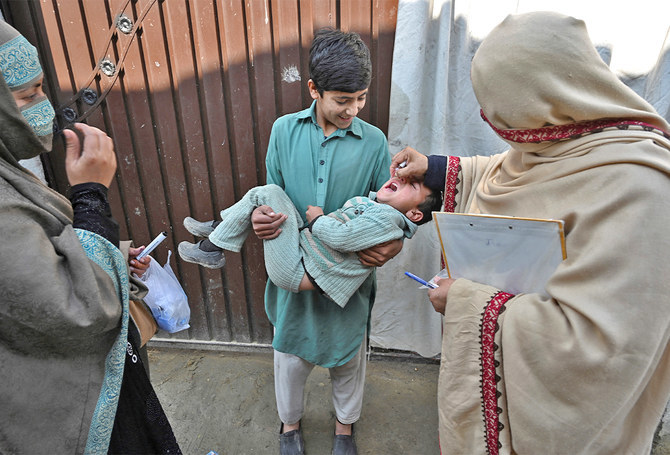
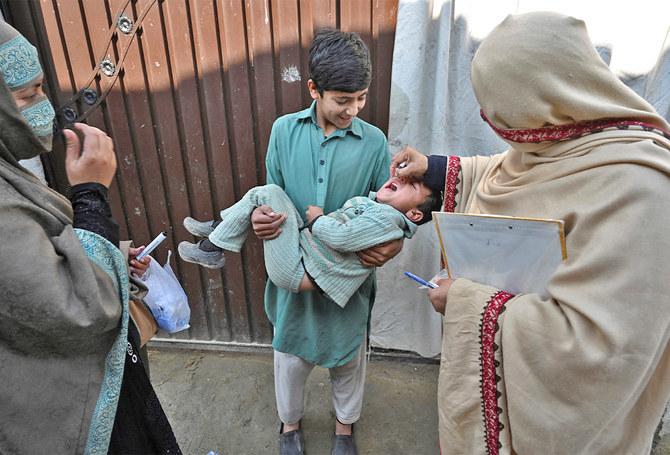
A health worker administers polio vaccine drops to a child during a polio vaccination campaign in the Pakistan's Khyber Pakhtunkhwa province on January 24, 2022. (AFP/File)
Short Url
Updated 23 July 2022
Follow

New polio case in northwestern Pakistan takes year's count to 13

  • Healthy ministry says an 18-month child paralyzed by wild polio virus in Lakki Marwat 
  • All children paralyzed in Pakistan this year belong to southern Khyber Pakhtunkhwa 

ISLAMABAD: Pakistani health officials on Friday confirmed the 13th case of polio virus so far this year in the country’s northwestern Khyber Pakhtunkhwa province, the health ministry said. 

The outbreak, after the first polio case of 2022 was registered in North Waziristan in April, is a blow to the South Asian nation’s efforts to eradicate the disease, which can cause severe paralysis in children. 

So far, 12 cases of the virus have been reported in North Waziristan district, while latest has been detected in Lakki Marwat district. 

“An 18-month child was paralyzed by wild polio in Lakki Marwat,” Pakistan’s health ministry said in a statement Friday. 

“The child had onset of paralysis on 20 June and is suffering from disabilities in both lower limbs. This is the thirteenth case in Pakistan this year.” 

All children paralyzed in Pakistan this year belong to southern parts of the province, the health ministry added. 

Most people residing in Pakistan’s conservative northwest consider the polio vaccination a Western campaign aimed at sterilizing the country’s population. 

In 2012, the local Taliban ordered a ban on immunization against polio in the country’s tribal areas bordering Afghanistan, while dozens of polio vaccinators and policemen have been killed in attacks on polio teams in the country. 

In April, the South Asian country detected the first case of the debilitating disease after a gap of 15 months. In less than three months, Pakistan has reported 12 more cases. 

“The virus remains contained in the districts at highest risk,” the statement quoted Health Minister Abdul Qadir Patel as saying. 

“To interrupt virus transmission in southern Khyber-Pakhtunkhwa, we have started giving injectable vaccines due to higher acceptance of this form of immunization, as well as offering hygiene products such as soap to prevent the spread of all germs.” 

Pakistan has for the past 25 years carried out regular inoculation campaigns in which health workers go door-to-door to give polio drops to children. Most of the workers are women, as they can get better access to mothers and children. The anti-polio teams are often escorted by security forces. 

So far this year, the government has carried out three nationwide anti-polio drives — in January, March and in May. During the March campaign, gunmen in northwestern Pakistan shot and killed a female polio worker as she was returning home after a day of vaccinations. And in January, gunmen shot and killed a police officer providing security for polio vaccination workers, also in the country’s northwest. 

Pakistan and Afghanistan are the only countries in the world where polio remains endemic. In 2021, Pakistan reported only one case, raising hopes it was close to eradicating polio. 


Pakistan turns to immersive technology to reimagine ancient Gandhara

Updated 12 sec ago
Follow

Pakistan turns to immersive technology to reimagine ancient Gandhara

  • New gallery uses artificial intelligence and 3D visuals to present Buddhist heritage
  • Visitors can explore archaeological sites digitally rather than through static displays

ISLAMABAD: At the Islamabad Museum, history no longer sits quietly behind glass.

In September 2025, the museum introduced Pakistan’s first Digital Immersive Gallery, an experiment in how ancient civilizations can be narrated in the age of artificial intelligence, 3D projection and virtual environments. Developed in collaboration with the Korea Heritage Agency, Pakistan’s Department of Archaeology and the National Heritage and Culture Division, the gallery marks a shift from object-centered displays to experience-based storytelling.

Rather than beginning with labels and timelines, the gallery opens with movement, sound and light. Visitors are invited to step into a reconstructed visual world shaped around Gandhara, one of South Asia’s most influential yet often under-explained civilizations that developed across what is now northwestern Pakistan and parts of eastern Afghanistan and later played a foundational role in the spread of Buddhism beyond the subcontinent.

“We have shown here in our Immersive Gallery how Buddhism flourished here, how it was introduced, how it declined and how it shifted to China, Korea and Japan from here,” Dr. Abdul Ghafoor, Deputy Director at the Department of Archaeology and Museums, told Arab News.

“In order to make it, the content developed by Korea has fully used AI and IT,” he continued. “AI and IT are common in Korea and other developed countries, but we have done it for the first time in Pakistan.”

A picture taken on December 30, 2025, shows women watching Gandhara history at the Digital Immersive Gallery in Islamabad, Pakistan. (AN photo)

Gandhara flourished between the first century BCE and the fifth century CE in this region, which served as a cultural crossroads, shaped by Greek, Central Asian, Persian and South Asian influences.

It was here that artists first began depicting the Buddha in human form, a visual language that later traveled along trade routes to Central Asia, China, Korea and Japan. This transmission of ideas, beliefs and artistic styles forms the core narrative of the immersive gallery.

“Inside the gallery, visitors are drawn into a world of interactive experiences, heritage documentaries they can zoom in and out of, Gandhara artifacts explored up close and photo zones where they can capture themselves against Pakistan’s most iconic sites,” Muhammad Azeem, Project Director at the Department of Archaeology and Museums, said.

A picture taken on December 30, 2025, shows map of Gandhara civilization at the Digital Immersive Gallery in Islamabad, Pakistan. (AN photo)

While Gandhara anchors the gallery, the experience expands outward to place it within a longer and wider historical arc. One section is dedicated to Pakistan’s six UNESCO World Heritage Sites, offering visitors a compressed journey across centuries and regions.

“The main hall takes it further with a fully immersive 3D journey,” Azeem added. “Each seven-minute segment transports audiences to treasures like Mohenjo-Daro, Makli Necropolis, Lahore’s Shalimar Gardens and Sheesh Mahal, and the historic landscapes of Taxila and Takht-i-Bahi, making the past feel vivid, unforgettable and alive.”

For many visitors, the gallery’s appeal lies in how it lowers the barrier to understanding. Instead of long explanatory panels, history is introduced through visuals, motion and guided narrative.

“I saw different historical sites on big screens which was very exciting for me,” Fatima Nawaz, a government employee, said. “After that, I watched a complete documentary in the gallery, which was about 20 minutes long, and in which different historical sites related to Gandhara were highlighted.”

“Overall, it was a very good experience,” she added.

A picture taken on December 30, 2025, shows visitors watching Gandhara history at the Digital Immersive Gallery in Islamabad, Pakistan. (AN photo)

Researchers see the initiative as part of a broader global shift in how museums function.

“My topic is Cultural Heritage Museum, and with this research, I am studying and visiting museums,” Abdul Khaliq, an M.Phil. student at Quaid-e-Azam University, said. “One thing I have not seen in Pakistan before is the shift toward virtual reality.”

He added that it was a good step while calling the immersive gallery “very educational and gives us a lot to learn.”

For the officials involved in the project, the gallery is a starting point rather than a finished model.

“The response we have received from the public in Islamabad makes me feel that this should be done in all the museums, in all four provinces of Pakistan,” Dr. Ghafoor, the senior archaeology department official, said. “This is because it can make it easier to follow history.”

“I think such immersive galleries should be there in all the museums,” he added.