

'Lunatic' politicians can't stop cricket-mad Sri Lanka grandfather

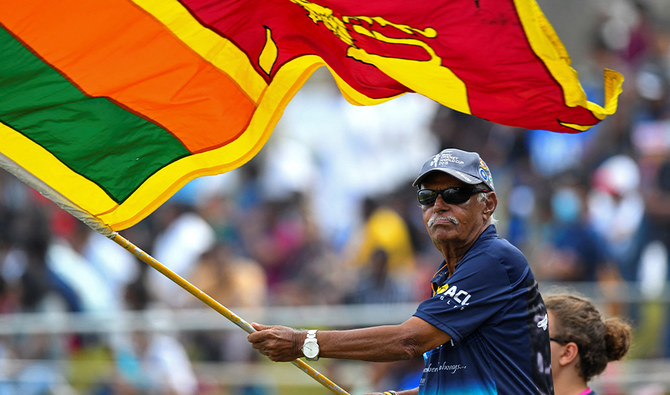
In this photograph taken on July 19, 2022, Sri Lanka's cricket fan Percy Abeysekera watches the fourth day play of the first cricket Test match between Sri Lanka and Pakistan in Galle. (AFP)
Short Url
Updated 23 July 2022
Follow

'Lunatic' politicians can't stop cricket-mad Sri Lanka grandfather

  • Pakistan cricket team currently touring Sri Lanka with the hosts looking to bounce back on Sunday in Galle
  • Host country is suffering its worst economic crisis since independence and leading to widespread shortages

Galle, Sri Lanka: Cricket-obsessed Percy Abeysekera has been a constant presence at Sri Lanka matches since their first Test against England in 1982 -- and even the country's worst economic crisis cannot keep him away.
Forty years ago, the man now fondly known as "Uncle Percy" escorted England batsman Chris Tavare on the pitch at the P. Sara Oval in the capital Colombo while holding a Sri Lankan flag.
Now 85, he has been a regular feature since, allowed on to the field by Sri Lanka's cricket authorities to accompany the team off after every game, win or lose, still carrying his flag.
And while an avid supporter of his national side, he is known for the respect with which he treats the opposition -- a far cry from the sledging employed by the fans of some teams, and even their players.
Naturally, he was at Galle earlier this month when hundreds of protesters climbed the walls of the ancient fort overlooking the ground during the second Test against Australia to demand the removal of president Gotabaya Rajapaksa.
The host country is suffering its worst economic crisis since independence, without the foreign exchange to pay for essentials including fuel and medicines, and leading to widespread shortages.
Hours later, a furious crowd in Colombo forced the president to flee his home, and days after that he flew abroad before submitting his resignation.
"Our team's performance is better than the performance of the politicians in Sri Lanka," said Abeysekera.
"Not a single politician can match up to these cricketers," he told AFP. "They are not politicians, they are lunatics."
"I hate politics," he added.
Abeysekera has twice been invited to join the Sri Lankan cricket board but declined the position.
"There are three things I don't like in the whole world, one is politics, the other one is cricket administration, and the third one is birth control," he said.
His grandsons are named Garfield after the West Indies' Sobers, the first batsman to hit six sixes in a first-class over, and Sachinka for Indian batting great Sachin Tendulkar.

Cricket has offered Sri Lankans a welcome distraction from their country's travails, with a 3-2 one-day series win over Australia followed by a 1-1 Test series draw.
Pakistan are currently touring the Indian Ocean island, with the hosts looking to bounce back on Sunday from a defeat in the first Test in Galle.
Abeysekera has worked for 59 years for a cable company, and friends and family take care of his accommodation at different venues.
He took a bus from Colombo to Galle to attend the current series of games but is having to walk to the stadium with no tuk-tuks available.
"Never have I seen such a crisis," he said.
"I saw the world war, I saw the tsunami, I saw the LTTE attacks," he added, referring to the Tamil Tigers who fought a separatist war for decades.
"This is something else, but I somehow manage to come to the ground."
As a boy, Abeysekera saw Don Bradman play at the Colombo Oval in 1948, and nearly half a century later watched Sri Lanka defeat Australia in Lahore to win the 50-over World Cup, one of his lifetime cricketing highlights.
Abeysekera's affable demeanour has won him the affection of even his beloved team's opponents.
Former New Zealand captain Martin Crowe once handed him his man-of-the-match award and he was embraced by Virat Kohli during India's tour to Sri Lanka in 2015 and even invited into the visitors' dressing room.
"For when the One Great Scorer comes to mark against your name, He writes not that you won or lost, but how you played the game," he says, quoting the American sportswriter Grantland Rice.
"Play fair, cheer the victor and honour the loser." 


Ugandan opposition denounces ‘military state’ ahead of election

Updated 5 sec ago
Follow

Ugandan opposition denounces ‘military state’ ahead of election

KAMPALA: As dark clouds gathered overhead, young and old members of Uganda’s long-embattled opposition gathered for prayers at the home of an imprisoned politician — the mood both defiant and bleak.
The mayor of Kampala, Erias Lukwago, told the gathering on Sunday that this week’s election was a “face off” between ordinary Ugandans and President Yoweri Museveni.
“All of you are in two categories: political prisoners and potential political prisoners,” he said.
Museveni is widely expected to extend his 40-year rule of the east African country in Thursday’s election, thanks to his near-total control of the state and security apparatus.
The 81-year-old came to power as a bush fighter in the 1980s and has maintained a militarised control over the country, brutally cracking down on challengers.
The latest campaign has seen hundreds of opposition supporters arrested and at least one killed, with the police claiming they are confronting “hooligans.”
The main opposition candidate Bobi Wine, real name Robert Kyagulanyi, is rarely seen in public without his flak jacket and has described the campaign as a “war.”
He has been arrested multiple times in the past and tortured in military custody.
The only other significant opposition leader, Kizza Besigye, was kidnapped in Kenya in 2024 and secretly smuggled to a Ugandan military prison to face treason charges in a case that has dragged on for months.
His wife, UNAIDS director Winnie Byanyima, hosted Sunday’s prayer meeting at their home. She said Uganda has only a “thin veneer” of democracy.
“We are really a military state,” she told AFP. “There’s total capture of state institutions by the individual who holds military power, President Museveni.”

Police ‘not neutral’

“The police officers I have met have never looked at themselves as neutral,” said Jude Kagoro, a researcher at the University of Bremen who has spent more than a decade studying African police.
Most officers view it as their duty to support the incumbent power, he said, and often require no explicit order to use brute force on opposition rallies.
Museveni’s regime has used many strategies to infiltrate and divide opposition groups, including through handouts to different ethnic groups.
Under a system informally known as “ghetto structures,” security officials recruit young people in opposition areas who “work for the police to disorganize opposition activities, and also to spy,” said Kagoro.
The government was taken by surprise when Wine burst on to the political scene ahead of the 2021 election, becoming the voice of the urban youth, and responded with extreme violence.
Similarly, Tanzania’s authoritarian government was caught unawares when protests broke out over rigging in last October’s election, and security forces responded by killing hundreds.
The Ugandan government is better prepared now.
“For the last four-plus years, they have been building an infrastructure that can withstand any sort of pressure from the opposition,” said Kagoro.
“We are used to the military and the police on the streets during elections.”

‘Too dangerous’

Still, the authorities are not taking any chances. Citizens are being told to vote and return home immediately.
“The regime wants to make people very scared so they don’t come out to vote,” said David Lewis Rubongoya, secretary-general of Wine’s National Unity Platform.
There has been a spate of arrests and abductions targeting the opposition — a tactic also increasingly used in neighboring Kenya and Tanzania — with rights groups accusing the east African governments of coordinating their repression.
The violence makes it hard for opposition groups to organize.
“The price people have to pay for engaging in political opposition has become very high,” said Kristof Titeca, a Uganda expert based at Antwerp University.
“What’s left is a group of core supporters. Is there a grassroots opposition? No, there isn’t. It’s way too dangerous.”