

In Malaysia, refugee Afghan actors find voice, solace on stage

1 / 3
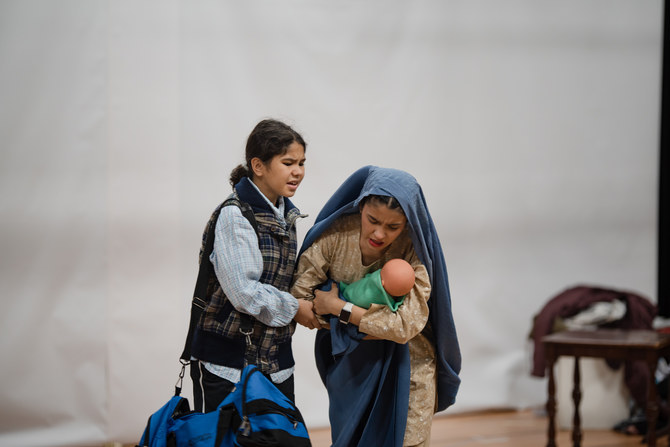
Farzana Hussaini, right, rehearses her role in “And Then Came Spring.” (Amin Kamrani/Parastoo Theatre)
2 / 3
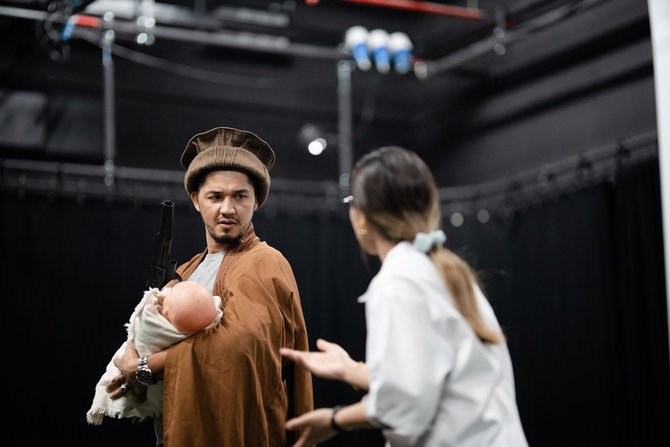
Actors rehearse their roles in “And Then Came Spring,” a new play by Parastoo Theatre, ahead of a July 22, 2022 stage performance in Kuala Lumpur, Malaysia. (Amin Kamrani/Parastoo Theatre)
3 / 3
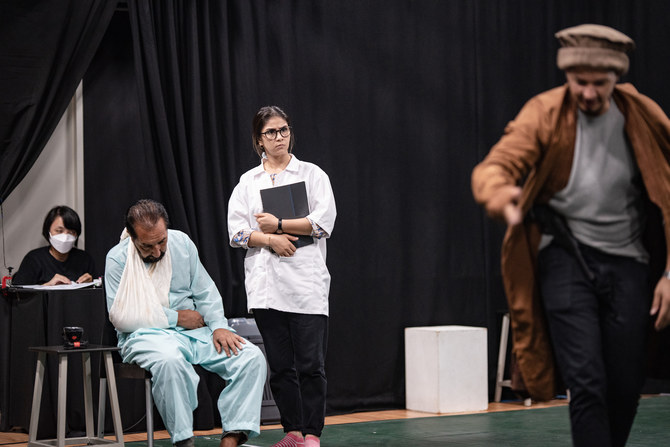
Actors rehearse their roles in “And Then Came Spring,” a new play by Parastoo Theatre, ahead of a July 22, 2022 stage performance in Kuala Lumpur, Malaysia. (Amin Kamrani/Parastoo Theatre)
Short Url
Updated 21 July 2022
Follow

In Malaysia, refugee Afghan actors find voice, solace on stage

  • Parastoo Theatre was founded by Afghan playwright Saleh Sepas in 2017
  • Group made up mainly of Afghans now welcomes other refugee performers

KUALA LUMPUR: Farzana Hussaini was screaming when her partner pointed a knife at her, until a man interrupted the pair to offer directing guidelines.
Shortly afterwards, the 20-year-old Afghan refugee was back in the same scene as the rehearsal continued.
Hussaini is playing the leading role in “And Then Came Spring,” which she and other refugee actors will stage over the weekend at the Damansara Performing Arts Center in Kuala Lumpur.
When she was 10, Hussaini’s family fled Afghanistan and settled in Malaysia. At a refugee school, she took part in several short performances, but it was not until three years later that she entered the real scene with Parastoo Theatre — a troupe run by Afghan playwright and director Saleh Sepas.
“Saleh Sepas asked me to join the Parastoo team. It was really hard in the beginning, because it was the first time doing theater and going on stage,” Hussaini told Arab News during a rehearsal break.
“With the help of other actors and my family encouraging me, I got through it. It was the best thing that ever happened to me and my journey as a refugee.”
“And Then Came Spring” is the latest play written and directed by Sepas for Parastoo Theatre, which he founded in 2017 to help fellow refugees establish themselves as a productive community in Malaysia.
Sepas used to work for the BBC World Service Trust’s Afghan Education Project as a writer and director of the radio program “New Home, New Life.”


Actors rehearse their roles in “And Then Came Spring,” a new play by Parastoo Theatre, ahead of a July 22, 2022 stage performance in Kuala Lumpur, Malaysia. (Amin Kamrani/Parastoo Theatre)


When he and his family left Kabul in 2016, they lost everything.
“I didn’t know why I came to Malaysia and knew nothing about it. When you are challenged and targeted, you just run away to save your life and your family,” he told Arab News.
“Being a refugee is really hard; you do not have the right to work and basic services. It’s very difficult. Some refugees have to work illegally and that’s very risky. I was a writer and director in my country, but when I first arrived in Malaysia, my first job was cleaning houses, moving items and working in the restaurant.”
Sepas did not want to rely on support from welfare NGOs.
“If my life needs change, it has to start with myself,” he said. “I started with art, because of my experience. I believe art could bring change to my life. In the beginning it was difficult as no one believed in the power of art.”
When Sepas opened Parastoo Theatre, he had only six actors, all amateurs and most traumatized by their refugee experience.
But a few months later, the group staged their first play.
“When they perform, they feel ‘this is our voice.’ They feel they could connect their community to a wider public,” Sepas said. “I wasn’t sure about the impact, but I saw and heard the reaction from the audience — people were crying.”
The performance group is made up mainly of Afghans, but has joined hands with other refugees from Iran, Syria, Myanmar, Somalia and Palestine, as well as artistic groups and educational institutions in Malaysia, Singapore and Taiwan.
In “And Then Came Spring,” they have collaborated with the Kuala Lumpur-based collective Instant Theatre Cafe Company.
The play tells the story of a teenager sold as a child bride to an older man so her family can settle their debts. Abandoned by her husband when he realizes she is pregnant with a girl, she flees Afghanistan to start a new life in another country.
Like the group’s other performances, the play is based on a true story.
“It is what either my friends or myself have been through,” Hussaini said.
She plays the child bride in “And Then Came Spring,” and views the role as a step toward realizing her plans of becoming a human and women’s rights activist.
“It is really hard on stage, to the point I (once) felt like fainting and my energy couldn’t hold it. But if I do this role well, part of me is standing up with other women out there,” she said. “I feel powerful if I can shout at him (male actor) as loud as I can to make him shut up and sit down.”
Theater also plays the role of a catalyst between refugees and the host community in Malaysia, which is not party to the 1951 Refugee Convention and does not have a system regulating their status.
The absence of a legal framework on asylum issues is a source of unpredictability in the lives of over 182,000 refugees in the country.
“The situation in Malaysia is very unstable, there is a hostility,” Iranian-born Amin Kamrani, producer of Parastoo Theatre, told Arab News.
“When you think of refugees, you think of camps, people who are desperate. The power of art itself, even if the message is not related to refugees, can change that perception,” he said.
“We hope to use art to inspire more refugees to do activities to show their humanity.”


Shooter kills 9 at Canadian school and residence

Updated 2 min 40 sec ago
Follow

Shooter kills 9 at Canadian school and residence

  • The shooter was found dead with an apparent self-inflicted gunshot wound
  • A total of 27 people were wounded in the shooting, including two with serious injuries

TORONTO: A shooter killed nine people and wounded dozens more at a secondary school and a residence in a remote part of western Canada on Tuesday, authorities said, in one of the deadliest mass shootings in the country’s history.
The suspect, described by police in an initial emergency alert as a “female in a dress with brown hair,” was found dead with an apparent self-inflicted gunshot wound, officials said.
The attack occurred in Tumbler Ridge, British Columbia, a picturesque mountain valley town in the foothills of the Rockies.
A total of 27 people were wounded in the shooting, including two with serious injuries, the Royal Canadian Mounted Police said in a statement.
Prime Minister Mark Carney said he was “devastated” by the “horrific acts of violence” and announced he was suspending plans to travel to the Munich Security Conference on Wednesday, where he had been set to hold talks with allies on transatlantic defense readiness.
Police said an alert was issued about an active shooter at Tumbler Ridge Secondary School on Tuesday afternoon.
As police searched the school, they found six people shot dead. A seventh person with a gunshot wound died en route to hospital.
Separately, police found two more bodies at a residence in the town.
The residence is “believed to be connected to the incident,” police said.
At the school, “an individual believed to be the shooter was also found deceased with what appears to be a self?inflicted injury,” police said.
Police have not yet released any information about the age of the shooter or the victims.
“We are devastated by the loss of life and the profound impact this tragedy has had on families, students, staff, and our entire town,” the municipality of Tumbler Ridge said in a statement.
Tumbler Ridge student Darian Quist told public broadcaster CBC that he was in his mechanics class when there was an announcement that the school was in lockdown.
He said that initially he “didn’t think anything was going on,” but started receiving “disturbing” photos about the carnage.
“It set in what was happening,” Quist said.
He said he stayed in lockdown for more than two hours until police stormed in, ordering everyone to put their hands up before escorting them out of the school.
Trent Ernst, a local journalist and a former substitute teacher at Tumbler Ridge, expressed shock over the shooting at the school, where one of his children has just graduated.
He noted that school shootings have been a rarity occurring every few years in Canada compared with the United States, where they are far more frequent.
“I used to kind of go: ‘Look at Canada, look at who we are.’ But then that one school shooting every 2.5 years happens in your town and things... just go off the rails,” he told AFP.

‘Heartbreak’ 

While mass shootings are extremely rare in Canada, last April, a vehicle attack that targeted a Filipino cultural festival in Vancouver killed 11 people.
British Columbia Premier David Eby called the latest violence “unimaginable.”
Nina Krieger, British Columbia’s minister of public safety, said it was “one of the worst mass shootings in our province’s and country’s history.”
The Canadian Olympic Committee, whose athletes are competing in the 2026 Winter Games in Italy, said Wednesday it was “heartbroken by the news of the horrific school shooting.”
Ken Floyd, commander of the police’s northern district, said: “This has been an incredibly difficult and emotional day for our community, and we are grateful for the cooperation shown as officers continue their work to advance the investigation.”
Floyd told reporters the shooter was the same suspect police described as “female” in a prior emergency alert to community members, but declined to provide any details on the suspect’s identity.
The police said officers were searching other homes and properties in the community to see if there were additional sites connected to the incident.
Tumbler Ridge, a quiet town with roughly 2,400 residents, is more than 1,100 kilometers (680 miles) north of Vancouver, British Columbia’s largest city.
“There are no words sufficient for the heartbreak our community is experiencing tonight,” the municipality said.