

Pakistani pilgrims praise Saudi Arabia for ‘innovative’ Hajj arrangements amid sweltering heat

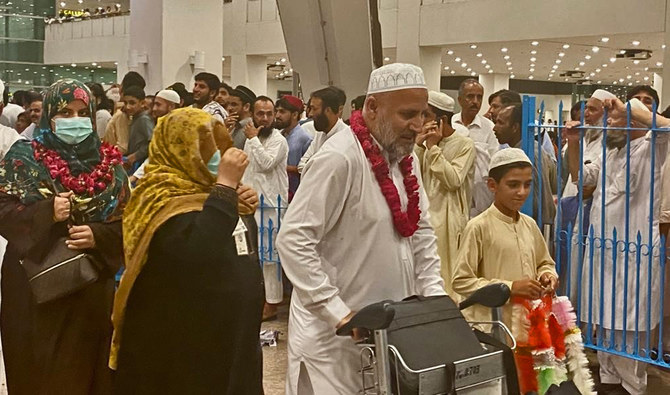
Families and friends welcome Pakistani Hajj pilgrims at the Islamabad International Airport, on July 19, 2022. (AN Photo)
Short Url
Updated 21 July 2022
Follow

Pakistani pilgrims praise Saudi Arabia for ‘innovative’ Hajj arrangements amid sweltering heat

  • Post-Hajj flight carrying 388 pilgrims arrives at Islamabad airport
  • Pilgrims praise Saudi government for arranging massive water sprinkler, modern transport

ISLAMABAD: Pakistani pilgrims who returned from Saudi Arabia after performing Hajj on Tuesday praised the kingdom for employing “innovative” techniques that facilitated them in performing the Hajj in the sweltering heat.

Up to one million people performed the annual Islamic pilgrimage of Hajj this month after Saudi Arabia lifted coronavirus restrictions after two years. Pilgrims were required to be under 65 years and be vaccinated against coronavirus.

The kingdom allowed Pakistan a quota of 83,132 pilgrims this year out of which 34,453 availed the government’s Hajj scheme while over 48,000 performed Hajj through private operators.

According to the Ministry of Religious Affairs, 134 flights of Pakistani airlines, Pakistan International Airlines (PIA), Airblue, Serene Air, and Saudi Airlines would take part in the post-Hajj flight operation for pilgrims who used the government’s scheme. The operation will continue till August 13.

On Tuesday night, the first post-Hajj flight to Islamabad brought home 388 pilgrims who performed the pilgrimage under the government’s scheme.

“The Saudi government has done excellent arrangements, especially their innovative technique to use a massive water sprinkler system helped us a lot to cool down under the scorching sun,” Rana Babar Wali, a pilgrim from Faisalabad, told Arab News.
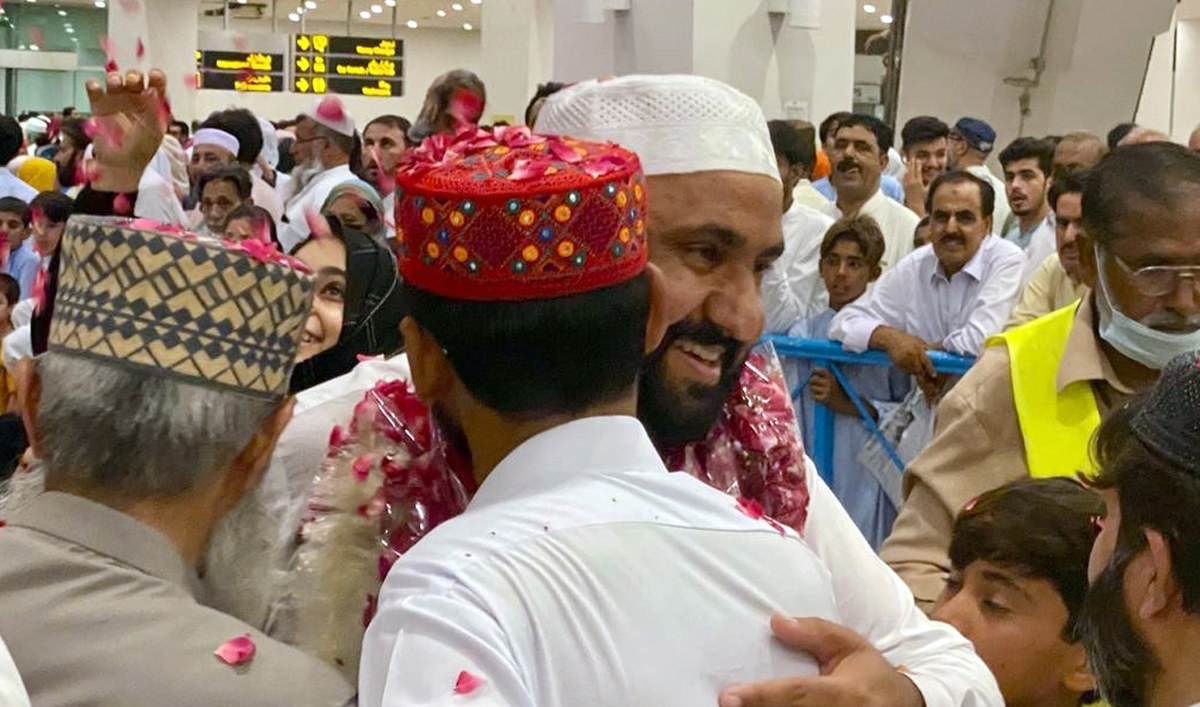


Families and friends welcome Pakistani Hajj pilgrims at the Islamabad International Airport, on July 19, 2022. (AN Photo) 

He said pilgrims’ tents this year were air-conditioned and transport arrangements were also impressive.

Haseeb Ahmed Siddiqui, director of the Hajj Complex in Islamabad, received pilgrims at the airport. He said all pilgrims were very satisfied with Hajj arrangements undertaken by Saudi authorities and the Pakistani Hajj mission as “this year complaints from pilgrims were almost negligible.”
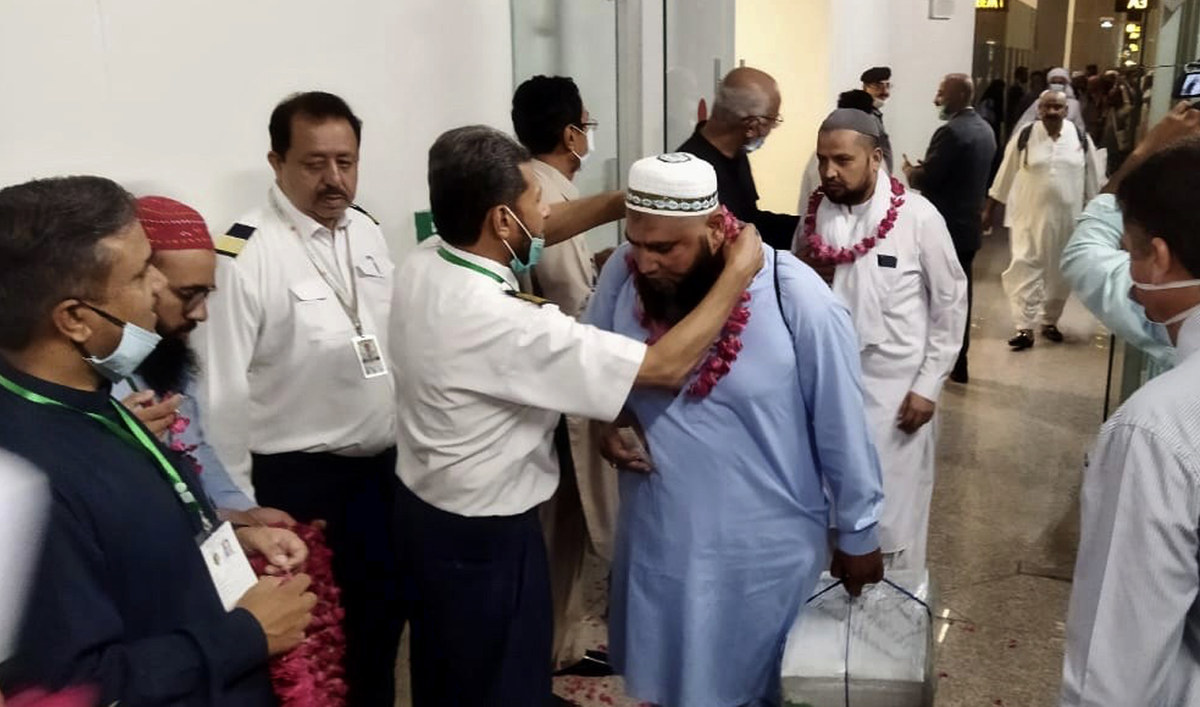


Officials from the Pakistani religious affairs ministry and PIA receive pilgrims at the Islamabad International Airport, on July 19, 2022. (AN Photo) 

Siddiqui said the Route to Makkah initiative was executed successfully this year at the Islamabad airport due to close cooperation and coordination from the Saudi government.

Under the Makkah Route initiative, Hajj pilgrims can fulfil all immigration requirements at the airport of origin. This saves them several hours upon reaching the kingdom since they can just enter the country, having already gone through immigration at home.

Irfan Ahmed Khan, another pilgrim from Peshawar, praised the Saudi government for revamping Mina, Arafat and providing modern transport arrangements for pilgrims.

“It was the second time that I performed Hajj and this time it was all changed,” Khan told Arab News, adding that both Saudi and Pakistani authorities made this year’s pilgrimage very easy for the pilgrims. He praised Pakistani volunteers and Saudi officials for guiding pilgrims at various stages of the Hajj.
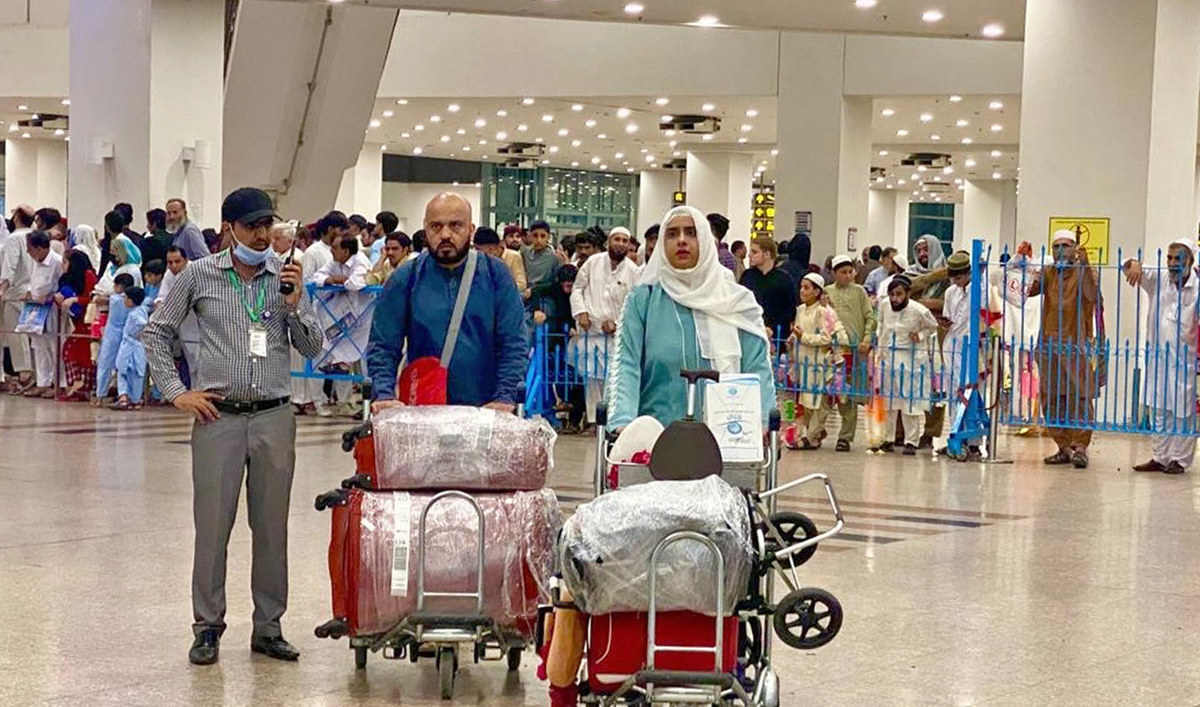


Pakistani pilgrims arrive at the arrival lounge of the Islamabad International Airport on July 19, 2022. (AN Photo) 

Kalsoom Anwer, a pilgrim from Pakistan’s Rawalpindi city, praised Saudi volunteers, policemen, and other officials for providing pilgrims with drinking water and orange juices in Arafat in the scorching heat. “The volunteers were also sprinkling cold water to reduce the effect of the heat,” she added.

Another pilgrim, Bashir Khan from Pakistan’s Swabi city in northwestern Khyber Pakhtunkhwa, said it took pilgrims only 20 minutes at the immigration booth at Jeddah airport, on their return flight, due to the home check-in facility provided by the government.

“They [PIA officials] provided boarding cards at our residence one day before and our luggage was also taken from there,” he said. “That is why it just took us 20 minutes during the immigration at Jeddah airport,” he added.


IMF warns against policy slippage amid weak recovery as it clears $1.2 billion for Pakistan

Updated 11 December 2025
Follow

IMF warns against policy slippage amid weak recovery as it clears $1.2 billion for Pakistan

  • Pakistan rebuilt reserves, cut its deficit and slowed inflation sharply over the past one year
  • Fund says climate shocks, energy debt, stalled reforms threaten stability despite recent gains

ISLAMABAD: Pakistan’s economic recovery remains fragile despite a year of painful stabilization measures that helped pull the country back from the brink of default, the International Monetary Fund (IMF) warned on Thursday, after it approved a fresh $1.2 billion disbursement under its ongoing loan program.

The approval covers the second review of Pakistan’s Extended Fund Facility (EFF) and the first review of its climate-focused Resilience and Sustainability Facility (RSF), bringing total disbursements since last year to about $3.3 billion.

Pakistan entered the IMF program in September 2024 after years of weak revenues, soaring fiscal deficits, import controls, currency depletion and repeated climate shocks left the economy close to external default. A smaller stopgap arrangement earlier that year helped avert immediate default, but the current 37-month program was designed to restore macroeconomic stability through strict monetary tightening, currency adjustments, subsidy rationalization and aggressive revenue measures.

The IMF’s new review shows that Pakistan has delivered significant gains since then. Growth recovered to 3 percent last year after shrinking the year before. Inflation fell from over 23 percent to low single digits before rising again after this year’s floods. The current account posted its first surplus in 14 years, helped by stronger remittances and a sharp reduction in imports. And the government delivered a primary budget surplus of 1.3 percent of GDP, a key program requirement. Foreign exchange reserves, which had dropped dangerously low in 2023, rose from US$9.4 billion to US$14.5 billion by June.

“Pakistan’s reform implementation under the EFF arrangement has helped preserve macroeconomic stability in the face of several recent shocks,” IMF Deputy Managing Director Nigel Clarke said in a statement after the Board meeting.

But he warned that Islamabad must “maintain prudent policies” and accelerate reforms needed for private-sector-led and sustainable growth.

The Fund noted that the 2025 monsoon floods, affecting nearly seven million people, damaging housing, livestock and key crops, and displacing more than four million, have set back the recovery. The IMF now expects GDP growth in FY26 to be slightly lower and forecasts inflation to rise to 8–10 percent in the coming months as food prices adjust.

The review warns Pakistan against relaxing monetary or fiscal discipline prematurely. It urges the State Bank to keep policy “appropriately tight,” allow exchange-rate flexibility and improve communication. Islamabad must also continue raising revenues, broadening the tax base and protecting social spending, the Fund said.

Despite the progress, Pakistan’s structural weaknesses remain severe.

Power-sector circular debt stands at about $5.7 billion, and gas-sector arrears have climbed to $11.3 billion despite tariff adjustments. Reform of state-owned enterprises has slowed, including delays in privatizing loss-making electricity distributors and Pakistan International Airlines. Key governance and anti-corruption reforms have also been pushed back.

The IMF welcomed Pakistan’s expansion of its flagship Benazir Income Support Program, which raises cash transfers for low-income families and expands coverage, saying social protection is essential as climate shocks intensify. But it warned that high public debt, about 72 percent of GDP, thin external buffers and climate exposure leave the country vulnerable if reform momentum weakens.

The Fund said Pakistan’s challenge now is to convert short-term stabilization into sustained recovery after years of economic volatility, with its ability to maintain discipline, rather than the size of external financing alone, determining the durability of its gains.