

‘World’s largest’ vertical farm officially opens in Dubai

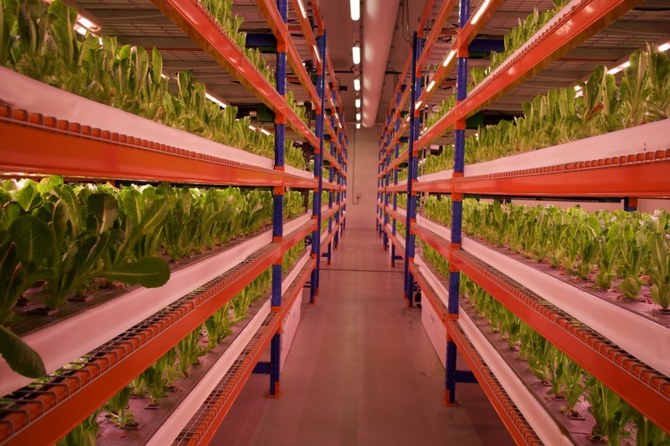
Emirates Flight Catering and Crop One Holdings have officially opened what they describe as the largest vertical farm in the world. (Supplied)
Short Url
Updated 19 July 2022
Follow

‘World’s largest’ vertical farm officially opens in Dubai

  • The 330,000-square-feet Bustanica hydroponic facility is the first result of a joint venture between Emirates Flight Catering and Crop One Holdings
  • It is designed to produce more than 1 million kilograms of high-quality leafy greens each year, using 95 percent less water than conventional agricultural methods

DUBAI: Emirates Flight Catering and Crop One Holdings have officially opened what they describe as the largest vertical farm in the world.

Located close to Al-Maktoum International Airport in Dubai, the facility, called Bustanica, is the first vertical farm operated by Emirates Crop One, a joint venture between the two businesses. It is backed by an investment of $40 million.

Emirates Flight Catering, which supplies more than 100 airlines, hospitality groups and Emirati government agencies, is one of the world’s largest catering operations. Crop One Holdings, which is headquartered in the US state of Massachusetts, is considered an industry leader in technology-driven indoor vertical farming.

Bustanica, a 330,000-square-feet hydroponic farm, has been designed to produce more than 1 million kilograms of high-quality leafy greens each year, using 95 percent less water than conventional agricultural methods. At any given time, more than 1 million plants will be growing at the facility, with a daily output of 3,000 kg.

It is powered by cutting-edge technology, including machine learning, artificial intelligence and other advanced methods, overseen by a highly specialized in-house team of agronomy (the science of soil management and crop production) experts, engineers, horticulturists and plant scientists. The continuous production cycle ensures that the produce is extremely fresh and clean, and it is grown without the use of any pesticides, herbicides or other chemicals.

Passengers on flights operated by Emirates and many other airlines can expect to be served leafy greens grown at the farm, including lettuce, arugula and spinach, beginning this month. In addition, shoppers in the UAE will be able to add the farm’s greens to their carts at local supermarkets. Bustanica also plans to expand into production and sale of other vegetables and fruit.

“Long-term food security and self-sufficiency are vital to the economic growth of any country and the UAE is no exception,” said Sheikh Ahmed bin Saeed Al-Maktoum, the chairman and chief executive of Emirates Airline and Group.

“We’ve specific challenges in our region, given the limitations around arable land and climate. Bustanica ushers in a new era of innovation and investments, which are important steps for sustainable growth and align with our country’s well-defined food- and water-security strategies.

“Emirates Flight Catering constantly invests in the latest technologies to delight customers, optimize operations, and minimize our environmental footprint. Bustanica helps secure our supply chain and ensures our customers can enjoy locally sourced, nutritious produce.”

He continued: “By bringing production closer to consumption, we’re reducing the food journey from farm to fork. Congratulations to the Bustanica team for their remarkable achievements so far and for setting global standards and benchmarks in agronomy.”

Crop One CEO Craig Ratajczyk said: “After significant planning and construction, and navigating the unforeseen challenges of the pandemic, we’re thrilled to celebrate this tremendous milestone alongside our joint-venture partner, Emirates Flight Catering.

“It’s our mission to cultivate a sustainable future to meet global demand for fresh, local food, and this first large-format farm is the manifestation of that commitment. This new facility serves as a model for what’s possible around the globe.”

The farm’s closed-loop irrigation system is designed to circulate water through the plants to maximize usage efficiency. As the water evaporates, it is recovered and recycled by the system, saving about 250 million liters each year compared with traditional outdoor farming methods that yield the same output.

In addition to the greatly reduced water use, Bustanica will have no impact on threatened soil resources and produce year-round harvests unhampered by the weather or pests.

The greens grown at the facility are so clean and pure, consumers who buy them from supermarkets will be able to eat them safely straight from the bag, producers say, because even the act of washing them can damage the leaves and introduce contaminants.


AI will never replace human creativity, says SRMG CEO 

Updated 30 January 2026
Follow

AI will never replace human creativity, says SRMG CEO 

  • Speaking to Maya Hojeij, senior business anchor at Asharq with Bloomberg, Jomana R. Alrashid expressed pride in SRMG platforms that had absorbed and adopted AI

RIYADH: Jomana R. Alrashid, CEO of Saudi Research and Media Group, highlighted how AI cannot replace human creativity during a session at The Family Office’s “Investing Is a Sea” summit at Shura Island on Friday. 

“You can never replace human creativity. Journalism at the end of the day, and content creation, is all about storytelling, and that’s a creative role that AI does not have the power to do just yet,” Alrashid told the investment summit. 

“We will never eliminate that human role which comes in to actually tell that story, do the actual investigative reporting around it, make sure to be able to also tell you what’s news or what’s factual from what’s wrong ... what’s a misinformation from bias, and that’s the bigger role that the editorial player does in the newsroom.”

Speaking on the topic of AI, moderated by Maya Hojeij, senior business anchor at Asharq with Bloomberg, the CEO expressed her pride in SRMG platforms that had absorbed and adopted AI in a way that was “transformative.”

“We are now translating all of our content leveraging AI. We are also now being able to create documentaries leveraging AI. We now have AI-facilitated fact-checking, AI facilities clipping, transcribing. This is what we believe is the future.”

Alrashid was asked what the journalist of the future would look like. “He’s a journalist and an engineer. He’s someone who needs to understand data. And I think this is another topic that is extremely important, understanding the data that you’re working with,” she said.

“This is something that AI has facilitated as well. I must say that over the past 20 years in the region, especially when it comes to media companies, we did not understand the importance of data.”


The CEO highlighted that previously, media would rely on polling, surveys or viewership numbers, but now more detailed information about what viewers wanted was available. 

During the fireside session, Alrashid was asked how the international community viewed the Middle Eastern media. Alrashid said that over the past decades it had played a critical role in informing wider audiences about issues that were extremely complex — politically, culturally and economically — and continued to play that role. 

“Right now it has a bigger role to play, given the role again of social media, citizen journalists, content creators. But I also do believe that it has been facilitated by the power that AI has. Now immediately, you can ensure that that kind of content that is being created by credible, tier-A journalists, world-class journalists, can travel beyond its borders, can travel instantly to target different geographies, different people, different countries, in different languages, in different formats.”

She said that there was a big opportunity for Arab media not to be limited to simply Arab consumption, but to finally transcend borders and be available in different languages and to cater to their audiences. 


The CEO expressed optimism about the future, emphasizing the importance of having a clear vision, a strong strategy, and full team alignment. 

Traditional advertising models, once centered on television and print, were rapidly changing, with social media platforms now dominating advertising revenue.

“It’s drastically changing. Ultimately in the past, we used to compete with one another over viewership. But now we’re also competing with the likes of social media platforms; 80 percent of the advertising revenue in the Middle East goes to the social media platforms, but that means that there’s 80 percent interest opportunities.” 

She said that the challenge was to create the right content on these platforms that engaged the target audiences and enabled commercial partnerships. “I don’t think this is a secret, but brands do not like to advertise with news channels. Ultimately, it’s always related with either conflict or war, which is a deterrent to advertisers. 

“And that’s why we’ve entered new verticals such as sports. And that’s why we also double down on our lifestyle vertical. Ultimately, we have the largest market share when it comes to lifestyle ... And we’ve launched new platforms such as Billboard Arabia that gives us an entry into music.” 

Alrashid said this was why the group was in a strong position to counter the decline in advertising revenues across different platforms, and by introducing new products.

“Another very important IP that we’ve created is events attached to the brands that have been operating in the region for 30-plus years. Any IP or any title right now that doesn’t have an event attached to it is missing out on a very big commercial opportunity that allows us to sit in a room, exchange ideas, talk to one another, get to know one another behind the screen.” 

The CEO said that disruption was now constant and often self-driving, adding that the future of the industry was often in storytelling and the ability to innovate by creating persuasive content that connected directly with the audience. 

“But the next disruption is going to continue to come from AI. And how quickly this tool and this very powerful technology evolves. And whether we are in a position to cope with it, adapt to it, and absorb it fully or not.”