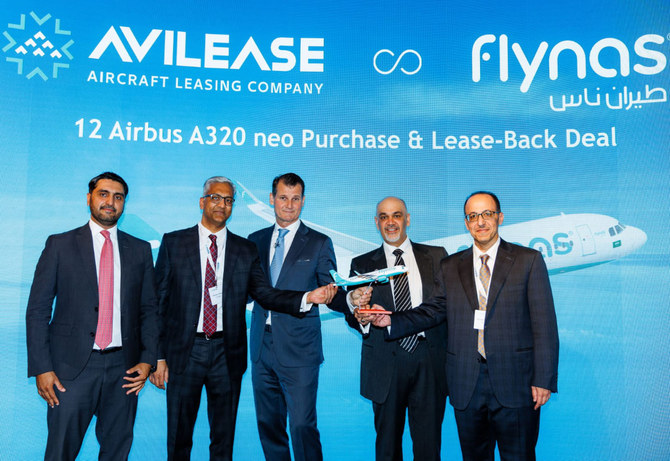
PIF-owned aviation firm AviLease launches in UK, signs deal with Flynas

AviLease signed its first leasing agreement, with leading low-cost Saudi airline Flynas, during the inaugural event in London. (Supplied)
Short Url
Updated 19 July 2022
Follow

PIF-owned aviation firm AviLease launches in UK, signs deal with Flynas

  • Under the agreement the new company, which is wholly owned by the Saudi Public Investment Fund, will buy 12 A320neo aircraft and lease them to the airline
  • ‘AviLease is launching with ambitious plans … today marks the start of the journey to become a leader in the aircraft-leasing market,’ said Chairperson Fahad Al-Saif

LONDON: The official launch of AviLease, a newly established aviation financing and leasing company wholly owned by the Saudi Public Investment Fund, took place in the UK on Monday.

The company signed its first leasing agreement, with leading low-cost Saudi airline Flynas, during the inaugural event in London, which was timed to coincide with the start of this week’s Farnborough International Airshow. Under the deal, AviLease will purchase 12 new A320neo aircraft, to be delivered in 2022 and 2023, and lease them to the airline.

“AviLease is launching with ambitious plans,” said Fahad Al-Saif, the new company’s chairperson. “We are delighted to have our first agreement in place with Flynas.

“Today marks the start of the journey to become a leader in the aircraft-leasing market. AviLease is going to have a critical role in enabling the PIF’s aviation-sector strategy in Saudi Arabia, contributing to the Kingdom’s Vision 2030.”

Ayed Aljeaid, the chairman of Flynas, said the agreement with AviLease underlines the role and mandate of the PIF in efforts to diversify the Saudi economy and contribute to non-oil-related gross domestic product growth.

“We congratulate the PIF on the launch of a new aircraft-leasing company, AviLease, and are pleased to announce the signing of this agreement,” he said.

“As a Saudi air carrier and the leading low-cost airline in the Middle East, we see great opportunities for expansion, supported by the strategic location of Saudi Arabia and the prospects opened up by Vision 2030 for the air-transport sector.”

AviLease CEO Edward O’Byrne said: “Our company has global ambition and the robust financial backing of the PIF. We are ready to capitalize on the strong and growing Saudi market, to scale rapidly and become a leading aviation lessor.

“Our plan is to invest in the most technologically advanced aircraft, to enable airlines to operate the most fuel-efficient and environment-friendly fleet. We appreciate the confidence placed in us by the Flynas team and wish them continued success as we start our partnership with them.”

Bander Almohanna, the CEO and managing director of Flynas, believes the deal with AviLease will go a long way toward achieving the aims of the Kingdom’s strategy to connect Saudi Arabia with more than 250 global destinations by the end of the decade.

“These 12 new A320neo aircraft will help us continue to grow our modern and fuel-efficient fleet,” he said. “This commitment supports our business strategy and advances our company’s ambitious agenda with our new partner, AviLease.”

Decoder

AviLease

Launched in the UK on Monday, AviLease is an aviation financing and leasing company wholly owned by the Saudi Public Investment Fund. It signed its first leasing agreement with leading low-cost Saudi airline Flynas during an inaugural event in London, which was timed to coincide with the start of this week’s Farnborough International Airshow. Under the deal, AviLease will purchase 12 new A320neo aircraft, to be delivered in 2022 and 2023, and lease them to the airline.


Sustainability Forum Middle East spotlights Saudi role in driving climate finance deployment

Updated 5 sec ago
Follow

Sustainability Forum Middle East spotlights Saudi role in driving climate finance deployment

MANAMA: Saudi Arabia’s growing influence over sustainable finance and climate-aligned investment was a central theme at the Sustainability Forum Middle East, as regional banks, investors, and policymakers signaled a shift from climate pledges to market execution.

The fourth edition of the forum, held in Bahrain under the theme “Advancing Alignment, Innovation, and Implementation for Energy and Climate Transformation,” brought together more than 500 participants and over 50 speakers from government, finance, energy, and industry. 

While the agenda covered climate diplomacy and national strategies, the dominant conversations this year centered on capital deployment, bankability, technology, and the commercial realities of the energy transition.

Saudi Arabia’s role in shaping that transition was repeatedly highlighted, particularly through its efforts to structure green finance instruments, integrate sustainability into Vision 2030 programs, and scale renewable energy ambitions. Global banks at the forum pointed to the kingdom as a key driver of demand for credible sustainable finance frameworks in the Gulf.

“Saudi Arabia has demonstrated clear leadership through Vision 2030 and its green financing frameworks,” Lina Osman, managing director and head of sustainable finance for the Middle East, Africa and Pakistan at Standard Chartered, told Arab News.

“The Public Investment Fund’s green bond issuance is a clear demonstration of the value of the opportunity that is available in Saudi Arabia and how Saudi Arabia is seizing that opportunity,” she added.

Osman also noted that Saudi Arabia’s target of sourcing 50 percent of its electricity from renewables represents a “true demonstration of leadership in sustainability,” adding that financing instruments will need to evolve to serve those ambitions. 

She said the bank has been customizing sustainable finance structures for Gulf Cooperation Council clients as the market becomes more sophisticated and sector-specific.

Organizations at the forum said the region has moved beyond ESG signaling and into discussions about return profiles, risk pricing, and revenue impact. 

“Financial institutions are now focused on how sustainability generates value — reducing costs, building resilience, and boosting revenue. Previously, it was mostly window dressing,” said Ian McCallum, chief sustainability officer at Bank ABC. 

Speaking to Arab News, he added that Saudi Arabia is playing a “significant role in shaping the direction of sustainable finance by continuing to strengthen ESG regulatory and disclosure requirements.”

Speakers from private markets and venture capital also pointed to Saudi Arabia as an emerging market for climate technologies that are moving from pilot phase to commercialization. 

Investors highlighted carbon removal, energy optimization, and AI-enabled climate solutions as areas where the Kingdom’s scaling capacity and demand for industrial decarbonization make deployment feasible.

Beyond finance, the forum examined how the GCC can accelerate industrial decarbonization through AI integration, carbon capture, supply chain reform, and the expansion of renewables. 

Panels explored how sovereign strategies and industrial policy are aligning across the region, with Saudi Arabia’s energy transition goals seen as an anchor for cross-border capital flows.

The event saw memorandums of understanding and multi-sector partnerships intended to translate national ambitions into deployable projects. 

Organizers said the agreements reflect a shift toward implementation, positioning the Gulf as a market where climate action is increasingly tied to competitiveness, industrial growth, and long-term economic resilience.