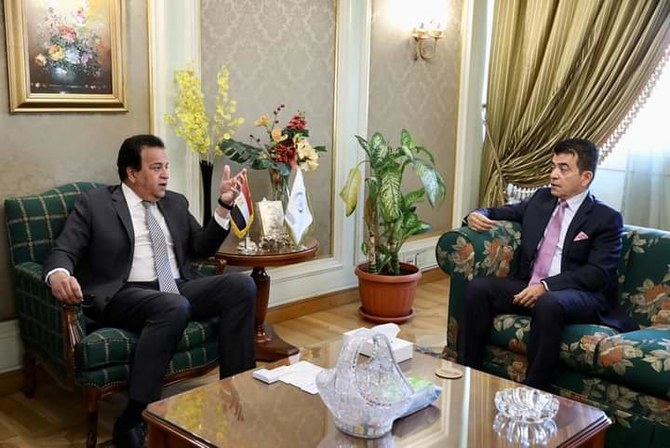
Egyptian minister, ISESCO chief hold talks

Egypt’s minister for higher education and scientific research meets with the director-general of ISESCO in Cairo. (@Mohesregypt)

Updated 17 July 2022
Follow

Egyptian minister, ISESCO chief hold talks

CAIRO: Khaled Abdel Ghaffar, Egypt’s minister for higher education and scientific research, met with Salim Mohammed Al-Malik, director-general of the Islamic World Educational, Scientific and Cultural Organization, at the ministry’s headquarters in Cairo.

They discussed aspects of cooperation between the ministry and ISESCO. Abdel Ghaffar praised ISESCO’s role in spreading science and culture, and stressed Egypt’s readiness to provide all necessary support for the organization.

The two sides also discussed the most important programs and activities that will be implemented in partnership between Egypt and the Organization of Islamic Cooperation this year.


Turkish, Greek leaders voice desire to resolve issues

Updated 3 sec ago
Follow

Turkish, Greek leaders voice desire to resolve issues

  • Greek Prime Minister Kyriakos ​Mitsotakis, ‌Turkish ⁠President ​Tayyip Erdogan say ⁠they discussed their issues 'in an open and sincere way'
  • The NATO allies but historic rivals try to build on warming relations
ANKARA: The leaders of Turkiye and Greece voiced their ​desire to resolve longstanding maritime disputes hobbling ties during discussions in Ankara on Wednesday, as the NATO allies and historic rivals try to build on warming relations.
The neighbors have been at odds over a range of issues for decades, primarily maritime boundaries and rights in the Aegean, an area widely believed to hold energy resources and with key implications for airspace and military activity.
Following years of heightened tensions, a 2023 declaration on friendly relations prompted a thaw in rhetoric, though their maritime issues have remained unresolved and the two sides still disagree over ‌regional matters.
Speaking at ‌a press conference in Ankara with Greek Prime Minister Kyriakos ​Mitsotakis, ‌Turkish ⁠President ​Tayyip Erdogan said ⁠they had discussed their issues in the Aegean and eastern Mediterranean “in an open and sincere way” during the talks.
“While the issues may be thorny, they are not unsolvable on the basis of international law. I saw that we were in agreement with my friend Kyriakos,” Erdogan said.
He added that the two countries would continue working to achieve their goal of reaching $10 billion in bilateral trade.
Mitsotakis said he hoped circumstances would allow the sides to solve a dispute on ⁠the demarcation of maritime and exclusive economic zones in the Aegean ‌and eastern Mediterranean.

If not now when?

“It is time to ‌remove any substantial and formal threats to our relations, if ​not now, when?” Mitsotakis said.
“Destiny has ‌appointed us to live in the same neighborhood. We cannot change geography, but we can ‌make it an ally, choosing convergence, dialogue and trust in international law... to build a future of peace, progress and prosperity for our people.”
Despite the positive tone, Greece’s foreign minister earlier said Athens planned to extend its territorial waters further, including potentially in the Aegean.
Shortly after, Ankara said it had issued ‌a maritime notice urging Greece to coordinate research activities in areas of the Aegean that Turkiye considers part of its continental shelf.
In ⁠1995, Turkiye’s parliament ⁠declared a casus belli — a cause for war — should Greece unilaterally extend its territorial waters beyond six nautical miles in the Aegean, a stance Athens says violates international maritime law. Greece says it wants only to discuss demarcation of maritime zones.

Migrant flows

Mitsotakis also said the flows of migrants in the Aegean Sea had decreased by almost 60 percent last year due to cooperation between the two countries, adding this should be strengthened.
Fifteen migrants died in a shipwreck off the Greek island of Chios last week after their boat collided with a Greek coast guard vessel and sank in the Aegean Sea off the Turkish coast.
Turkiye is a transit country for migrants seeking to reach the European Union via Greece. Ankara says the EU has not ​fully delivered on commitments under a 2016 migration ​deal and Athens wants Turkiye to do more to curb irregular crossings.