Iran arrests several after protests at drying lake

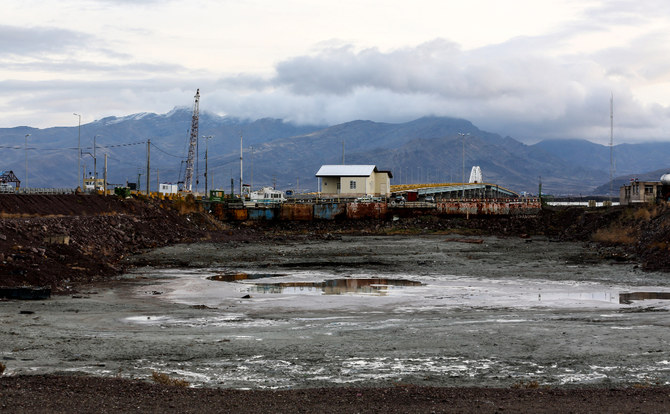
Iran's salt lake of Urmia had been shrinking in one of the worst ecological disasters of the past 25 years. (AFP)
Short Url
Updated 18 July 2022
Follow

Iran arrests several after protests at drying lake

  • Lake Urmia began shrinking in 1995 due to drought and water extraction for farming

TEHRAN: Iranian police have arrested several people for disturbing security after they protested the drying up of a lake once regarded as the Middle East’s largest, official media said Sunday.
Lake Urmia, in the mountains of northwest Iran, began shrinking in 1995 due to a combination of prolonged drought, and the extraction of water for farming and dams, according to the UN Environment Programme.
Urmia, one of the largest “hypersaline” — or super salty — lakes in the world, is located between the cities of Tabriz and Urmia, with more than six million people dependent on agriculture around its shores.
On Sunday, Rahim Jahanbakhsh, the police chief of Iran’s West Azerbaijan province, reported the arrests.

Opinion

This section contains relevant reference points, placed in (Opinion field)

He described the suspects as “many evil and hostile elements, who had no other objective than to destroy public property and disturb the security of the population,” according to state news agency IRNA.
On Saturday, the Fars news agency reported that “dozens of people in the cities of Naghadeh and Urmia had protested against the authorities’ lack of attention to the drying up of Lake Urmia.”
Fars said protesters had shouted slogans in the provincial capital of Urmia warning the lake was shrinking.
“Lake Urmia is dying, parliament orders its killing,” some shouted, Fars reported, with others calling out that “Lake Urmia is thirsty.”
Largely arid Iran, like other nearby countries, has suffered chronic dry spells and heat waves for years, which are expected to worsen with the impacts of climate change.
In the last few months, thousands of people have demonstrated against the drying up of rivers, particularly in central and southwestern Iran.
Lake Urmia is an important ecosystems, a key stopping point for migratory birds, and home to an endemic shrimp as well as other underwater species.

Druze: the great survivors
How the world's most secretive faithhas endured for a thousand years

Enter


keywords

The UN says Al-Hol camp population has dropped sharply as Syria moves to relocate remaining families

Updated 15 February 2026
Follow

The UN says Al-Hol camp population has dropped sharply as Syria moves to relocate remaining families

  • Forces of Syria’s central government captured the Al-Hol camp on Jan. 21 during a weekslong offensive against the SDF, which had been running the camp near the border with Iraq for a decade

DAMASCUS: The UN refugee agency said Sunday that a large number of residents of a camp housing family members of suspected Daesh group militants have left and the Syrian government plans to relocate those who remain.
Gonzalo Vargas Llosa, UNHCR’s representative in Syria, said in a statement that the agency “has observed a significant decrease in the number of residents in Al-Hol camp in recent weeks.”
“Syrian authorities have informed UNHCR of their plan to relocate the remaining families to Akhtarin camp in Aleppo Governorate (province) and have requested UNHCR’s support to assist the population in the new camp, which we stand ready to provide,” he said.
He added that UNHCR “will continue to support the return and reintegration of Syrians who have departed Al-Hol, as well as those who remain.”
The statement did not say how residents had left the camp or how many remain. Many families are believed to have escaped either during the chaos when government forces captured the camp from the Kurdish-led Syrian Democratic Forces last month or afterward.
There was no immediate statement from the Syrian government and a government spokesperson did not respond to a request for comment.
At its peak after the defeat of IS in Syria in 2019, around 73,000 people were living at Al-Hol. Since then, the number has declined with some countries repatriating their citizens. The camp’s residents are mostly children and women, including many wives or widows of IS members.
The camp’s residents are not technically prisoners and most have not been accused of crimes, but they have been held in de facto detention at the heavily guarded facility.
Forces of Syria’s central government captured the Al-Hol camp on Jan. 21 during a weekslong offensive against the SDF, which had been running the camp near the border with Iraq for a decade. A ceasefire deal has since ended the fighting.
Separately, thousands of accused IS militants who were held in detention centers in northeastern Syria have been transferred to Iraq to stand trial under an agreement with the US
The US military said Friday that it had completed the transfer of more than 5,700 adult male IS suspects from detention facilities in Syria to Iraqi custody.
Iraq’s National Center for International Judicial Cooperation said a total of 5,704 suspects from 61 countries who were affiliated with IS — most of them Syrian and Iraqi — were transferred from prisons in Syria. They are now being interrogated in Iraq.