NEW YORK CITY: On US President Joe Biden’s visit to Saudi Arabia, he should take note of the massive social transformation underway in the Kingdom, according to American journalist and media executive Karen Elliott House.
Author of the 2012 book “On Saudi Arabia: Its People, Past, Religion, Fault Lines — and Future,” a Pulitzer Prize-winning journalist, former publisher of The Wall Street Journal, and former president of Dow Jones International, she has enjoyed a long relationship with the Kingdom, tracing its evolution from the early 1970s to the present day.
“It boggles my mind how much has changed for women and young people,” House told Arab News ahead of Biden’s visit, adding that the Kingdom’s transformation over the past decade alone in terms of individual rights is “staggering.”
“The very best thing President Biden can do for himself and the country, frankly, is take a walk down Riyadh Boulevard — anything that exposes him to what’s really going on in the country,” she said, reflecting on the Kingdom’s economic and social reforms.
“All these men and women and children, relaxed, having a nice time, instead of women sitting in one part of the house and men in another, young people being separated and segregated. They’re sitting together in Starbucks, just like here (in the US), working on their computers and talking.”
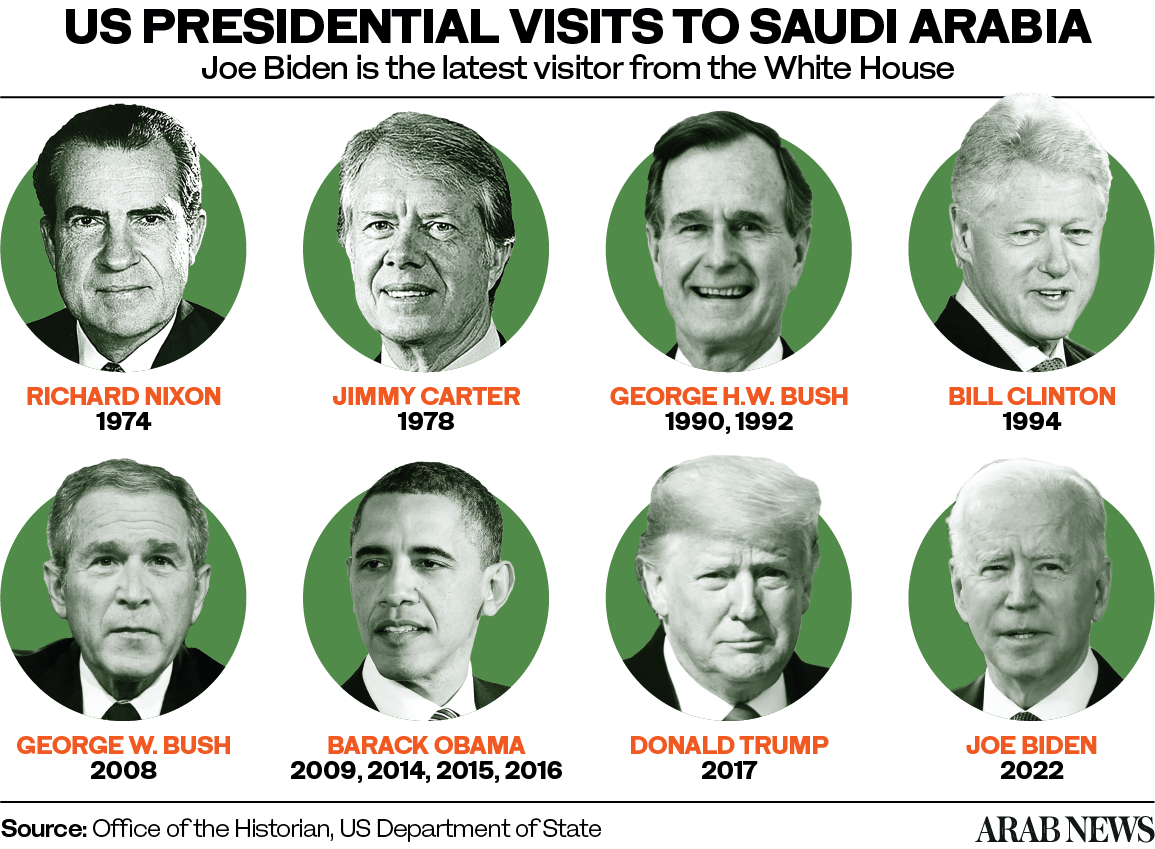
Although she is broadly pessimistic about the prospect of the US president changing his negative attitude toward the Kingdom, House hopes Biden will at the very least use the opportunity provided by his meetings with Saudi leaders to recalibrate and rebuild the historic relationship between the two nations.
Biden arrived in the Kingdom on Friday for talks with the Saudi leadership and other Arab leaders. Observers expect the issue of oil production to top the agenda, in light of spiraling global energy prices as a result of the war in Ukraine and the resultant Western embargo on Russian oil and gas.
Saudi Arabia and other oil producers in the Middle East have been reluctant to boost production at Washington’s behest. Biden’s tour of the region is therefore widely viewed as a charm offensive to help mend strained ties with the Kingdom.
“I personally do not expect much to come of it because I believe it is being done for the wrong reasons,” said House.
“Biden is coming for selfish reasons, acting in his own personal interest, trying to improve his sinking standing by doing something to secure oil that will help reduce the price, when his real agenda is not about easing national pain.
“I’m not saying he enjoys America having actual pain but his biggest primary goal is to help himself, not the country. And so it’s going to be, in my view, mostly a propaganda trip, not a policy trip.”
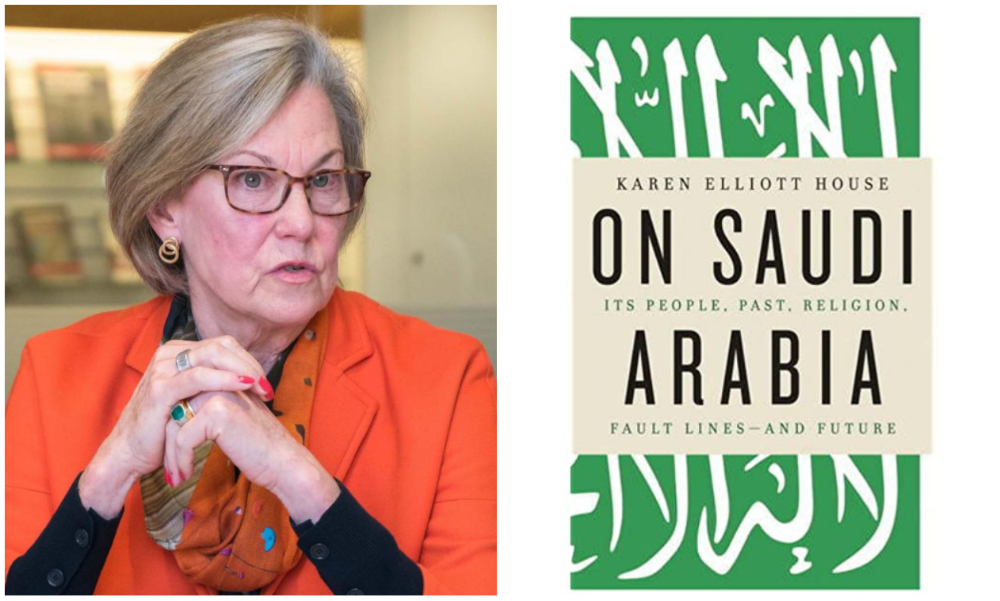
Karen Elliton House is the author of the 2012 book “On Saudi Arabia: Its People, Past, Religion, Fault Lines — and Future.” (Supplied)
Despite her doubts about the president’s intentions, House believes it is “incredibly important that the US and Saudi Arabia rebuild security cooperation to contain and deter Iran at a time when Tehran reportedly has enough fissile material for a nuclear device, while talks to revive the 2015 nuclear deal (more formally known as the Joint Comprehensive Plan of Action) continue to falter.”
She added: “We should be working hard to rebuild a relationship that is absolutely in our interest, because the Iranians are doing very bad things in the region and I believe have every intention of producing a nuclear weapon. And if something transpires there, it will be a potential disaster (not only) for Saudi Arabia but the whole world.
“We have to be concerned about security in the whole world, yes, but in the Middle East and South China Sea in particular, because if we aren’t prepared to cooperate with countries like Saudi Arabia, the younger Saudi generation (of Crown Prince) Mohammed bin Salman is much more willing to cooperate with Russia and China.
“Their parents, being anti-communists, were much less willing to do so. But it is a different mindset now in Saudi Arabia. We can’t just slap the Saudis around and then expect them to salute when we need them.”
US-Saudi relations were not always this way. After US President Franklin D. Roosevelt met King Abdulaziz, known in the West as Ibn Saud, on Valentine’s Day 1945 on the American cruiser USS Quincy in the Suez Canal, a close bond developed between their countries.
The two leaders are said to have made a strong impression on one another. Ibn Saud famously said he and FDR were “twins” of a sort; they were both about the same age, heads of state with grave responsibilities, farmers at heart, and stricken with poor health.
Despite their differences over the future of Palestine, the friendly atmosphere during that meeting on the Great Bitter Lake laid the foundations for a bilateral relationship that endured for decades despite conflicts and disasters.
Indeed, the personal relationships between successive US presidents and Saudi monarchs have been a key determinant in setting both the tone and substance of ties between the two countries.
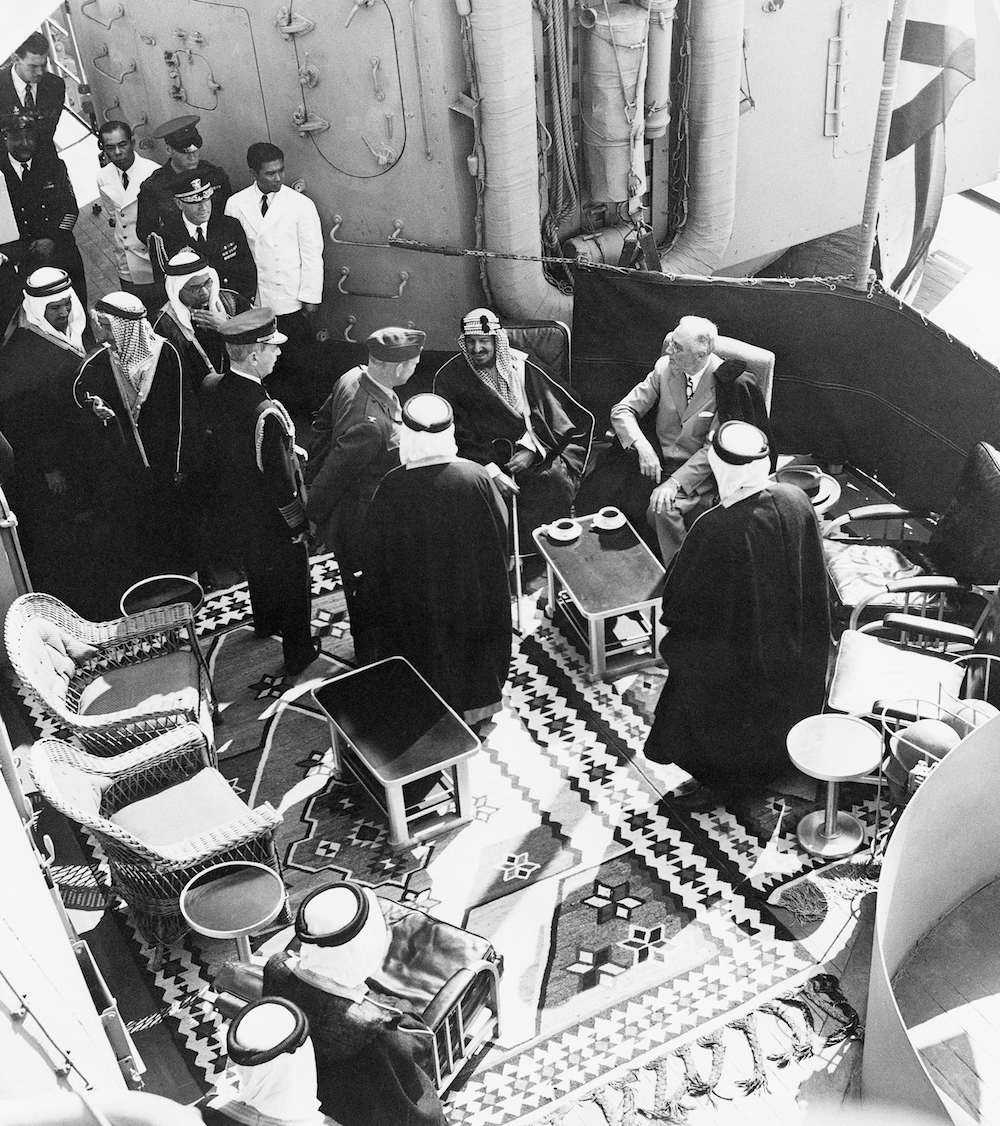
US President Roosevelt speaking with King Ibn Saud of Saudi Arabia in 1945. (Getty Images)
In the decades immediately following the Second World War, the US and Saudi Arabia were closely allied in their opposition to the spread of communism and their support for stable oil prices and the security of oil fields and maritime shipping routes.
The nations stood shoulder to shoulder in defiance of the Soviet invasion of Afghanistan in 1979 and during the war to expel the forces of Iraqi dictator Saddam Hussein from Kuwait in 1991.
Nevertheless, the relationship has faced many challenges along the way. It was seriously strained during the 1973 oil embargo, and again in 2001 in the wake of the 9/11 terrorist attacks on Washington and New York.
“At those times the American public was very aware of Saudi Arabia, which it isn’t at most times, and angry,” said House. “But on both of those occasions the US government worked very hard, and quietly, to keep the relationship in as good a shape as possible despite public anger. And of course, that is not the case now.”
During his 2020 presidential election campaign, Biden vowed to make Saudi Arabia a “pariah state,” in Washington and internationally, to cut off support for the Coalition to Restore Legitimacy in Yemen’s war against the Iran-backed Houthis.
He also severed personal links with the Saudi heir apparent, Crown Prince Mohammed, following the killing of Saudi journalist Jamal Khashoggi on Oct. 2, 2018, inside the Kingdom’s consulate in Istanbul. In Sept. 2020, Saudi Arabia’s Public Prosecution passed the final sentences on eight people convicted of the murder; five of them were jailed for 20 years, one for 10 years and two for seven years.
“President Biden himself has personally led the cheering squad against Saudi Arabia, when I don’t think the public is as disturbed by Saudi Arabia as the president is,” said House.
“That’s the big difference, to me, in the ups and downs in the past. Those were two big downs (the oil embargo and 9/11). But this big down is much worse and it is not led by something Saudi Arabia allegedly did, but something the president chooses to focus on and accuse mostly the crown prince of, and then tar the whole country.”
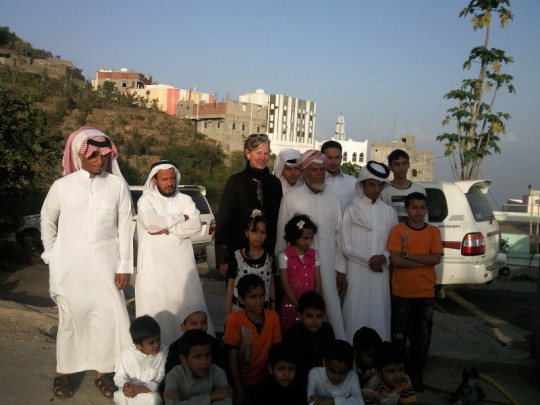
The author surrounded by an extended family of Saudis in the Faifa mountains of Jizan, a remote Saudi province bordering Yemen. (Supplied/Karen Elliot House Blog)
She views Biden’s snubbing of the crown prince as an insult to all Saudis.
“If the Saudi king refused to speak to President Biden, I think it would at some level insult many Americans,” she said. “In the reverse, it is even bigger because (Saudi Arabia) identifies with its leadership more than Americans do.
“So I think it has been insulting to the Saudi people that the president won’t speak to the crown prince, who day-to-day runs the country.”
House believes Biden has been keen to rebuke Saudi Arabia as a means of endearing himself to progressive members of Congress.
“I personally think it is all a part of his efforts now to appeal to progressives, the people who are deeply anti-Saudi,” she said.
“He is courting them more than reflecting his own innate or acquired views. It’s like a lot of other stuff he is doing. He’s been vastly more progressive and pro-abortion than he ever was as a senator or as vice president.”
House is well positioned to talk about the changing mindsets in Saudi Arabia, having closely monitored the nation’s evolution during frequent visits to the Kingdom. In particular, she views King Salman’s decision to bring the crown prince to the forefront of the nation’s affairs as an era-defining moment that Biden would be wise to recognize.
Saudi Arabia “was at risk of winding up like the old Soviet Union, with one elderly, infirm leader after another and then just kind of petering out because the old brothers were getting older and older, and how would they bring themselves to make the change without running out the line?” said House.
“And the great news is that King Salman did that. He brought in a young leader. And whatever people think of this young leader, he is very confident, very decisive, he has a vision and, most importantly, the time to execute it. And that’s what previous Saudi leaders, even King Abdullah, didn’t have.”

keywords