President Biden’s visit may cement Saudi-American defense ties

1 / 3
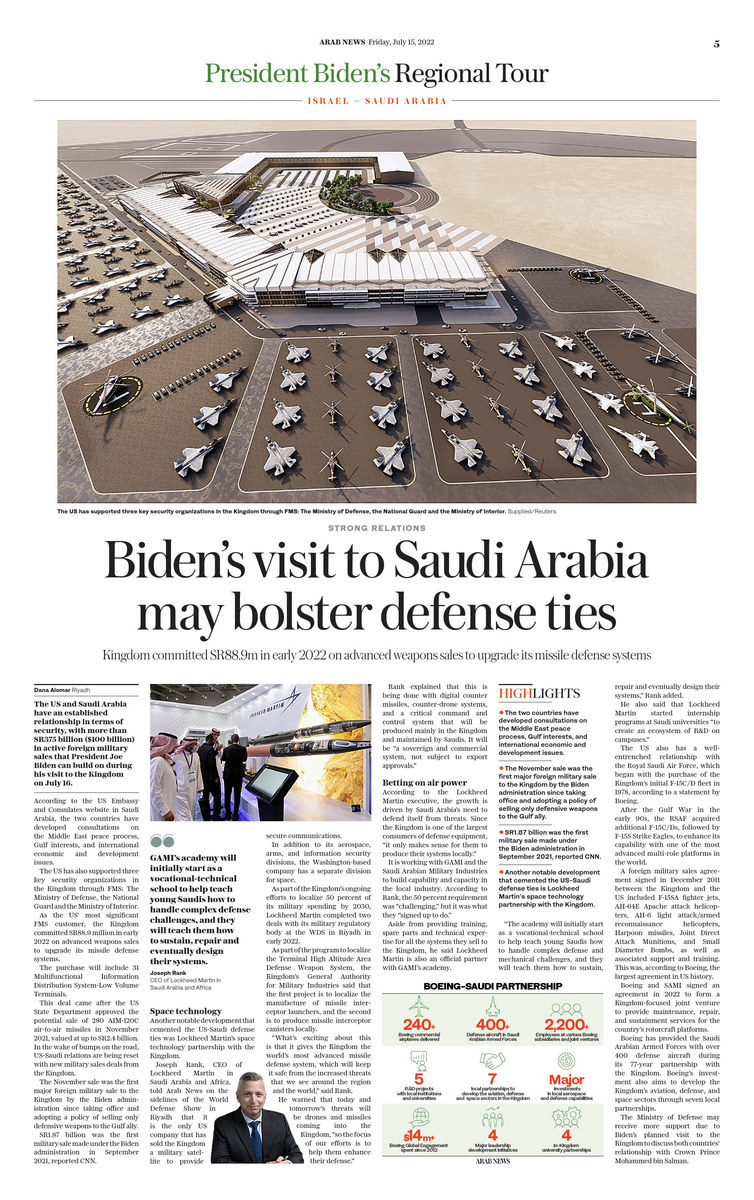
The US has supported three key security organizations in the Kingdom through FMS: The Ministry of Defense, the National Guard and the Ministry of Interior. (Supplied/Reuters)
2 / 3
Saudi Arabia has become one of the largest consumers of defense equipment, owing to the need to defend itself from threats. (AFP file photo)
3 / 3
Saudi Arabia has become one of the largest consumers of defense equipment, owing to the need to defend itself from threats. (AFP file photo)
Short Url
Updated 15 July 2022
Follow

President Biden’s visit may cement Saudi-American defense ties

  • As strategic allies, the US and Saudi Arabia already share more than $100 billion in active foreign military sales
  • Defense ties have been further cemented by Lockheed Martin’s space technology partnership with the Kingdom

RIYADH: The United States and Saudi Arabia have an established relationship in terms of security, with more than SR375 billion ($100 billion) in active foreign military sales that President Joe Biden can build on during his visit to the Kingdom.

According to the US Embassy and Consulates website in Saudi Arabia, the two countries have developed consultations on the Middle East peace process, Gulf interests, and international economic and development issues.

The US has also supported three key security organizations in the Kingdom through FMS: the Ministry of Defense, the National Guard and the Ministry of Interior.

As the US’ most significant FMS customer, the Kingdom committed SR88.9 million in early 2022 on advanced weapons sales to upgrade its missile defense systems.
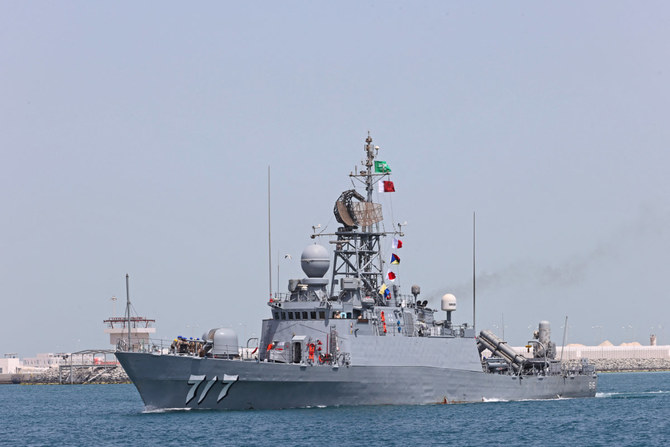
The purchase will include 31 Multifunctional Information Distribution System-Low Volume Terminals.

This deal came after the US State Department approved the potential sale of 280 AIM-120C air-to-air missiles in November 2021, valued at up to SR2.4 billion. In the wake of bumps on the road, US-Saudi relations are being reset with new military sales deals from the Kingdom.

The November sale was the first major foreign military sale to the Kingdom by the Biden administration since taking office and adopting a policy of selling only defensive weapons to the Gulf ally.

SR1.87 billion was the first military sale made under the Biden administration in September 2021, reported CNN.
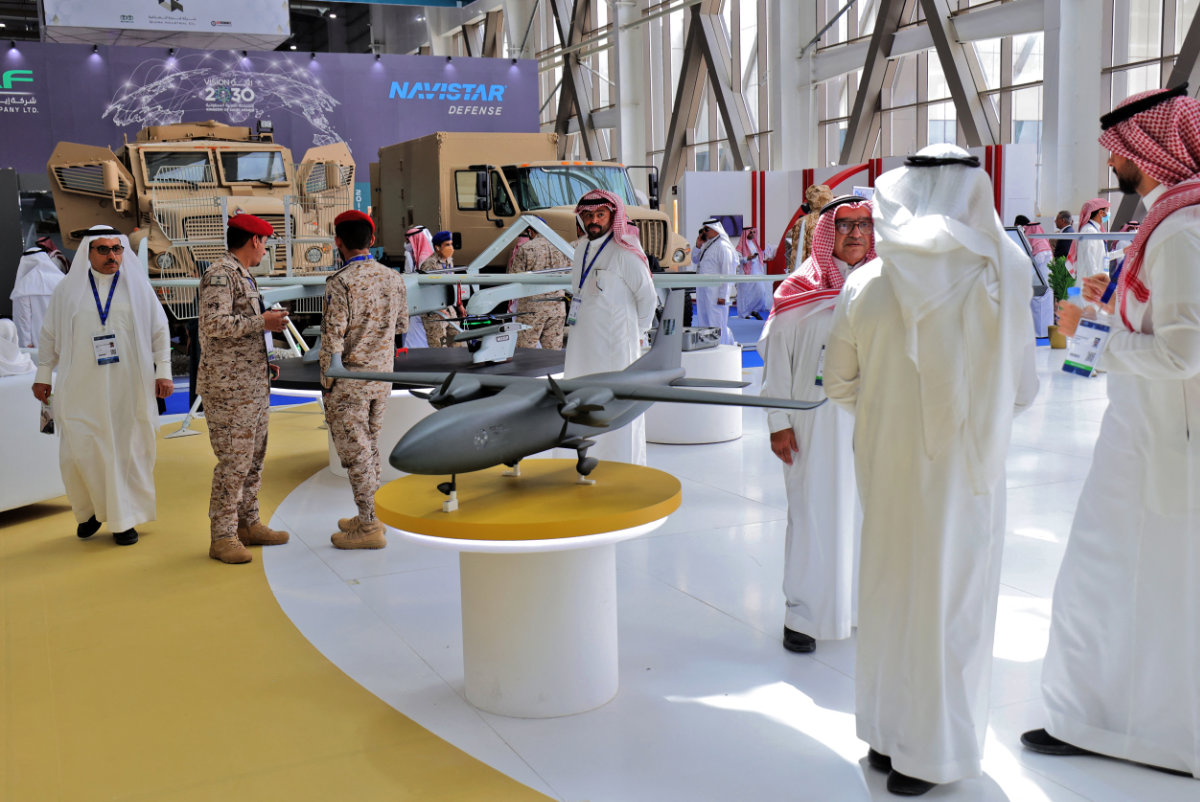


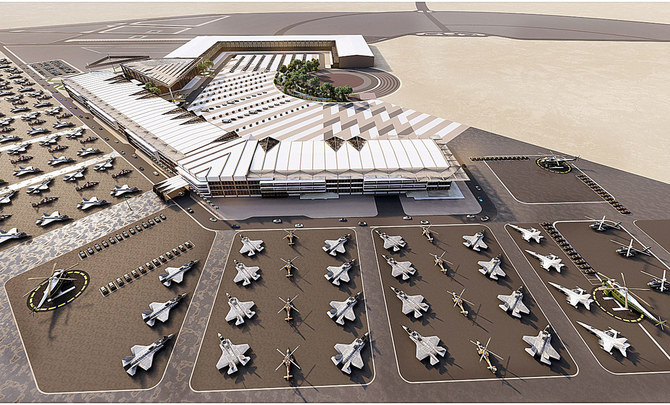
Saudi Arabian Military Industries has partnered with multinational firms in developing the Kingdom's weapons industry. (Supplied)

Space technology prowess

Another notable development that cemented the US-Saudi defense ties was Lockheed Martin’s space technology partnership with the Kingdom.

Joseph Rank, CEO of Lockheed Martin in Saudi Arabia and Africa, told Arab News on the sidelines of the World Defense Show in Riyadh that it is the only US company that has sold the Kingdom a military satellite to provide secure communications.

HIGHLIGHTS

The two countries have developed consultations on the Middle East peace process, Gulf interests, and international economic and development issues.

The November sale was the first major foreign military sale to the Kingdom by the Biden administration since taking office and adopting a policy of selling only defensive weapons to the Gulf ally.

SR1.87 billion was the first military sale made under the Biden administration in September 2021, reported CNN.

Another notable development that cemented the US-Saudi defense ties is Lockheed Martin’s space technology partnership with the Kingdom.

In addition to its aerospace, arms, and information security divisions, the Washington-based company has a separate division for space.

As part of the Kingdom’s ongoing efforts to localize 50 percent of its military spending by 2030, Lockheed Martin completed two deals with its military regulatory body at the WDS in Riyadh in early 2022.
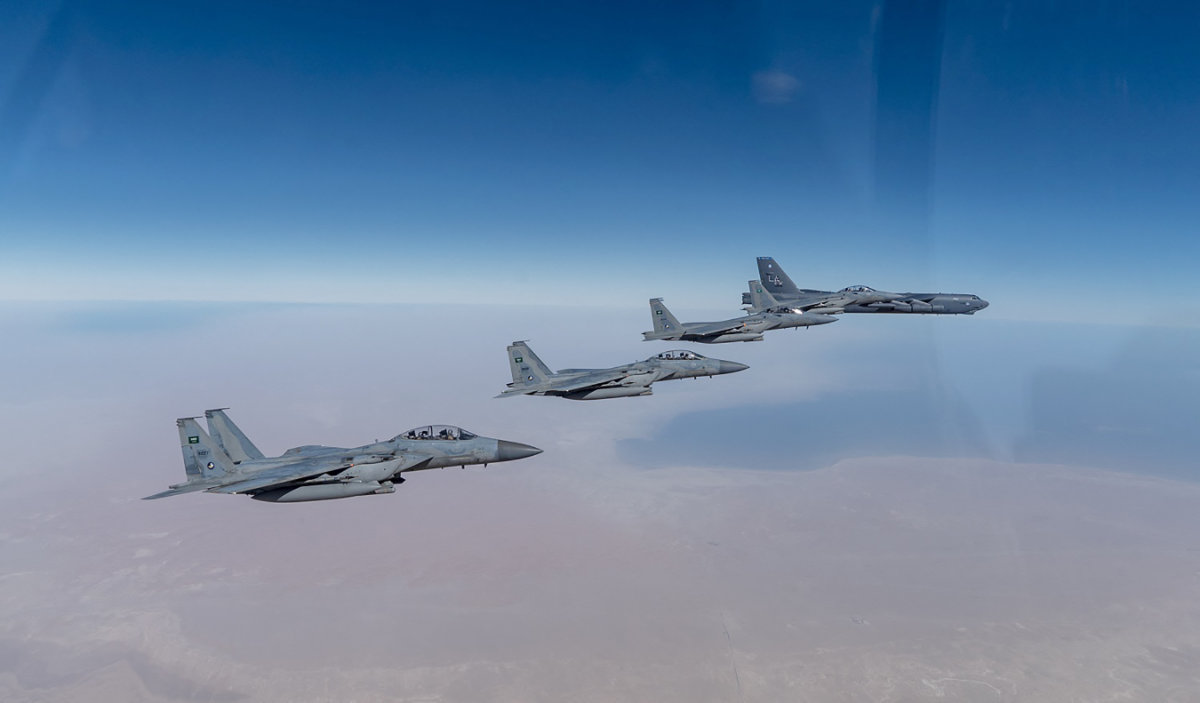


A US Air Force B-52 Stratofortress flies with Saudi F-15SAs during a bomber task force mission in the Gul area on Jan. 27, 2021. (USAF photo handout via AFP) 

As part of the program to localize the Terminal High Altitude Area Defense Weapon System, the Kingdom’s General Authority for Military Industries said that the first project is to localize the manufacture of missile interceptor launchers, and the second is to produce missile interceptor canisters locally.

“What’s exciting about this is that it gives the Kingdom the world’s most advanced missile defense system, which will keep it safe from the increased threats that we see around the region and the world,” said Rank.

He warned that today and tomorrow’s threats will be drones and missiles coming into the Kingdom, “so the focus of our efforts is to help them enhance their defense.”

Rank explained that this is being done with digital counter missiles, counter-drone systems, and a critical command and control system that will be produced mainly in the Kingdom and maintained by Saudis. It will be “a sovereign and commercial system, not subject to export approvals.”


Betting on air power

According to the Lockheed Martin executive, the growth is driven by Saudi Arabia’s need to defend itself from threats. Since the Kingdom is one of the largest consumers of defense equipment, “it only makes sense for them to produce their systems locally.”

It is working with GAMI and the Saudi Arabian Military Industries to build capability and capacity in the local industry. According to Rank, the 50 percent requirement was “challenging,” but it was what they “signed up to do.”
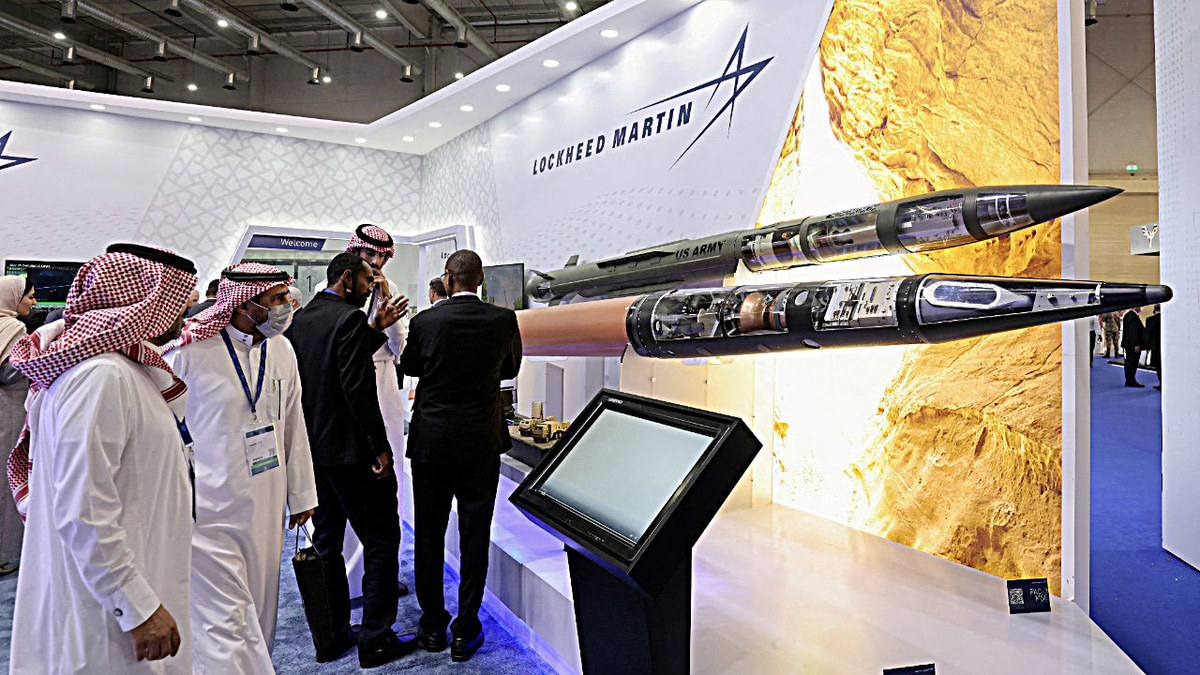


The Saudi Arabian Military Industries has partnered with multinational firm such as Lockheed Martin in developing the Kingdom's weapons industry. (Supplied)

Aside from providing training, spare parts and technical expertise for all the systems they sell to the Kingdom, he said Lockheed Martin is also an official partner with GAMI’s academy.

“The academy will initially start as a vocational-technical school to help teach young Saudis how to handle complex defense and mechanical challenges, and they will teach them how to sustain, repair and eventually design their systems,” Rank added.

He also said that Lockheed Martin started internship programs at Saudi universities “to create an ecosystem of R&D on campuses.”

The US also has a well-entrenched relationship with the Royal Saudi Air Force, which began with the purchase of the Kingdom’s initial F-15C/D fleet in 1978, according to a statement by Boeing.

After the Gulf War in the early 90s, the RSAF acquired additional F-15C/Ds, followed by F-15S Strike Eagles, to enhance its capability with one of the most advanced multi-role platforms in the world.

A foreign military sales agreement signed in December 2011 between the Kingdom and the US included F-15SA fighter jets, AH-64E Apache attack helicopters, AH-6 light attack/armed reconnaissance helicopters, Harpoon missiles, Joint Direct Attack Munitions, and Small Diameter Bombs, as well as associated support and training. This was, according to Boeing, the largest agreement in US history.
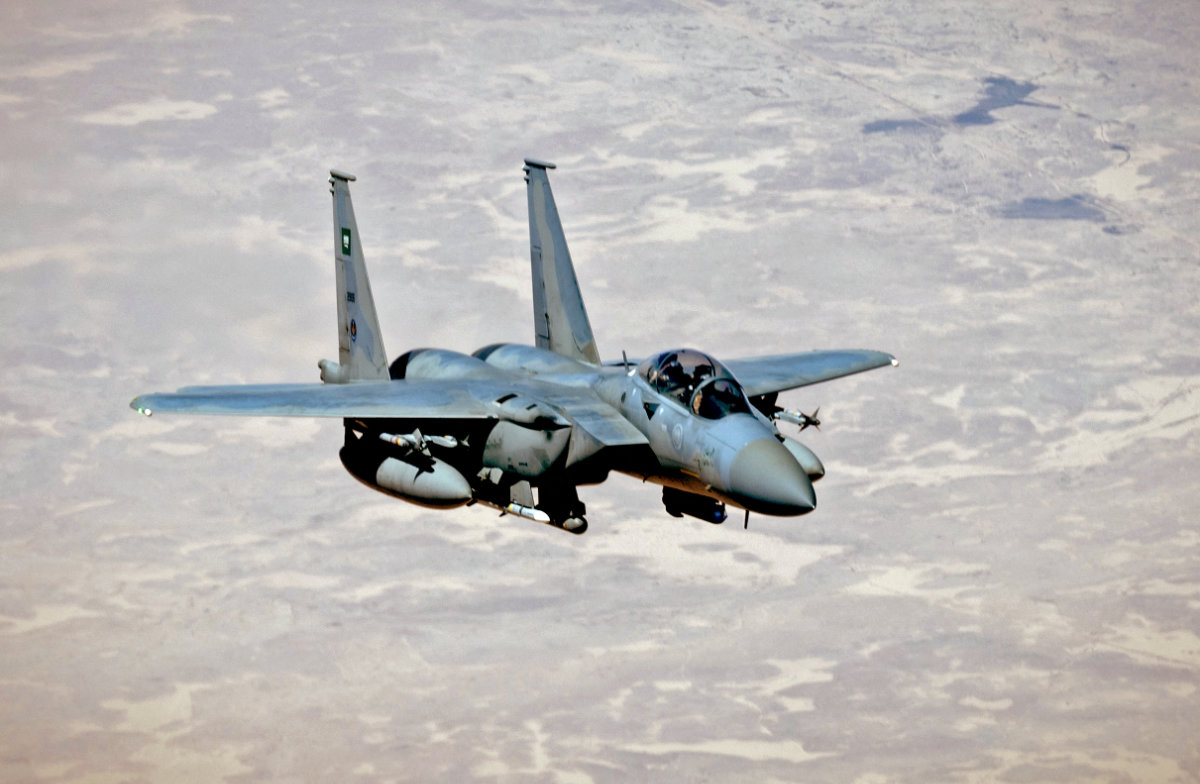


US F-15 fighter jets, manufactured by McDonnell Douglas, which is now part of Boeing, are the mainstay of the Royal Saudi Air Force. (AFP file photo)

Boeing and SAMI signed an agreement in 2022 to form a Kingdom-focused joint venture to provide maintenance, repair, and sustainment services for the country’s rotorcraft platforms.

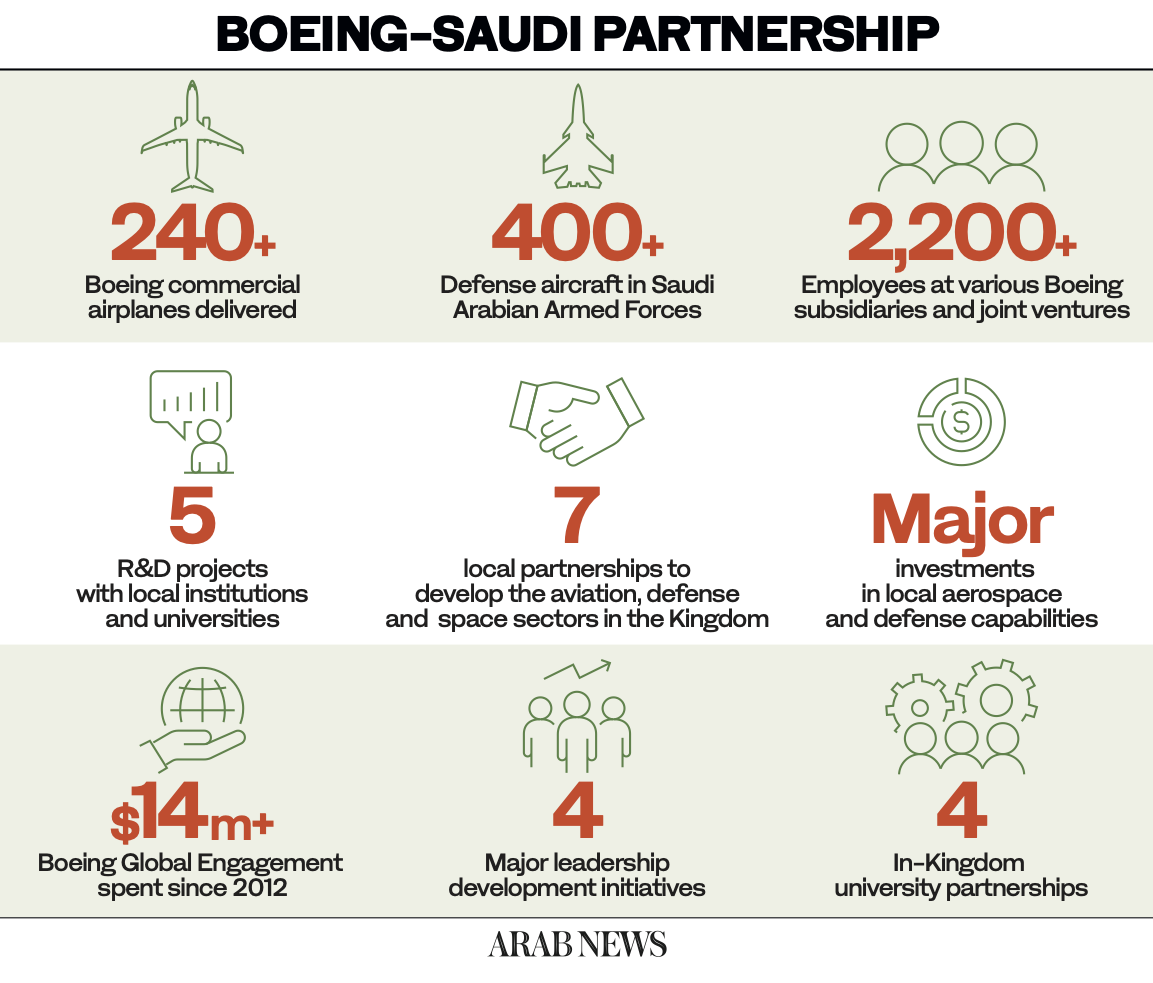
Boeing has provided the Saudi Arabian Armed Forces with over 400 defense aircraft during its 77-year partnership with the Kingdom. Boeing’s investment also aims to develop the Kingdom’s aviation, defense, and space sectors through seven local partnerships.

The Ministry of Defense may receive more support due to Biden’s planned visit to the Kingdom to discuss both countries’ relationship with Crown Prince Mohammed bin Salman.
 

Druze: the great survivors
How the world's most secretive faithhas endured for a thousand years

Enter


keywords


Saudi Arabia sets global benchmark in AI modernization

Updated 15 January 2026
Follow

Saudi Arabia sets global benchmark in AI modernization

  • Executives hail the Kingdom’s robust infrastructure and strategic workforce programs

RIYADH: Saudi Arabia is emerging as a global leader in artificial intelligence, according to executives from OpenText, one of the world’s largest enterprise information management companies. 

With 22 years of international AI experience, Harald Adams, OpenText’s senior vice president of sales for international markets, said the Kingdom’s modernization efforts are now setting a global standard.

“From my perspective, Saudi Arabia is not only leading the modernization towards artificial intelligence in the Middle East, I think it is even not leading it only in the MENA region. I think it is leading it globally,” Adams told Arab News.

In an interview, Adams and George Schembri, vice president and general manager for the Middle East at OpenText, discussed the Kingdom’s significant investments in AI during the inauguration of OpenText’s new regional headquarters in Riyadh.

“So for us (OpenText), from our perspective, it was a strategic decision to move our MENA headquarters to Saudi Arabia because we believe that we will see here a lot of innovation coming out of the country, we can replicate not only to the MENA region, maybe even further to the global level,” Adams said.

The new headquarters, located in the King Abdullah Financial District, will serve as a central hub for OpenText customers and partners across the Middle East. Its opening reflects a broader trend of tech giants relocating to Riyadh, signaling the Kingdom’s rise as a hub for global AI innovation.

Adams attributed Saudi Arabia’s lead in AI modernization to a combination of substantial financial backing, a unified national strategy, and a remarkable pace of execution.

“I mean, a couple of things, because the ingredients in Saudi Arabia are of course, quite interesting. On the one hand side, Saudi Arabia has deep pockets and great ambitions. And they are, I mean, and they are executing fast, yeah,” he said.
“So from that perspective, at the moment, what we see is that there are, especially on the government side, I can’t see any other government organizations globally moving faster into that direction than it is happening in Saudi Arabia. Not in the region, not even on a global level, they are leading the game,” he underlined.

Schembri added, “Saudi’s AI vision is one of the most ambitious in the world, and AI on a national scale is not good without trusted, secured, and governed, and this is where OpenText helps to enable the Saudi organizations to be able to deliver on the 2030 Vision.”

“The Kingdom’s focus on AI and digital transformation creates a powerful opportunity for organizations to unlock value from their information,” Schembri stated.
“With OpenText on the ground in Riyadh, our customers gain direct access to trusted global expertise combined with local insight — enabling them to manage information securely, scale AI with confidence, and compete on a global stage,” he added.

DID YOU KNOW?

• Saudi Arabia ranks 5th globally and 1st in the region for AI growth under the 2025 Global AI Index.

• The Kingdom is also 3rd globally in advanced AI model development, trailing only the US and China.

• AI is projected to contribute $235.2 billion — or 12.4 percent — to Saudi Arabia’s GDP by 2030.

The inauguration of OpenText’s new regional headquarters was attended by Canada’s Minister of International Trade and Economic Development, Maninder Sidhu, and Jean-Philippe Linteau, Canada’s ambassador to Saudi Arabia. 

Sidhu emphasized the alignment of Saudi Vision 2030 with Canada’s economic and innovation goals.

“His Highness (Crown Prince Mohammed bin Salman) and Vision 2030, there is a lot of alignment with Canada, as you know, with the economic collaboration, with his vision around mining, around education, tourism, healthcare, you look at AI and tech, there’s a lot of alignment here at OpenText Grand opening their regional headquarters,” Sidhu told Arab News.

Saudi Arabia’s AI ambitions are projected to contribute $235.2 billion — or 12.4 percent — to its GDP by 2030, according to PwC. The Saudi Data and AI Authority, established by a royal decree in 2019, drives the Kingdom’s national data and AI strategy.

One flagship initiative, Humain, chaired by Crown Prince Mohammed bin Salman, was launched in May 2025 under the Public Investment Fund. It aims to build a full AI stack — from data centers and cloud infrastructure to models and applications — positioning Saudi Arabia as a globally competitive AI hub. The project plans to establish a data center capacity of 1.8 GW by 2030 and 100 GW of AI compute capacity by 2026.

Saudi Arabia is also expanding international partnerships. In May 2025, Humain signed a $5 billion agreement with Amazon Web Services to accelerate AI adoption domestically and globally, focusing on infrastructure, services, and talent development.

The Kingdom ranked fifth globally and first in the Arab region for AI sector growth under the 2025 Global AI Index, and third worldwide in advanced AI model development, behind only the US and China, according to the Stanford University AI Index 2025.

Education is another pillar of Saudi AI strategy. Starting in the 2025-26 academic year, AI will be taught as a core subject across all public school grades, reaching roughly 6.7 million students. The curriculum will cover algorithmic thinking, data literacy, and AI ethics.

OpenText executives emphasized their commitment to supporting Vision 2030 and the national AI strategy through workforce development.

“OpenText has put a lot of investment in the Kingdom, right. We brought cloud to the Kingdom, we’ve opened our headquarters in the Kingdom, we’ve basically hiring Saudis in the Kingdom, We basically building, if you like, an ecosystem to support the Kingdom. And on top of that, what we’re doing is we’re putting a plan together, if you like, a program to look at how we can educate, if you like, the students at universities,” Schembri said.
“So this is something that we are looking into, we are basically investigating and to see how we can support the Saudi nationals when they come into the workplace. And I’m really excited. I have Harry who is, our leadership who’s supporting this program.”
“It’s something that we are putting together. It’ll take some effort. So it’s still in play because we want to make sure what we put it basically delivers on what we're trying to achieve based on the vision of Saudi,” he added.

“The younger generation is sooner or later either working for us or maybe for a partner or for maybe for a customer. So that’s why we are to 100 percent committed to enable all of that,” Adams said.