

Nasrallah speech prompts Lebanese fears of Israel escalation amid maritime border row

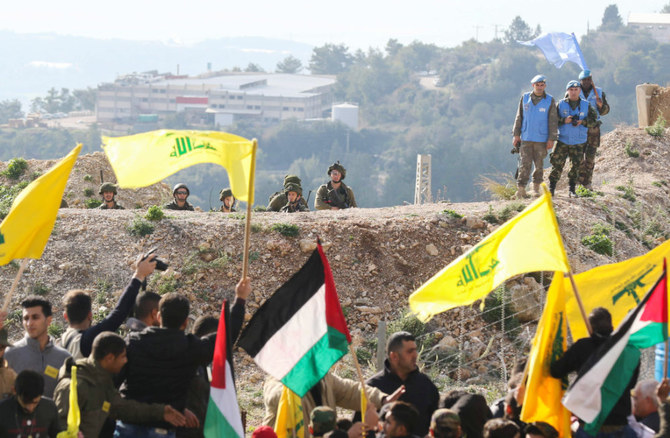
Israeli soldiers (top L) and UN peacekeepers (top R) look at Lebanese supporters of the Shiite Hezbollah movement attending a rally on January 28, 2018, in Alma al-Shaab, on the border with Israel. (AFP)
Short Url
Updated 14 July 2022
Follow

Nasrallah speech prompts Lebanese fears of Israel escalation amid maritime border row

  • Energy vessel to begin drilling in Karish field despite IDF shooting down Hezbollah drones
  • Politicians, oil experts slam Iran-inspired Nasrallah statements

BEIRUT: Hezbollah Secretary-General Hassan Nasrallah’s speech on Wednesday night, in which he ratcheted up tensions with Israel, has raised fresh fears in Lebanon over possible escalations with its southern neighbor.

The speech came amid indirect Lebanese–Israeli talks over the demarcation of the maritime border between the two countries, and follows the downing of three drones flown by Hezbollah towards the Karish gas field by the Israel Defense Forces earlier this month.

Nasrallah warned that sending drones over the field in the Mediterranean earlier this month was “a modest beginning to where the situation could be heading,” adding that “if the results of the negotiations are negative, not only will we reach Karish, but we will also go beyond Karish.”
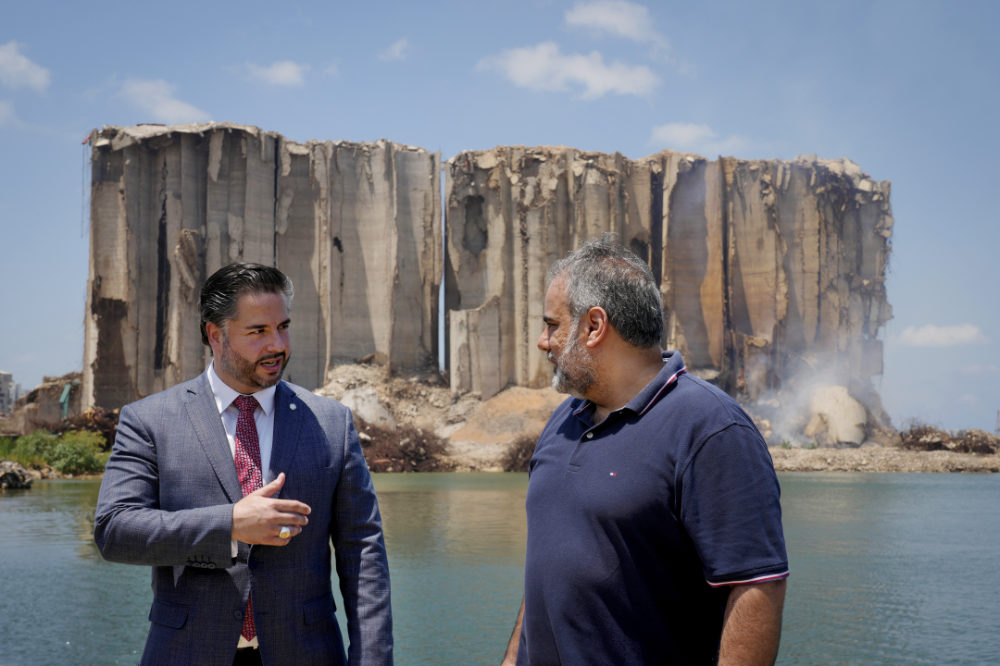


Lebanese caretaker Economy Minister Amin Salam speaks with Beirut Port Silos General Manager Assad Haddad near Beirut Port silos, that were destroyed by a massive explosion in 2020. (AP)

He added that “maritime border demarcation and Lebanon’s gas exploration and extraction constitutes a crucial matter to save the country,” and stressed that it was necessary to “settle this issue once and for all through demarcation and extraction, or else we will cross all limits and flip the table on everyone.”

In September, a liquefied natural gas production and storage vessel belonging to Energean will start extracting gas at the behest of Israel from the Karish field, which was discovered in 2013.

Part of the field is located within two miles of Line 29 to the north, considered by Lebanon a potential starting point of its maritime border with Israel.

Lebanon recognizes Line 23 as the current demarcation, according to documents submitted to the UN in 2011, and has not yet legally amended its stance, but considers Line 29 to be open to negotiation — whilst the gas field may well extend under it.

Nasrallah described the moment as a “golden opportunity” for Lebanon to exploit Mediterranean gas resources, with the conflict between Russia and Ukraine causing energy issues in Europe, with autumn fast approaching.

The speech raised fears across Lebanon about possible escalation with Israel, with the Energean Power vessel a point of contention amid Hezbollah’s threats to continue to operate drones in the area.

Christina Abi Haidar, a legal expert in oil affairs, cast doubt on the feasibility of exploiting Europe’s energy issues, saying: “In case we find gas, we cannot export it to Europe because we are not part of the EastMed project.”

She told Arab News that Nasrallah’s speech would not help Lebanon’s negotiating position, adding: “Lebanon is no longer the starting point of the maritime demarcation, meaning that what Nasrallah has said does not have any legal grounds.

“Moreover, Hezbollah is part of the ruling class, the government and the Parliament, so why did not it push toward the amendments previously?

Regarding Nasrallah’s remarks and the effect they may have on oil and gas exploration and extraction in the region, Abi Haidar said: “The Israeli party is in a hurry to finish the maritime border demarcation talks with Lebanon because it’s seeking stable security for its companies in the event of any shock, given the high costs.”

She added: “What should be known is that Israel (has) started the exploration phase, while it took us between two to five years to start this phase.”

A number of Lebanese politicians also criticized Nasrallah after the speech.

Progressive Socialist Party head Walid Jumblatt said on social media: “Nasrallah’s speech put an end to the possibility of reaching a settlement regarding Line 23.”

Kataeb Party leader Samy Gemayel said Nasrallah “is embroiling the Lebanese in a new adventure that might cost them a lot without asking for their permission.”

Lebanese Forces MP Ghayath Yazbeck said: “After Nasrallah’s speech, it became clear to everyone that we don’t have a state. Hezbollah is acting within the frames set by Iran and its calculations are not Lebanese. Nasrallah’s claim that he speaks on behalf of most Lebanese and most Shiites is inaccurate.”

Yazbeck added Lebanon “cannot go to war while it is starving. Nasrallah’s statements are nihilistic.”

Parliamentarian Said Al-Asmar called on Nasrallah to “fight corruption and not cover it with the party’s weapons,” adding: “The decision of peace and war should be left to the state only.”

Free Patriotic Movement leader Gebran Bassil, though, tweeted: “You (Israel) want your gas, then we want our gas too. That is how a strong sate acts. That is how it preserves the national dignity and that is how sovereignty should be.”


US military launches strikes in Syria against Daesh fighters after American deaths

Updated 5 min 37 sec ago
Follow

US military launches strikes in Syria against Daesh fighters after American deaths

  • “This is not the beginning of a war — it is a declaration of vengeance,” Defense Secretary Pete Hegseth says
  • President Trump earlier pledged “very serious retaliation” but stressed that Syria was fighting alongside US troops

WASHINGTON: The Trump administration launched military strikes Friday in Syria to “eliminate” Daesh group fighters and weapons sites in retaliation for an ambush attack that killed two US troops and an American interpreter almost a week ago.
A US official described it as “a large-scale” strike that hit 70 targets in areas across central Syria that had Daesh (also known as Islamic State or IS) infrastructure and weapons. Another US official, who also spoke on condition of anonymity to discuss sensitive operations, said more strikes should be expected.
The attack was conducted using F-15 Eagle jets, A-10 Thunderbolt ground attack aircraft and AH-64 Apache helicopters, the officials said. F-16 fighter jets from Jordan and HIMARS rocket artillery also were used, one official said.
“This is not the beginning of a war — it is a declaration of vengeance. The United States of America, under President Trump’s leadership, will never hesitate and never relent to defend our people,” Defense Secretary Pete Hegseth said on social media.
President Donald Trump had pledged “very serious retaliation” after the shooting in the Syrian desert, for which he blamed Daesh. The troops were among hundreds of US troops deployed in eastern Syria as part of a coalition fighting the terrorist group.
Trump in a social media post said the strikes were targeting Daesh “strongholds.” He reiterated his support for Syrian President Ahmad Al-Sharaa, who he said was “fully in support” of the US effort to target the militant group.
Trump also offered an all-caps threat, warning the group against attacking US personnel again.
“All terrorists who are evil enough to attack Americans are hereby warned — YOU WILL BE HIT HARDER THAN YOU HAVE EVER BEEN HIT BEFORE IF YOU, IN ANY WAY, ATTACK OR THREATEN THE USA.,” the president added.
The attack was a major test for the warming ties between the United States and Syria since the ouster of autocratic leader Bashar Assad a year ago. Trump has stressed that Syria was fighting alongside US troops and said Al-Sharaa was “extremely angry and disturbed by this attack,” which came as the US military is expanding its cooperation with Syrian security forces.
Syria’s foreign ministry in a statement on X following the launch of US strikes said that last week’s attack “underscores the urgent necessity of strengthening international cooperation to combat terrorism in all its forms” and that Syria is committed “to fighting Daesh and ensuring that it has no safe havens on Syrian territory and will continue to intensify military operations against it wherever it poses a threat.”
IS has not claimed responsibility for the attack on the US service members, but the group has claimed responsibility for two attacks on Syrian security forces since, one of which killed four Syrian soldiers in Idlib province. The group in its statements described Al-Sharaa’s government and army as “apostates.” While Al-Sharaa once led a group affiliated with Al-Qaeda, he has had a long-running enmity with IS.
Syrian state television reported that the US strikes hit targets in rural areas of Deir ez-Zor and Raqqa provinces and in the Jabal Al-Amour area near Palmyra. It said they targeted “weapons storage sites and headquarters used by Daesh as launching points for its operations in the region.”

Map showing the location of Syria's provinces of Deir ez-Zor and Raqqa and the city of Palmyra, where Daesh positions were targetted on Dec. 19, 2025 by US air strikes. (Map courtesy of Gemini)

Trump this week met privately with the families of the slain Americans at Dover Air Force Base in Delaware before he joined top military officials and other dignitaries on the tarmac for the dignified transfer, a solemn and largely silent ritual honoring US service members killed in action.
The guardsmen killed in Syria last Saturday were Sgt. Edgar Brian Torres-Tovar, 25, of Des Moines, and Sgt. William Nathaniel Howard, 29, of Marshalltown, according to the US Army. Ayad Mansoor Sakat, of Macomb, Michigan, a US civilian working as an interpreter, was also killed.
The shooting nearly a week ago near the historic city of Palmyra also wounded three other US troops as well as members of Syria’s security forces, and the gunman was killed. The assailant had joined Syria’s internal security forces as a base security guard two months ago and recently was reassigned because of suspicions that he might be affiliated with Daesh, Interior Ministry spokesperson Nour Al-Din Al-Baba has said.
The man stormed a meeting between US and Syrian security officials who were having lunch together and opened fire after clashing with Syrian guards.
When asked for further information, the Pentagon referred AP to Hegseth’s social media post.