Solomon Islands PM meets Australian, NZ leaders over China pact

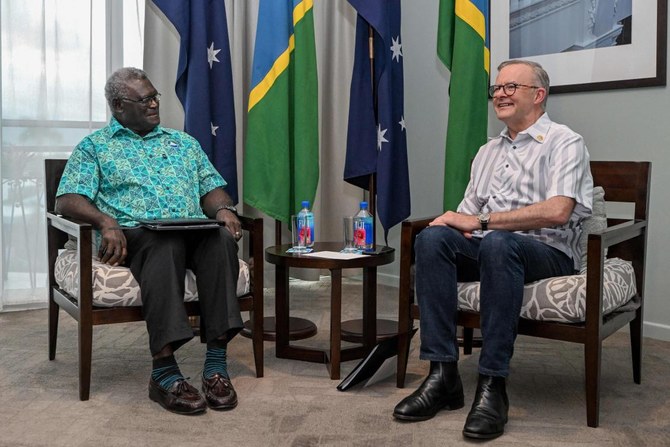
Australia’s Prime Minister Anthony Albanese, right, and Solomon Islands Prime Minister Manasseh Sogavare during a bilateral meeting at the Pacific Islands Forum in Suva on July 13, 2022. (AFP)
Short Url
Updated 13 July 2022
Follow

Solomon Islands PM meets Australian, NZ leaders over China pact

  • Pacific island leaders meet to discuss how to gather more international support and funding to fight the impact of rising sea levels and climate change

SUVA: The Solomon Islands prime minister met counterparts from Australia and New Zealand for the first time since striking a security pact with China that sparked concern among US allies over Beijing’s military ambitions in the Pacific islands.
Prime Minister Manasseh Sogavare met Australian Prime Minister Anthony Albanese and New Zealand premier Jacinda Ardern in separate bilateral meetings on the sidelines of the Pacific Islands Forum in Fiji.
During the four-day meeting, Pacific island leaders will discuss how to gather more international support and funding to fight the impact of rising sea levels and climate change, as well as China’s aim for greater security ties in the region.
The Solomon Islands security pact with China became a major election issue in Australia. Albanese said it was a failing of diplomacy by his predecessor Scott Morrison.
“We are family and there are many issues, and that makes family stronger,” Sogavare said, after hugging Albanese.
Details of the pact have not been disclosed, but Sogavare has ruled out allowing China to have a military base and said the deal covered policing to protect Chinese projects because an agreement with traditional partner Australia was “inadequate.”
Albanese said Australia and the Solomon Islands could to more to build trust and “for joint benefit.”
“As members of the region we want to advance the interests of the Pacific,” he said.


Russia’s war footing may remain after Ukraine war, Latvia spy chief warns

Updated 7 sec ago
Follow

Russia’s war footing may remain after Ukraine war, Latvia spy chief warns

MUNICH: Russia will not end the militarization of its economy after fighting in Ukraine ends, the head of Latvia’s intelligence agency told AFP on the sidelines of the Munich Security Conference which ends Sunday.
“The potential aggressiveness of Russia when the Ukraine war stops will depend of many factors: How the war ends, if it’s frozen or not, and if the sanctions remain,” Egils Zviedris, director of the Latvian intelligence service SAB, told AFP.
Some observers believe that Russia has so thoroughly embraced a war economy and full military mobilization that it will be difficult for it to reverse course, and that this could push Moscow to launch further offensives against European territories.
Zviedris said that lifting current sanctions “would allow Russia to develop its military capacities” more quickly.
He acknowledged that Russia has drawn up military plans to potentially attack Latvia and its Baltic neighbors, but also said that “Russia does not pose a military threat to Latvia at the moment.”
“The fact that Russia has made plans to invade the Baltics, as they have plans for many things, does not mean Russia is going to attack,” Zviedris told AFP.
However, the country is subject to other types of threats from Moscow, particularly cyberattacks, according to the agency he leads.
The SAB recently wrote in its 2025 annual report that Russia poses the main cyber threat to Latvia, because of broader strategic goals as well as Latvia’s staunch support of Ukraine.
The threat has “considerably increased” since Moscow’s full-scale invasion of Ukraine in 2022, it said.
The agency has also warned that Russia is seeking to exploit alleged grievances of Russian-speaking minorities in the Baltics — and in Latvia in particular.
Russia’s Ministry of Foreign Affairs has repeatedly claimed to be preparing cases against Latvia, Lithuania and Estonia at the UN International Court of Justice over the rights of their Russian-speaking minorities.
“The aim of litigation: to discredit Latvia on an international level and ensure long-term international pressure on Latvia to change its policy toward Russia and the Russian-speaking population,” the report said.
In 2025, approximately 23 percent of Latvia’s 1.8 million residents identified as being of Russian ethnicity, according to the national statistics office.
Following the Russian invasion of Ukraine in 2022, Latvian authorities decided to require Russian speakers residing in the country to take an exam to assess their knowledge of the Latvian language — with those failing at potential risk of deportation.