



MOJU CHOWDHURY HAT, Bangladesh: Shahida Begum's family lost their land along Bangladesh's ever-eroding river deltas so long ago that none of her family can remember a life on land.
"I was born on a boat on the river, like my father and grandfather. I heard we started living on boats after losing our land and house to the Meghna River," Begum, 30, told the Thomson Reuters Foundation.
Today, Begum's entire community -known as the Manta people — live aboard small boats on two of the nation's major rivers. It's a challenging way to survive — but one more Bangladeshis may be driven to adopt as climate change and sea level rise speed land erosion.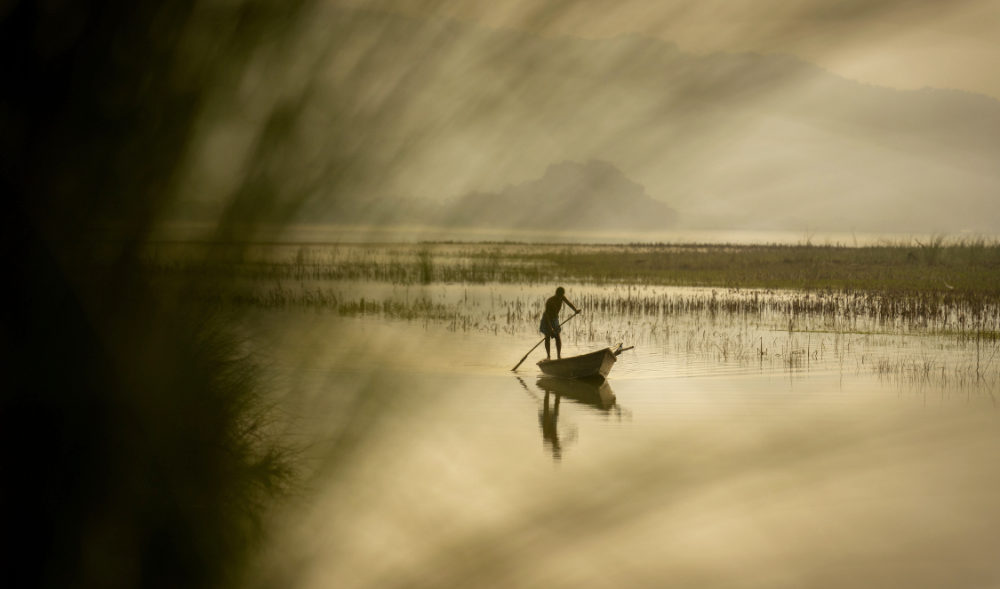
Only in death are most Manta taken permanently ashore — to be buried in the soil in accordance with Muslim tradition.
"We neither float our dead into the river nor burn them," said Sohrab Majhi, a Manta leader whose buoyant community lives near Moju Chowdhury Hat, a market village in southeast Bangladesh.
"We have to have good relations with people who have at least some land where we can bury our dead."
The Manta used to be farmers and fishermen until the rising rivers engulfed their land and forced them to move onto the Meghna River and its offshoot, the Tetulia, Majhi explained.
Today, increasingly intense cyclones, heavy rains and other natural disasters — like the flash floods earlier this month that stranded more than 4.5 million people and killed dozens in northeast Bangladesh are battering Manta boats and incomes, he said.
Without a permanent address, most Manta don't qualify for state services. They have called on the government to give them houses on land and national identity cards that will let their children go to school.
"There is nothing for us. I want the next generation to be educated and do something for us and our community," said Chan Miah, a 58-year-old fisherman.
"We are exhausted from this life. We want a place where we can live in peace."
INVISIBLE COMMUNITY
More than 30 million people around the world had to relocate within their home countries due to natural disasters in 2020, nearly 4.5 million of them in Bangladesh, data from the Geneva-based Internal Displacement Monitoring Centre shows.
One of the drivers of all that movement is erosion, when heavy, erratic rainfall and flooding worsened by climate change eat away at riverbanks, causing rivers to swell and swallow the land https://news.trust.org/item/20220606082445-jmvs3 around them.
According to a report by the Center for Environmental and Geographic Information Services, based in Dhaka, from 1973 to 2017 Bangladesh lost more than 162,000 hectares of land (400,310 acres) — double the size of Singapore — to three of its largest rivers.
Gawher Nayeem Wahra, director of disaster management and climate change at the development organisation BRAC, estimates there are about 300,000 Manta living on boats around the country — and the number is growing.
"They are taking to the boats as a last resort to survival," said Wahra.
Manta families spend up to 12 hours a day catching fish to sell at coastal fish markets or to other fishermen, said Majhi, the Manta leader.
But earning a living fishing is getting harder, he said, with fish populations shrinking due to the dominance of commercial fishing as well as overfishing driven by a growing population.
Every dry season, Manta families have to move with the receding river water and follow the fish, meaning they never stay in one place for more than three months.
That constant movement contributes to them being invisible to the government, Majhi said.
"We are denied our basic rights, such as food, shelter, education - and it's continuing from generation to generation. We are in the shadows of civilisation," he said.
'THIS DIFFICULT LIFE'
Living on boats also makes the community more vulnerable to increasingly frequent and violent storms.
Ratna Akter, 21, recalled the time she and her husband nearly drowned when they dove into the river to rescue their 4-year-old son, who had fallen in while the family was fishing during heavy rains.
"We were able to catch him, but by then our boat had drifted far from us. We tried to swim to the bank of the river, but our energy was failing," Akter said.
They were saved when her foot got tangled in their long fishing net, which they followed back to their boat.
With climate experts warning that extreme weather events will only get worse, Bangladesh can't afford to ignore the growing number of people whose lives are being uprooted by rising rivers, said Mohammad Azaz, chairman of the River and Delta Research Centre, a local non-governmental group.
"River erosion is not a short-term event," he noted.
Azaz said the government should focus on making sure affected communities can quickly get back to earning money to support themselves.
Nurul Islam Patwari, deputy director of District Social Services for Bangladesh's government, said his department already has various programmes to help Manta families improve their living standards, including training in handicrafts such as tailoring.
He added that community members need to get their national identity cards if they want to access help from the state.
"Then, if they contact us about government benefits — including old age allowance, widow allowance — we will help them," he said.
More than two dozen Manta families have been given houses — the first step to an identity card — under the long-running Ashrayan development project, which has so far provided housing for more than 507,000 previously homeless families.
But some, like Jahanara Begum, 38, have rejected the government's help because the homes on offer are located too far inland, cutting them off from their livelihoods.
"The house is too far from our fishing area, it takes too long to get there, so we didn't accept it," said Begum.
For now, the Manta wait for a solution that will let them build safer, more stable lives on land — but simultaneously remain close enough to rivers.
"I don't want to live in the water anymore. There is no future for my children here," said Asma Banu, 28, a mother of three who was born and raised on her family's boat on the Meghna River.
"If my children could be educated, they would at least get rid of this difficult life," she said.


